European Central Bank should raise rates in June, says Schnabel
ECB Executive Board member Isabel Schnabel pushes for a rate hike regardless of U.S.-Iran peace deal progress, signaling a hawkish pivot that could ripple through crypto markets.
Share
Add us on Google by Editorial Team May. 26, 2026Isabel Schnabel, one of the European Central Bank’s most hawkish voices, wants rates going up in June. And she doesn’t care what happens with Iran.
The ECB Executive Board member argued on May 26 that the central bank should raise its key interest rate at the upcoming June meeting, even if a US-Iran peace deal materializes in the interim. Her logic: the inflationary damage from persistently high energy prices is already baked in, and waiting around for geopolitical breakthroughs isn’t a monetary policy strategy.
The numbers behind the pivot
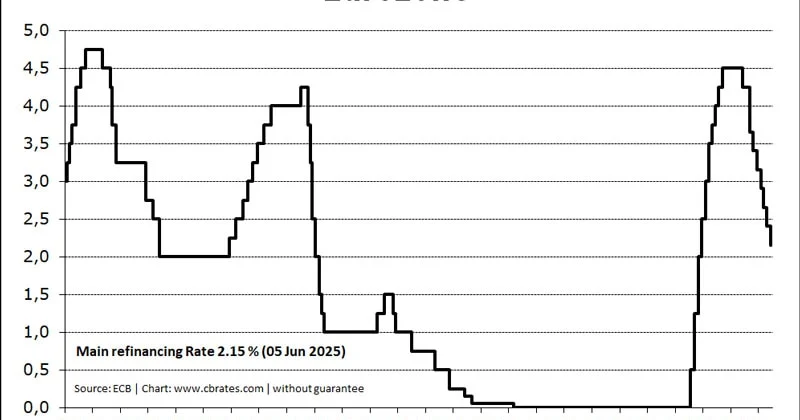
The ECB’s deposit facility rate currently sits at 2.00%, with the main refinancing rate at 2.15% and the marginal lending rate at 2.40%. Those levels reflect a period of sustained holds after multiple cuts throughout 2025. Schnabel’s comments suggest that era of accommodation is over.
Financial markets are already pricing in the shift. Expectations now point to the deposit facility rate climbing to somewhere between 2.75% and 3% by year’s end. That would mean three or more hikes over the next 12 months, a dramatic reversal from the easing cycle that dominated last year.
Schnabel has been building toward this moment. She began warning about inflation risks tied to the Iran conflict and its effect on euro-zone energy imports earlier this year. Her consistent hawkish messaging since late 2025 has gradually moved market expectations in her direction. This isn’t a surprise announcement. It’s the conclusion of a deliberate campaign.
AdvertisementThe core argument is straightforward: Europe imports a significant share of its energy, the Iran conflict has kept those prices elevated, and elevated energy prices feed directly into consumer inflation. A peace deal might eventually bring relief, but central bankers don’t set policy based on diplomatic optimism.
What this means for risk assets and crypto
Here’s the thing about rate hikes: they’re the financial equivalent of turning down the music at a party. Borrowing gets more expensive, liquidity shrinks, and investors start looking at risk through a much harsher lens.
For crypto specifically, the relationship between central bank policy and digital asset prices has become impossible to ignore. The 2022-2023 tightening cycle by the Federal Reserve coincided with brutal drawdowns across the crypto market. When the Fed pivoted to cuts, risk appetite returned. The ECB following a similar hawkish path, while the Fed’s own trajectory remains uncertain, introduces a new variable into the global liquidity equation.
Euro-denominated capital flowing into crypto could face headwinds if European yields become more attractive on a risk-adjusted basis. When you can earn 2.75% to 3% on essentially risk-free ECB deposits, the hurdle rate for speculative investments goes up. In English: investors need bigger potential returns to justify the volatility of assets like Bitcoin or Ethereum when safe alternatives start paying real yields.
The euro-zone is not a minor player in global crypto markets. European exchanges and institutional investors represent a meaningful share of daily trading volume. Tighter monetary conditions in Europe could dampen demand from that cohort, even if US conditions remain relatively accommodative.
Stablecoin dynamics could also shift. Euro-backed stablecoins have been growing in adoption, and higher ECB rates would increase the yield that issuers earn on their reserves. That’s good for stablecoin business models but potentially complicates the competitive landscape between dollar-denominated and euro-denominated stable assets.
The broader macro chessboard
Schnabel’s push doesn’t exist in isolation. The global monetary policy landscape has become increasingly fragmented, with major central banks moving in different directions based on their domestic inflation pictures and geopolitical exposures.
The ECB hiking while other central banks hold or cut creates divergence in interest rate differentials. That typically strengthens the euro against other currencies, which has its own cascading effects. A stronger euro makes dollar-denominated assets, including Bitcoin, more expensive for European buyers. It also affects the competitiveness of European exports, which feeds back into growth expectations.
For DeFi protocols with significant euro-denominated activity, higher rates could either be a challenge or an opportunity. Lending protocols that can offer yields competitive with rising traditional rates will retain users. Those that can’t may see capital migrate back to TradFi. The 2.75% to 3% projected rate range isn’t just a number on a central bank press release. It’s a benchmark that every yield-generating protocol in crypto will be measured against.
Sectors sensitive to interest rate changes, like real estate and consumer discretionary, tend to underperform during hiking cycles. The tokenized real-world asset space, which has been one of crypto’s fastest-growing narratives, includes significant real estate exposure. Higher European rates could cool enthusiasm for tokenized property investments, at least on the continent.
Look, Schnabel is one voice on the ECB’s Executive Board, not a dictator. But she’s an influential one, and the fact that markets have already moved to price in her preferred outcome suggests she’s not alone in her thinking. Traders positioned in euro-zone crypto exposure should be preparing for a world where European monetary policy is no longer a tailwind. Three or more rate hikes in 12 months changes the calculus for anyone deploying capital in risk assets, whether those assets trade on Binance or the Frankfurt Stock Exchange.
Disclosure: This article was edited by Editorial Team. For more information on how we create and review content, see our Editorial Policy.