ETH/BTC Ratio 760:1 — The New Market Structure Shaped by Bitmine
 Younchan jung3 min read·Just now
--
Why Bitmine’s 4.04% ETH Accumulation Reveals the Future of Institutional Crypto Strategy
In crypto, the loudest voices often come from charismatic believers. On X, Tom Lee is often described as the Ethereum counterpart to Michael Saylor. Both speak confidently about long‑term price appreciation and institutional adoption — yet the way their institutions actually use digital assets reveals a deeper difference.
That difference is why I chose today’s topic: how institutional wallet structures expose their real strategy.
Institutions don’t just talk about the future — they position themselves for it. And Bitmine’s ETH strategy is one of the clearest signals we’ve seen.
A Single Company Now Holds 4.04% of All ETH
CryptosRus recently reported:
“Bitmine has accumulated 71,524 more ETH, bringing their total to 4.87M — 4.04% of Ethereum’s total supply.”
This level of concentration is unprecedented. It shows that institutional ETH accumulation has moved beyond experimentation and into a strategic phase.
What matters most is not the amount — but the structure.
Bitmine divides its ETH into three wallet types:
- Treasury Wallet
- Operational Wallet
- Validator Wallet
This is not speculative hoarding. It is a blueprint for how institutions use Ethereum as financial infrastructure — and it stands in sharp contrast to Michael Saylor’s Bitcoin‑only treasury strategy.
The Three Wallet Structures Behind Bitmine’s Strategy
1. Treasury Wallet — Long‑Term Reserve
- Low transaction frequency
- Institutional‑grade custody
- Strengthens the balance sheet
- Reduces circulating supply and signals long‑term confidence
This is the only wallet type Bitcoin can occupy.
2. Operational Wallet — Active On‑Chain Usage
- Staking, L2 activity, liquidity provision
- Generates yield (3–6%)
- Supports L2 growth and network security
- Reduces volatility through added liquidity
Bitcoin cannot participate in any of these functions.
3. Validator Wallet — Network Security
- Repeated 32 ETH deposits
- Long‑term validator commitment
- MEV‑Boost and staking rewards
- Reinforces Ethereum’s economic security
Again, Bitcoin cannot operate here.
The ETH/BTC Ratio Is Widening — And This Is Why
Over the past year, Bitmine increased its ETH holdings by 1.87 million, while BTC holdings barely changed. This divergence is not a market anomaly — it is the structural result of an ETH‑centric strategy.
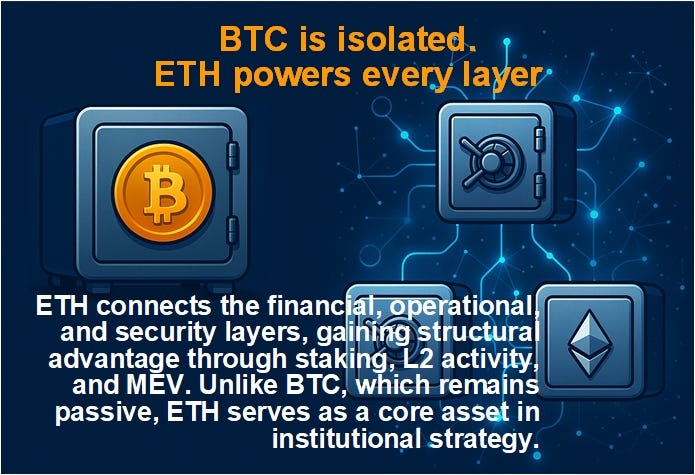
- Bitcoin exists only in the Treasury Wallet. It is a passive reserve asset.
- Ethereum exists across Treasury, Operational, and Validator layers. It is simultaneously a financial, operational, and security asset.
This multi‑layer utility is why the ETH/BTC value ratio expanded from 489:1 to 760:1.
Institutions are not just buying ETH — they are using it.
The Insight: Who Would You Trust to Run a Company?
Imagine choosing between two executives:
Executive A
- Holds digital assets only in a treasury
- Cannot use them for operations, yield, or security
- Promotes long‑term appreciation but cannot deploy the asset productively
Executive B
- Uses digital assets across treasury, operations, and security
- Generates yield, strengthens infrastructure, and participates in ecosystem growth
- Treats the asset as a system, not just a reserve
Institutions are already answering this question with their balance sheets.
Conclusion — Bitmine’s ETH Accumulation Is Strategy, Not Hoarding
Bitmine’s behavior reveals a simple truth:
Ethereum is no longer just an asset. It is a system.
Its three‑wallet structure shows how institutions use ETH across:
- Finance (Treasury)
- Operations (L2, staking, liquidity)
- Security (validators, MEV, EigenLayer)
Bitcoin remains a powerful reserve asset, but its institutional role is fundamentally different.
The widening ETH/BTC ratio is not speculation — it is the mathematical outcome of two different asset architectures.
To understand the future of the crypto ecosystem, we must look not at what institutions say, but at how they structure their wallets.
Reference Full analysis: https://dailycryptotimes1.blogspot.com/2026/04/eth-btc-760-1-bitmine-market-structure-en.html