The Bidirectional Relationship Between Quantum Hardware and Machine Learning
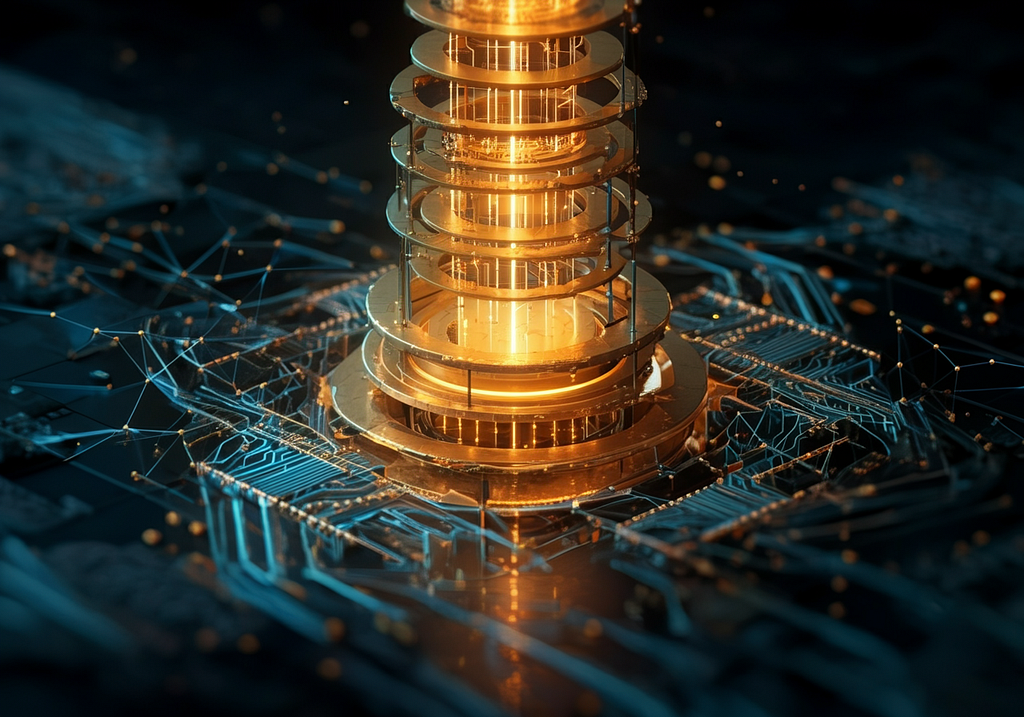
The ultimate technological heist: when Quantum Mechanics met Generative AI.
Let’s talk about the greatest buddy-cop movie the universe has ever produced.
On one side, we have Quantum Mechanics: the wild, unpredictable, rule-breaking maverick who communicates faster than light and refuses to commit to a single state until someone is looking. On the other side, we have Generative AI: the smooth, pattern-recognizing, hyper-calculating detective who can look at a mountain of chaotic data and instantly spot the hidden truth.
For the past few years, these two have been teaming up to pull off the ultimate technological heist.
You see, in 2022, the Nobel Prize in Physics recognized a 50-year experimental crusade that proved “quantum entanglement” — which Albert Einstein grumpily dismissed as “spooky action at a distance” — is actually the fundamental operating reality of our universe (Nobel Prize Committee, 2022). But while the physicists were popping champagne, a second, equally profound revolution was quietly happening in the background: mapping and harnessing this “spooky action” has fundamentally become a Generative Artificial Intelligence problem.
Describing entangled quantum systems requires mathematical calculations so massive that they physically break classical supercomputers. To bypass this, the world’s leading physicists have quietly pivoted to using the exact same GenAI architectures behind ChatGPT and Midjourney.
Classical GenAI is the only tool capable of simulating complex quantum states. Concurrently, quantum entanglement is being weaponized as the ultimate hardware substrate to run next-generation “Quantum Generative Models.” Understanding this bidirectional entanglement of AI and quantum mechanics isn’t just for lab-coat-wearing geniuses anymore — it’s the prerequisite for the next decade of tech supremacy.
So, let’s dive into the rabbit hole.
💬 “Quantum mechanics is magic, but Generative AI is the magician’s assistant who actually figures out how the trick works behind the curtain.” — Dr. Mohit Sewak
The Stakes: Hitting the Dimensionality Wall

Classical physics tries to measure every grain of sand; Generative AI maps the entire multidimensional city at once.
Imagine trying to map a sprawling, exponentially growing mega-city by walking around with a ruler and measuring every individual grain of sand on the ground. That’s classical physics trying to map a quantum computer. Now imagine training an AI to recognize the city’s overall architectural patterns instantly from a few satellite images. That’s Generative AI.
In the quantum world, this sand-measuring problem is called the “curse of dimensionality.” To verify that a quantum computer is actually working, scientists perform Quantum State Tomography (QST). But as you add qubits (the building blocks of a quantum computer), the complexity scales exponentially (2N2N). Verifying a mere 20-qubit state using traditional brute-force math is like trying to guess a 20-character password by typing randomly — it’s practically impossible.
We cannot achieve “Quantum Advantage” without AI. The industry has shifted from treating entanglement as a weird philosophical paradox to treating it as an informational resource that must be compressed, learned, and managed by neural networks.
For the executives and policymakers sipping their own tea right now: if your nation or corporation is investing billions into quantum hardware, you must simultaneously invest in the AI required to operate it. Furthermore, running AI natively on quantum hardware introduces unprecedented “black box” risks that require immediate regulatory frameworks.
🚀 ProTip for Executives: Stop treating Quantum Computing and Generative AI as two different R&D departments. The companies that win the next decade will be the ones that integrate GenAI directly into their quantum hardware stacks from day one.
Deep Dive 1: From Philosophical Weapon to Computational Resource
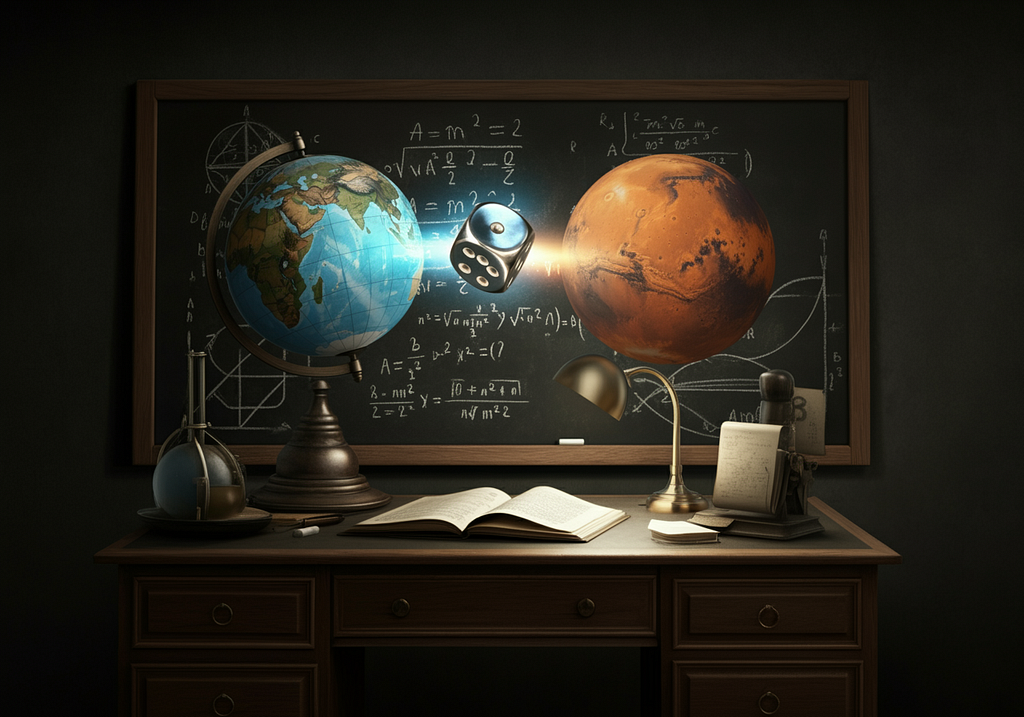
Einstein’s “spooky action at a distance” has evolved from a philosophical paradox into a mathematically quantifiable resource.
To appreciate where we are, you have to understand the epic 90-year beef that started it all.
Back in 1935, Albert Einstein, Boris Podolsky, and Nathan Rosen published the EPR Paradox (Einstein et al., 1935). Einstein hated the idea of entanglement. He demanded “local realism” — the idea that physical properties exist independently of us looking at them, and that nothing can travel faster than the speed of light. He tried to use entanglement as a philosophical weapon to invalidate quantum mechanics entirely.
Think of it like a pair of magic dice. If you roll one die on Earth and it lands on a 6, the other entangled die on Mars instantly lands on a 6. Einstein thought the dice had hidden, pre-programmed internal mechanisms (“hidden variables”). He refused to believe the dice were communicating instantaneously across space.
Then, in 1964, a physicist named John Bell transformed this philosophical bar-fight into a rigorous mathematical test called Bell’s Theorem (Bell, 1964). He proved mathematically that if the dice were using hidden variables, their correlations would hit a strict mathematical limit. If they violated that limit, it meant the dice were genuinely communicating faster than light.
Fast forward through decades of grueling experiments by absolute legends like Alain Aspect (Aspect et al., 1982) and Anton Zeilinger (Zeilinger, 1998), culminating in the 2015 loophole-free Bell tests (Hensen et al., 2015). The verdict? Einstein was wrong. Quantum non-locality is an unassailable physical truth.
Eventually, researchers like the Horodecki family formalized this truth: entanglement was no longer just a physics anomaly; it was a consumable, mathematically quantifiable resource like electricity or energy (Horodecki et al., 2009).
💡 Fact Check: The 2015 loophole-free Bell test by Ronald Hanson’s team at TU Delft placed two diamond crystals 1.3 kilometers apart. They proved entanglement was real with such certainty that the chance of their results being a statistical fluke was practically zero.
Deep Dive 2: AI Taming the Quantum Realm
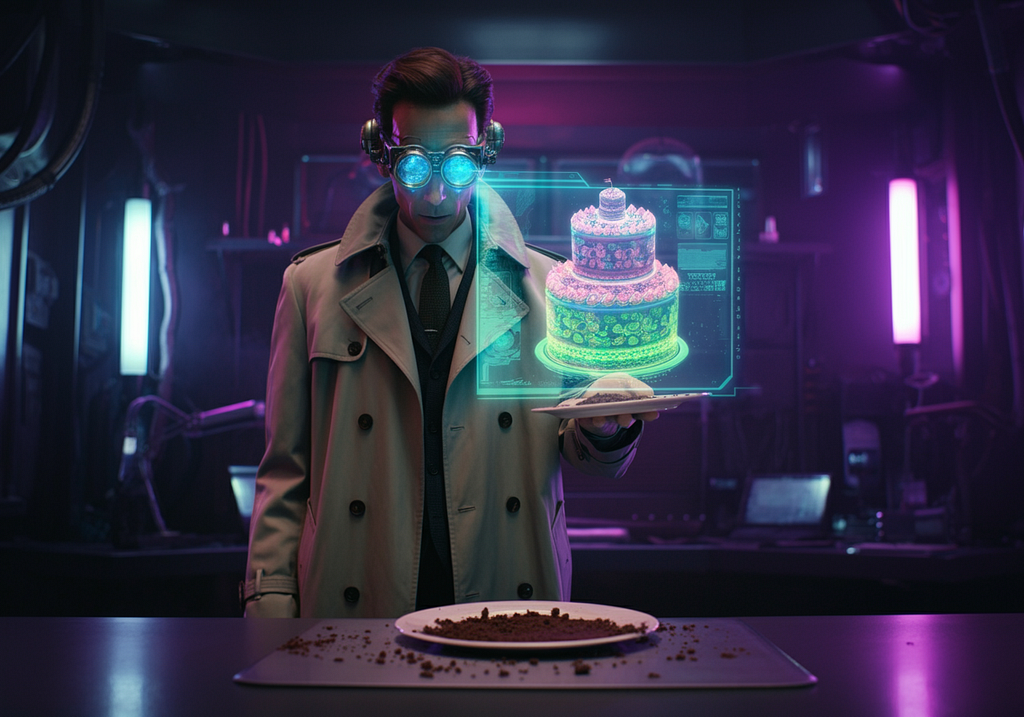
Generative AI acts as the detective, hallucinating the complete recipe of complex quantum states from mere scattered crumbs of data.
So, we have this incredible, universe-breaking resource, but measuring it breaks our computers. How do we fix it? We call in the detective: Generative AI.
Physicists realized they could treat Quantum State Tomography (QST) as an unsupervised machine learning problem. Because quantum wave-functions naturally represent probability distributions, GenAI models — which are absolute beasts at learning high-dimensional probabilities — are the perfect tool to reconstruct them (Carrasquilla et al., 2019).
Let me translate that. QST is like trying to reverse-engineer a complex, multi-layered, Michelin-star baked cake back into its exact recipe based only on a few scattered crumbs on a plate. Classical computers look at the crumbs and crash. Generative AI looks at the crumbs, recognizes the patterns of baking, and accurately “hallucinates” the full recipe in seconds.
The architecture evolved rapidly:
- Restricted Boltzmann Machines (RBMs): These were the early heroes, successfully compressing entangled states like a ZIP file for the quantum realm (Torlai et al., 2018).
- Adversarial Approaches: Researchers started using Conditional GANs (Generative Adversarial Networks) to synthesize candidate density matrices, synthesizing high-fidelity reconstructions orders of magnitude faster (Ahmed et al., 2021).
- The Transformer Hegemony: Just like ChatGPT treats English as a language, models like DeepMind’s FermiNet and Psiformer started treating quantum states like an “unknown language” where measurement outcomes are words. The self-attention mechanisms natively capture long-range quantum correlations, solving the Schrödinger equation from first principles (Spencer et al., 2020; von Glehn et al., 2022).
🚀 ProTip for Researchers: If you are a physicist, learn PyTorch. If you are an AI developer, learn what a Hilbert space is. The magic happens exactly where these two fields overlap.
Deep Dive 3: Quantum Generating AI (The Hardware Reversal)

The hardware reversal: Quantum states are now generating AI, creating masterpieces of data far beyond classical comprehension.
Here is where the buddy-cop movie gets a sequel. The relationship has flipped. AI isn’t just reading quantum states anymore; quantum states are now generating AI.
Welcome to the era of Quantum Generative Adversarial Networks (QGANs).
In a classical GAN, two AI agents play a forgery game — one tries to paint a fake Mona Lisa (the generator), and the other tries to spot the fake (the discriminator). In a QGAN, the canvas and the paint itself are made of entangled qubits (Dallaire-Demers & Killoran, 2018). This allows them to forge masterpieces of data far too complex for traditional computers to even comprehend.
Tech giants are already flexing this muscle. IBM used QGANs to load classical data distributions into quantum states exponentially faster, which is a game-changer for pricing financial derivatives (Zoufal et al., 2019). Google Quantum AI developed an Entangling Quantum GAN (EQ-GAN) to guarantee convergence and executed it on their 53-qubit Sycamore processor (Niu et al., 2021). We are even seeing QGANs generate real-world images of handwritten digits directly on superconducting hardware (Huang et al., 2020), and the emergence of Quantum LSTMs to process sequential data without destroying it (Chu et al., 2024).
💬 “We are no longer just teaching rocks to think. We are teaching the fundamental fabric of spacetime to hallucinate.” — Dr. Mohit Sewak
Debates and Limitations: The “Opaque Black Box”
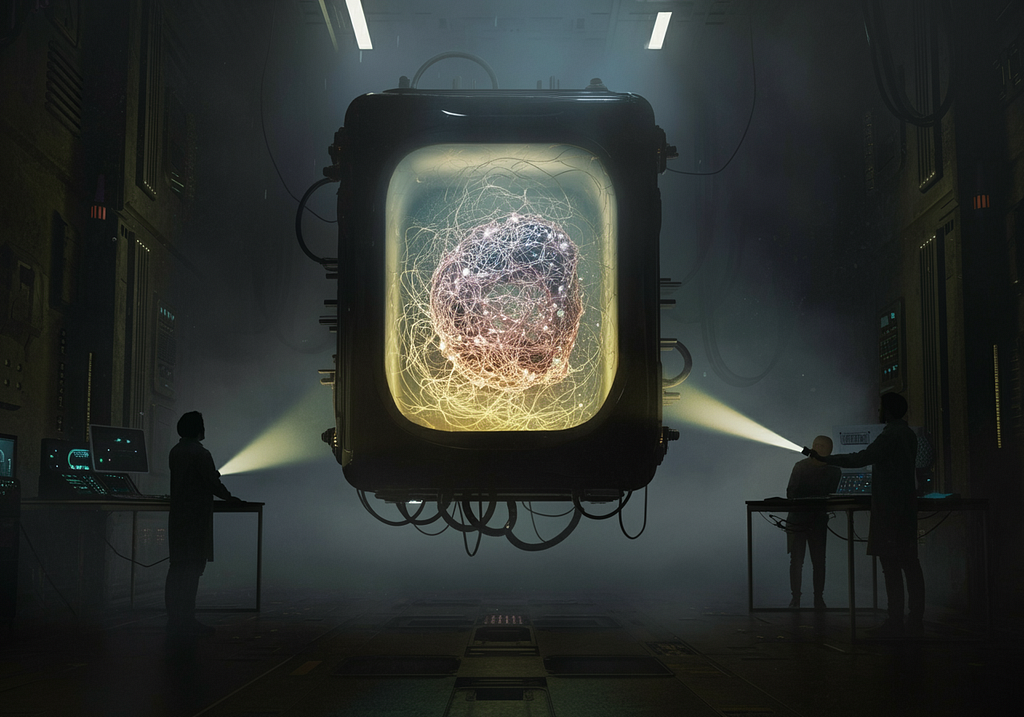
The opaque, interdimensional black box: deploying Quantum GenAI without understanding its pathways poses massive systemic risks.
Now, I’m a guy who has spent years in cybersecurity and Responsible AI. I practice kickboxing to stay sharp. And let me tell you, fighting an opponent you can’t see is a great way to get knocked out.
Classical deep learning already suffers from a severe lack of interpretability. When an AI makes a decision, it’s hard to know why. Now, combine that black box with the deeply non-intuitive, physics-defying realities of quantum superposition and entanglement. You don’t just get a black box; you get an opaque, interdimensional black box.
We are facing a massive alignment problem. Quantum kernel methods map data into wildly complex, non-separable spaces. How do we isolate genuine, logical causality from spurious quantum correlations?
Emerging research is proposing “model inversion” techniques to trace generated outputs backward through the entangled circuit to their latent roots (Zhang et al., 2024). Others are exploring “quantum DO-calculus” to physically sever entanglement links during model training, treating entanglement as a “super-confounder” (Emergent Mind Reviews, 2025).
Deploying Quantum GenAI without understanding its decision pathways poses systemic risks. We cannot just unleash quantum-powered AI into healthcare or finance without rigorous safety protocols.
💡 Fact Check: The concept of the “black box” in AI is being actively challenged by “model inversion,” a technique where researchers basically run the AI backwards to see what raw data triggered a specific decision. In quantum AI, this requires untangling literal physical qubits!
The Path Forward & Implications

The future belongs to those who successfully unite AI safety protocols with quantum-augmented machine learning frameworks.
So, what do we do with all this? How do we prepare for a world where AI and Quantum hardware are essentially the same entity?
- For Policymakers: Our governance frameworks are painfully behind. We need regulations that update traditional AI safety protocols with what I call “Bell’s epistemological rigor.” We need frameworks built for quantum-augmented machine learning.
- For Enterprise Executives: Stop the silos. The quantum race will not be won by the company with the coldest dilution refrigerator; it will be won by the company that flawlessly integrates Generative AI directly into its quantum hardware stack.
- For Researchers: Cross-disciplinary fusion is your only path forward. The future belongs to those building “Transparent and Controllable Quantum Generative Models.”
Conclusion
The magic show is real, and Generative AI is the one waving the wand.
Let’s bring it all back home.
The story of entanglement is the ultimate underdog story. It started in 1935 as an epistemological weapon forged by Einstein to destroy quantum mechanics. It survived a half-century of rigorous laboratory testing to become a proven mathematical truth. And today, it has evolved into the ultimate computational resource of the 21st century.
But the sheer dimensionality of quantum mechanics is a beast that classical math cannot tame. It can only be mapped, understood, and controlled by Generative AI. And simultaneously, the future evolution of artificial intelligence — to become faster, deeper, and more capable — requires the entangled, multi-dimensional substrate of quantum hardware.
They need each other.
To understand the future of computation, you must simultaneously understand the optical bench where photons are split, and the neural networks that learn to interpret their impossible correlations. The magic show is real, my friends, and Generative AI is the one waving the wand.
Stay curious, keep your guard up, and I’ll see you in the next dimension.
References
Theme 1: Foundational Theory and The Epistemological Debate
- Bell, J. S. (1964). On the Einstein Podolsky Rosen paradox. Physics Physique Fizika, 1(3), 195. Link
- Einstein, A., Podolsky, B., & Rosen, N. (1935). Can Quantum-Mechanical Description of Physical Reality Be Considered Complete? Physical Review, 47(10), 777. Link
Theme 2: Experimental Verification and The Closing of Loopholes
- Aspect, A., Dalibard, J., & Roger, G. (1982). Experimental Test of Bell’s Inequalities Using Time-Varying Analyzers. Physical Review Letters, 49(25), 1804. Link
- Hensen, B., Bernien, H., Dréau, A., Reiserer, A., Hanson, R., et al. (2015). Loophole-free Bell inequality violation using electron spins separated by 1.3 kilometres. Nature, 526(7575), 682–686. Link
- Nobel Prize Committee (2022). Scientific Background on the Nobel Prize in Physics 2022.
- Zeilinger, A. (1998). Experimental Entanglement Swapping: Entangling Photons That Never Interacted. Physical Review Letters, 80(18), 3891. Link
Theme 3: Quantum Information Theory and Entanglement Quantification
- Horodecki, R., Horodecki, P., Horodecki, M., & Horodecki, K. (2009). Quantum entanglement. Reviews of Modern Physics, 81(2), 865–942. Link
Theme 4: The Intersection of Generative AI and Quantum Entanglement
- Ahmed, S., Muñoz, C. S., Nori, F., & Kockum, A. F. (2021). Quantum State Tomography with Conditional Generative Adversarial Networks. Physical Review Letters, 127(14), 140502. Link
- Carrasquilla, J., Torlai, G., Melko, R. G., & Aolita, L. (2019). Reconstructing quantum states with generative models. Nature Machine Intelligence, 1(3), 155–161. Link
- Chu, C., Hastak, A., & Chen, F. (2024). LSTM-QGAN: Scalable NISQ Generative Adversarial Network. arXiv preprint. Link
- Dallaire-Demers, P.-L., & Killoran, N. (2018). Quantum generative adversarial networks. Physical Review A, 98(1), 012324. Link
- Emergent Mind Reviews. (2025). Quantum Generative Models Overview. Emergent Mind. Link
- Huang, H.-L., Du, Y., Gong, M., Zhao, Y., Wu, Y., et al. (2020). Experimental Quantum Generative Adversarial Networks for Image Generation. Physical Review Applied, 16(2), 024051. Link
- Niu, M. Y., Zlokapa, A., Broughton, M., Boixo, S., Mohseni, M., Smelyanskyi, V., & Neven, H. (2021). Entangling Quantum Generative Adversarial Networks. PRX Quantum, 3(3), 030317. Link
- Spencer, J. S., Pfau, D., Botev, A., & Foulkes, W. M. C. (2020). Better, Faster Fermionic Neural Networks. arXiv preprint. Link
- Torlai, G., Mazzola, G., Carrasquilla, J., Troyer, M., Melko, R., & Carleo, G. (2018). Neural-network quantum state tomography. Nature Physics, 14, 447–450. Link
- von Glehn, I., Spencer, J. S., & Pfau, D. (2022). A Self-Attention Ansatz for Ab-initio Quantum Chemistry. arXiv preprint. Link
- Zhang, Y., et al. (2024). Toward Transparent and Controllable Quantum Generative Models. MDPI, Information. Link
- Zoufal, C., Lucchi, A., & Woerner, S. (2019). Quantum Generative Adversarial Networks for learning and loading random distributions. npj Quantum Information, 5(1), 103. Link
Disclaimer: The views and opinions expressed in this article are solely personal. Artificial Intelligence assistance was utilized in researching for, drafting of this article, and generating related concepts. Licensed under CC BY-ND 4.0.
Entangled AI: The Rise of Quantum Generative Models was originally published in Level Up Coding on Medium, where people are continuing the conversation by highlighting and responding to this story.