
Emerging markets investing has long fascinated global investors. These economies often promise faster growth, expanding middle classes, and rapidly evolving financial markets.
Yet despite these opportunities, many investors misunderstand the nature of emerging markets risk.
The mistake is surprisingly common: investors often confuse volatility with structural risk. While the two concepts may appear similar on the surface, they represent very different realities in global finance.
Understanding this distinction is essential for anyone allocating capital across developing economies.
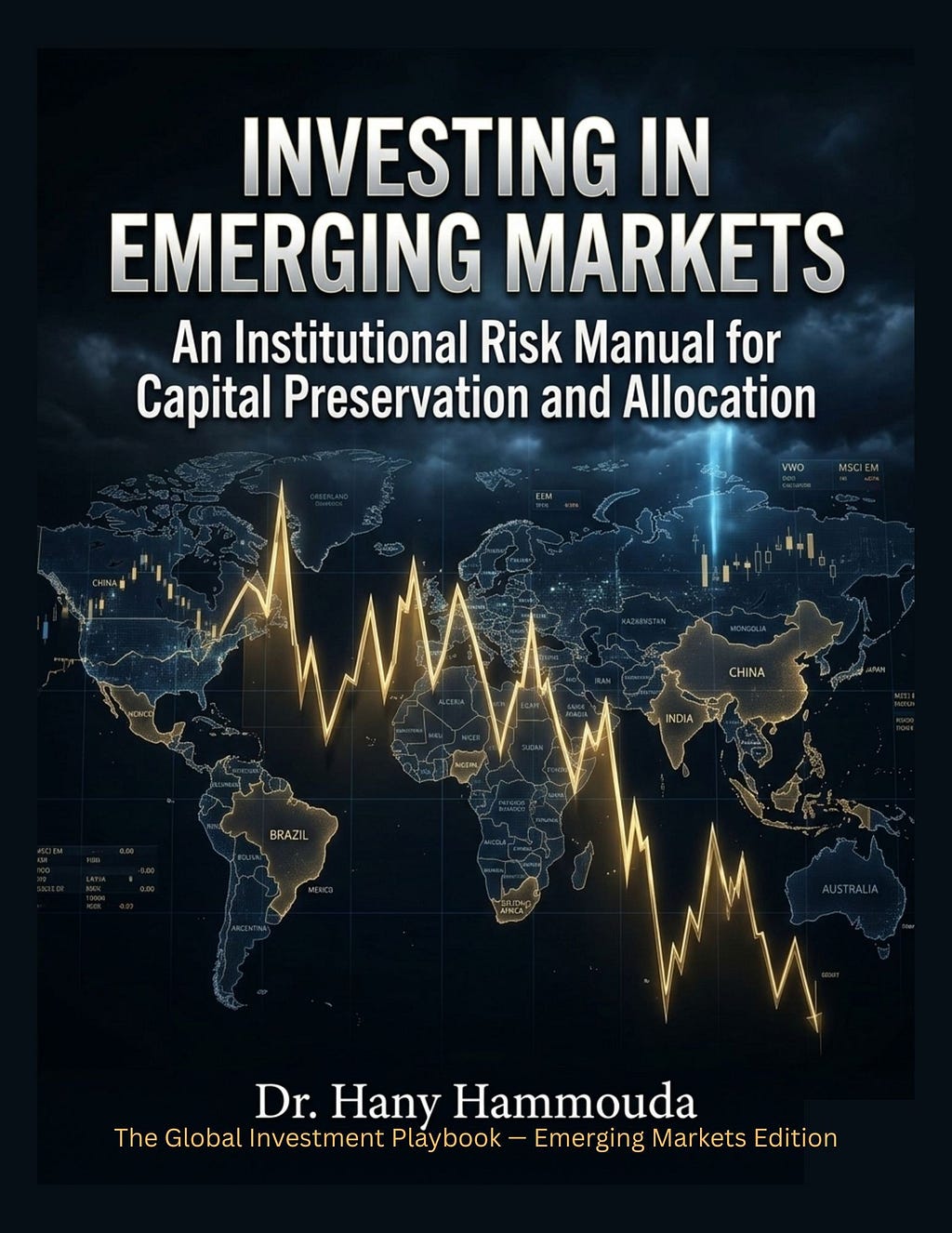
A deeper analytical framework for evaluating these structural risks is explored in my book Investing in Emerging Markets: An Institutional Risk Manual for Capital Preservation and Allocation, available on Amazon.
Volatility vs Structural Risk
In developed markets such as the United States or Western Europe, volatility is typically interpreted as short-term price movement.
Equities fluctuate. Bond yields adjust to inflation expectations. Currency markets respond to monetary policy signals.
But beneath these fluctuations lies a relatively stable financial system supported by durable institutions, deep capital markets, and predictable regulatory frameworks.
Volatility in these environments rarely threatens the fundamental structure of the financial system.
Emerging markets are different.
Price movements in these economies often reflect deeper forces such as capital flow reversals, currency imbalances, or institutional fragility.
In other words, volatility may be a symptom of structural pressures rather than temporary market sentiment.
Why Emerging Market Risk Is Structural
Several structural characteristics distinguish emerging markets from developed financial systems.
Understanding these forces is critical for investors.
Dependence on Global Capital
Many emerging economies rely heavily on foreign investment to finance growth.
During periods of abundant global liquidity, capital flows rapidly into emerging markets in search of higher returns.
But when financial conditions tighten — especially in major financial centers — those flows can reverse quickly.
Research from the International Monetary Fund shows that global liquidity cycles strongly influence capital flows to developing economies.
These cycles create investment environments that can shift dramatically within short periods.
Currency Regimes and Exchange Rate Risk
Currency dynamics are another structural driver of emerging market risk.
Unlike developed economies with deep currency markets, many emerging markets operate under exchange rate systems that can amplify financial stress.
Currency depreciation can rapidly increase the burden of foreign-currency debt, weaken domestic balance sheets, and trigger capital flight.
Data from the World Bank consistently highlights how exchange rate volatility affects financial stability across developing economies.
For investors, understanding currency architecture is therefore essential.
Institutional Stability
Markets do not operate in isolation from political and legal institutions.
In developed economies, regulatory frameworks and governance systems tend to evolve gradually.
In emerging markets, however, institutional changes can occur quickly and unexpectedly.
Policy shifts, regulatory interventions, or political transitions may significantly alter investment conditions.
These institutional dynamics often shape long-term market outcomes more than short-term economic indicators.
The Global Liquidity Cycle
Another key driver of emerging market behavior is the global liquidity cycle.
When interest rates are low in advanced economies, global investors search for higher yields abroad.
Emerging markets frequently attract significant inflows during these periods.
But when monetary policy tightens in major economies, global capital often retreats toward developed markets.
This reversal can trigger rapid adjustments in emerging market currencies, equity prices, and bond yields.
What appears to be volatility may actually reflect deeper structural connections between global liquidity and emerging market stability.
Why Growth Narratives Are Not Enough
Emerging markets are often promoted through powerful growth narratives.
Rising populations. Expanding consumer markets. Rapid technological adoption.
These trends are real and important.
However, growth alone does not determine investment outcomes.
Financial markets respond not only to economic expansion but also to institutional resilience, currency stability, and capital flow dynamics.
Investors who focus solely on growth projections may underestimate the structural risks embedded in emerging market financial systems.

A More Disciplined Approach to Emerging Market Investing
For investors, the key lesson is that emerging market analysis requires a broader framework.
Traditional valuation metrics remain useful, but they must be complemented by deeper structural analysis.
Important factors include:
• global liquidity cycles
• currency regime stability
• institutional durability
• capital flow dependence
• market ownership structure
These elements often determine whether volatility represents temporary fluctuation or deeper systemic risk.
Final Thoughts
Emerging markets will remain among the most dynamic arenas in global finance.
Their economic transformation continues to reshape trade, investment, and global capital flows.
But the complexity of these markets requires investors to think beyond simple narratives of growth or volatility.
Understanding the architecture of risk — not just the surface movement of prices — is essential for navigating these environments.
For investors willing to adopt a disciplined framework, emerging markets can offer significant opportunities.
But those opportunities are best approached with a clear understanding of the structural forces that shape global financial systems.
Further Reading
If you are interested in a deeper institutional framework for analyzing emerging markets risk, you can explore my book:
Investing in Emerging Markets: An Institutional Risk Manual for Capital Preservation and Allocation. A comprehensive guide to understanding structural risk, global liquidity cycles, and institutional dynamics shaping emerging market investments. Available on Amazon.
Emerging Markets Risk: Why Most Investors Misunderstand It was originally published in DataDrivenInvestor on Medium, where people are continuing the conversation by highlighting and responding to this story.