Economists Said AI Wouldn’t Take Jobs—Some Now Admit They Got It Wrong
A new multi-university study surveyed 69 economists, 52 AI experts, and 38 superforecasters. All three groups agree: faster AI means fewer jobs.
 By Jose Antonio LanzEdited by Guillermo JimenezApr 11, 2026Apr 11, 20263 min read
In brief
- A major multi-university study finds faster AI means fewer people working.
- Economists now see real job losses alongside strong economic growth.
- The debate has shifted to whether AI will replace the need for new jobs entirely.
For years, economists were the professionals most likely to tell you to calm down about any fear related to technology. ATMs didn’t replace cashiers, Excel didn’t replace bookkeepers and robotic vacuums didn’t replace maids. "Augment, not replace" was the consensus.
Well, that consensus is cracking.
A new paper from researchers at the Federal Reserve Bank of Chicago, the Forecasting Research Institute, Yale, Stanford, and the University of Pennsylvania surveyed 69 economists, 52 AI specialists, and 38 superforecasters about how AI will reshape the U.S. economy.
All three groups agree on one thing: Faster AI progress means lower labor force participation. That's the polite way to say “fewer people working.”
The numbers are staggering. Under what the researchers call the "rapid" scenario—where AI surpasses human performance across most cognitive and physical tasks by 2030—economists forecast the U.S. labor force participation rate dropping from its current 62% to 54% by 2050.
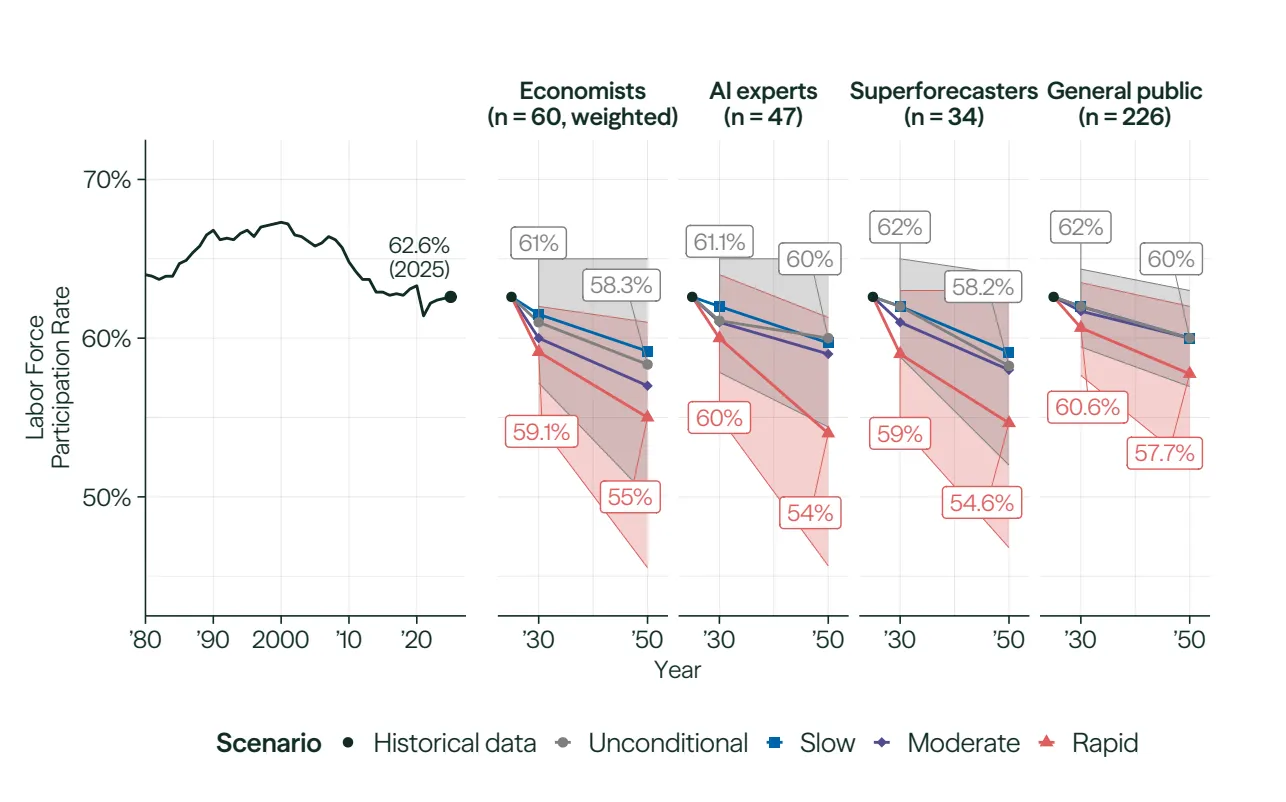
About half of that drop, roughly 10 million lost jobs, would be directly attributable to AI rather than demographics or other trends.
The rapid scenario isn't science fiction. It's the world where AI can negotiate book contracts, assist in any factory or home, and replace all freelance software engineers, paralegals, and customer service agents.
Anthropic CEO Dario Amodei has already warned that the disruption is accelerating faster than most expect—and the study's rapid scenario effectively validates that framing. GDP tells the other half of the story.
Under the same rapid scenario, economists project annual GDP growth hitting 3.5% by 2045-2049—approaching post-WWII boom levels. AI experts are even more bullish, forecasting 5.3% growth. Tremendous aggregate wealth creation, concentrated at the top, with a thinner workforce to share it. The researchers flag that under rapid AI, the wealthiest 10% of households could hold 80% of total wealth by 2050—higher than pre-WWII inequality.
But there's a nuance that often gets lost in the AI jobs debate. The paper finds that expert disagreement isn't mainly about whether powerful AI will arrive, but about what happens to the economy once it does. That's a meaningful shift. The previous pro-tech arguments assumed that even transformative automation would eventually create new categories of work. The new question economists are wrestling with is whether AI, unlike ATMs, automates the task of inventing new tasks.
For now, the aggregate employment data still looks mostly stable. A Yale and Brookings study from late 2025 found no mass unemployment signal nearly three years after ChatGPT's launch. But research cited in the new paper documents a 13% relative employment drop among workers aged 22-25 in the most AI-exposed occupations. The macro is stable. The leading edge is not.
On policy, economists and the general public part ways sharply. Economists favor targeted retraining programs (71.8% support) and largely reject job guarantees (13.7%) and universal basic income (37.4%). The general public is far more open to structural interventions. The paper's authors note that optimal policy depends heavily on which scenario plays out—and right now, nobody knows which one will.
So, the “augment, not replace” parable isn't dead, but it's on life support, and the economists running the numbers have enough data to be worried.