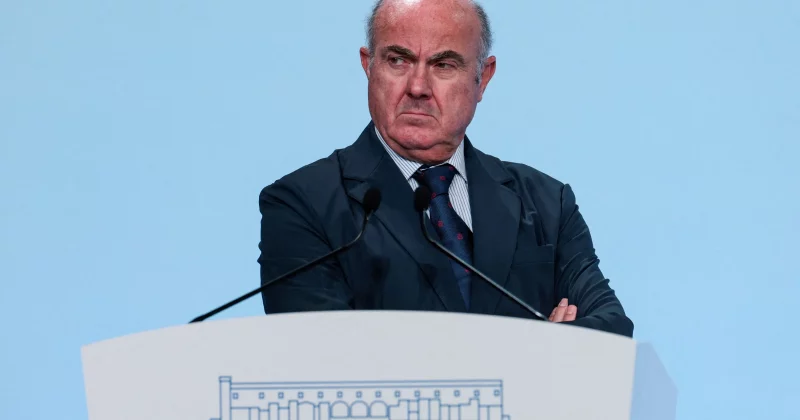
ECB vice president flags energy shock risks as euro area financial vulnerabilities deepen
Luis de Guindos laid out the dual threat of rising inflation and weakening growth during a Bloomberg TV appearance, with notable silence on crypto assets in the ECB's latest Financial Stability Review.
Share
Add us on Google by Editorial Team May. 27, 2026The European Central Bank’s second-in-command went on Bloomberg Television on May 27 to deliver a message that was equal parts warning and preview: the energy supply shock battering the euro area is making the ECB’s job considerably harder ahead of its June monetary policy decision.
ECB Vice President Luis de Guindos used the appearance to walk through the findings of the bank’s newly released May 2026 Financial Stability Review, a document that paints a picture of an economy caught between two very unpleasant forces. Rising inflation on one side. Weakening growth on the other.
The energy shock’s double bind
De Guindos was direct about the challenge facing European policymakers right now.
“The current energy supply shock poses upside risks to inflation and downside risks to economic growth.”
Advertisement
The Financial Stability Review itself pointed to financial vulnerabilities across the euro area that have intensified due to what the ECB terms “geoeconomic tensions” and persistent energy supply disruptions. Geopolitical strife in the Middle East continues to ripple through global energy markets, and Europe, with its particular sensitivity to energy imports, is absorbing the impact more acutely than most.
The FSR flagged concerns across several traditional sectors. Banking stability, commercial real estate valuations, and debt servicing capacity all received attention as areas where stress is building.
De Guindos emphasized that these vulnerabilities could amplify market swings as borrowing becomes more expensive across the euro area.
What’s missing tells its own story
Here’s the thing about the May 2026 FSR that crypto observers will find interesting: it contains zero explicit references to digital assets or cryptocurrency.
Previous editions of the ECB’s Financial Stability Review had addressed crypto-asset risks directly. The decision to omit them this time around represents a notable shift in focus. The entire document centers on traditional financial stability concerns.
What this means for investors
The ECB’s June monetary policy decision now becomes a critical waypoint. De Guindos essentially previewed the internal debate: cut rates to support faltering growth, or hold firm to fight inflation that energy prices keep stoking.
For traditional asset holders, the FSR’s emphasis on elevated vulnerabilities in banking and real estate suggests these sectors face outsized risk if the ECB misjudges its next move.
Disclosure: This article was edited by Editorial Team. For more information on how we create and review content, see our Editorial Policy.