Too many organizations are afraid of AI.
AI is not the monster under the bed. The data waiting for it is.
Organizations are in the process of rapidly adopting AI, often on top of data they don’t fully trust, hoping it will answer the questions they have been struggling with, for years in some cases.
Questions like can AI help us:
• prioritize the right customers?
• improve our pricing model?
• identify and fix AI broken processes faster?
Here’s the Part Nobody Wants to Look At
All of this assumes something.
That the data is good.
It’s not.
And the numbers are devastating:
- 77% of organizations say their data quality is “average at best,” up from 66% the year before.
- Only 15% of executives at large enterprises believe they have the data quality needed to achieve their goals.
- Roughly 26% of enterprise data is considered “dirty.”
- 94% of businesses suspect their customer data is inaccurate.
- 85% of AI project failures are caused by poor data quality.
One research summary put it bluntly:
“There is not a company on the planet without a data quality problem.”
The fear is valid – it’s just pointed at the wrong thing.
Organizations say that:
- They’re afraid of the cost.
- They’re afraid of skills gaps.
- They’re afraid of losing control and introducing security gaps.
And all of these concerns seem valid:
- It feels prudent.
- It feels disciplined.
- It feels like risk management.
The problem is these are really just concerns that relate to the symptoms of implementing AI.
AI doesn’t fix bad data.
It operationalizes it.
What is the result of your lending models being messy?
- AI approving bad loans
What happens if your sales and customer data is duplicative or incorrect?
- AI prioritizing the wrong customers
What comes out of poor operational and production metrics?
- AI optimizing already broken processes
“The most dangerous outcome isn’t that AI is wrong.
It’s that it’s wrong… and you trust it.”
AI Doesn’t Change the Cost Curve. It Changes the Economic Model.
For decades, technology economics were predictable:
You stored data.
You queried data.
You paid for what you ran.
Efficiency meant reducing consumption.
FinOps was built for that world.
AI isn’t.
You’re Using a 2019 Model to Manage a 2026 System
You’re still managing:
Cost → Efficiency → Reduction
But AI operates as:
Usage → Output → Value
Except AI is not a retrieval system. It’s a reasoning engine.
AI doesn’t scale like cloud. It scales like labor — except it never sleeps and bills by the millisecond
AI is a processing system.
- Every prompt triggers compute.
- Every follow‑up expands context.
- Every interaction reprocesses information.
You’re not paying for infrastructure anymore.
You’re paying for cognition.
- Tokens processed.
- Context maintained.
- Reasoning performed.
- Outputs generated.
And often, you’re paying to process the same messy data repeatedly as conversations evolve.
The CPU vs GPU Reality Check
Traditional search is a CPU problem.
AI search is a GPU problem.
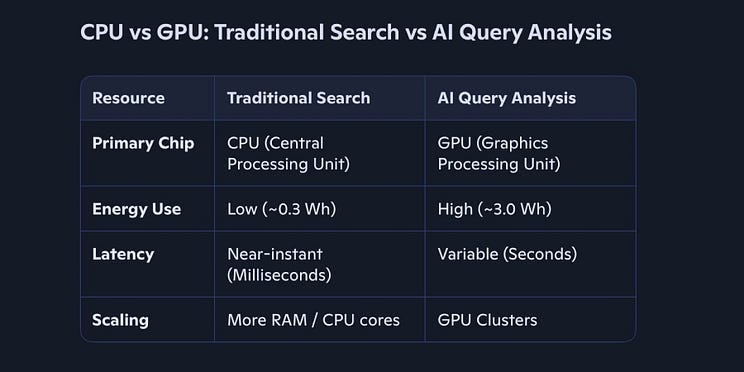
A traditional query like “What products sold the most units last year?” is trivial:
- Scan the units_sold column.
- Sum values.
- Sort.
Milliseconds.
Mathematically perfect.
Near‑zero marginal cost.
AI doesn’t work like that.
AI loads model weights into GPU memory.
It converts your records into high‑dimensional vectors.
It performs millions of parallel matrix multiplications to interpret meaning.
Even a simple AI query can consume ten times the energy of a traditional search.
AI isn’t expensive because it’s powerful.
AI is expensive because your data forces it to work harder than it should.
Semantic vs. Exact: Why AI Works Differently
Traditional search is literal.
- It matches strings.
- It requires exact terms.
- It returns rows.
You do the analysis.
AI search is semantic.
- It understands meaning.
- It interprets intent.
- It synthesizes answers.
It performs the analysis for you.
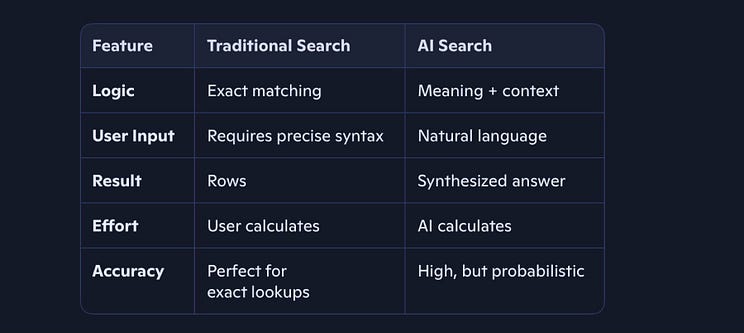
This is why AI feels magical – and why it’s expensive.
How AI Actually Handles Your 10,000 Records
Traditional Querying: Deterministic and Cheap
A SQL engine scans 10,000 rows, sums them, sorts them. Done.
AI Querying: Transformative and Costly
AI doesn’t “read” your records one by one.
It transforms them.
Most AI systems use vector databases to convert your data into mathematical embeddings.
This allows the model to find relationships you never explicitly defined:
- Which products sold most during holiday spikes.
- Which SKUs correlate with repeat buyers.
- Which items drive high‑value customers.
You didn’t specify time windows.
You didn’t define correlation logic.
You didn’t write a query.
The AI infers it.
That inference is compute‑heavy – and expensive.
Reactive vs. Proactive Insight
Traditional (Reactive)
You ask: “What sold the most?”
It answers exactly that – nothing more.
AI (Proactive)
AI doesn’t just answer the question.
It analyzes the context around the question.
It might tell you:
- Product A sold the most, but only because of one large outlier order.
- Product B has more consistent demand.
- Product C spikes seasonally.
This is the difference between a search engine and an analyst.
AI Isn’t Creating Your Data Problems
It’s exposing them.
Amplifying them.
Operationalizing them.
Before AI, bad data was a background problem.
It polluted reports.
It skewed dashboards.
It slowed decisions.
But it stayed contained.
Now?
Every question touches it.
Every model processes it.
Every answer depends on it.
And every time you use AI, you scale the consequences.
AI doesn’t create bad decisions.
It industrializes them.
And Then You Blame the Cost
Costs rise → “AI is too expensive.”
Outputs vary → “AI isn’t reliable.”
Adoption slows → “We need more control.”
But these aren’t root causes.
They’re symptoms.
You’re Using an IT Cost Model to Manage a Cognitive System
You’re still managing:
Cost → Efficiency → Reduction
But AI operates as:
Usage → Output → Value
And in reality:
Usage → Output → Data Quality → Value
That middle layer is where everything collapses.
Executives clamp down on usage because it’s measurable. They ignore data quality because it isn’t.
This Isn’t an AI Problem
It’s a data problem.
A visibility problem.
A model problem.
You’re trying to plan and build:
- A consumption‑based system
- Producing probabilistic outputs
- Fueled by imperfect data
Using a framework designed for:
- Static infrastructure
- Deterministic systems
- Assumed data integrity
It’s the wrong tool for the job.
What happens when AI confidently recommends shutting down profitable product lines — not because the model was wrong, but because the underlying data was.
The Question Every Leader Must Answer
If AI is finally revealing what your data actually looks like…
Are you trying to fix the system —
or are you trying to avoid seeing it?
Because AI is going to be a mirror you can’t ignore.
Don’t be Afraid of AI. Be Terrified of Your Data. was originally published in DataDrivenInvestor on Medium, where people are continuing the conversation by highlighting and responding to this story.