Direct Crypto Exchange vs Aggregator: Why Middlemen Complicate Cross-Chain Swaps
--
A common frustration in decentralized finance and cryptocurrency trading occurs right after pressing the “swap” button. The user waits, the pending circle spins, and minutes — sometimes hours — pass without the target asset arriving. Often, this delay is the result of underlying architectural choices the user is entirely unaware of. When users conduct a direct crypto exchange vs aggregator comparison, the differences in underlying mechanics reveal exactly why some transactions process seamlessly while others get stuck in a maze of smart contracts.
The blockchain ecosystem was built on the premise of peer-to-peer efficiency. However, as the number of disparate blockchain networks has grown, so has the complexity of moving value between them. To solve this, developers introduced exchange aggregators. While these platforms promise the best possible exchange rate by scanning multiple decentralized exchanges (DEXs) and liquidity pools, they introduce a significant middleman layer. This article explores the systemic differences between these models and why choosing a direct exchange service often results in superior execution, transparency, and reliability.
The Hidden Costs of Swap Routing
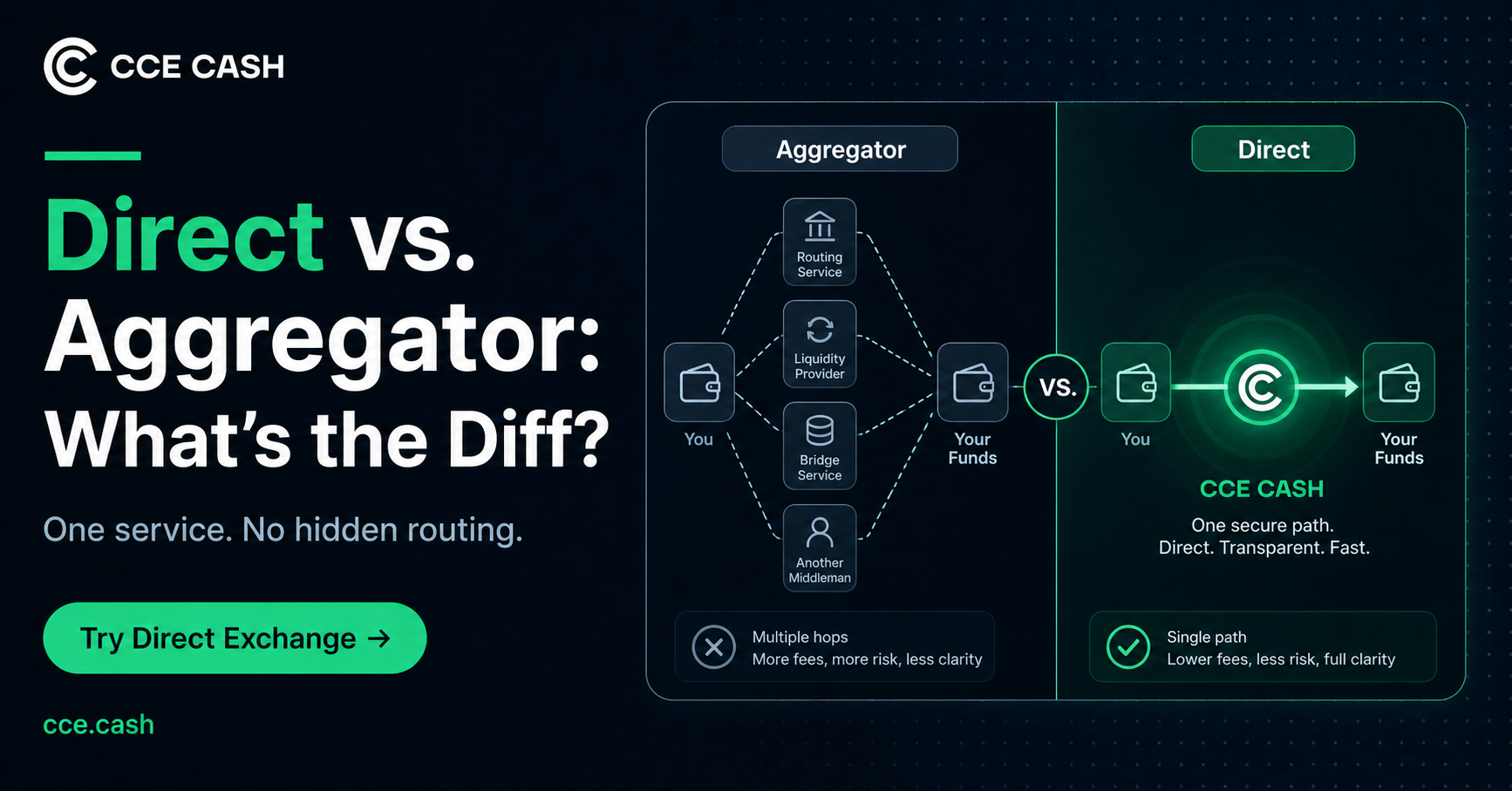
In any comprehensive exchange aggregator comparison, the core mechanism of the aggregator is the routing protocol. An aggregator does not hold its own liquidity. Instead, it acts as a search engine and automated broker. If a user wishes to execute a cross-chain swap, the aggregator might route the transaction through three or four different intermediary protocols to find the mathematical optimal path.
This process, known as swap routing, introduces several layers of execution risk. First, each hop between protocols incurs separate network fees, which can quickly eat into the promised “optimal” rate. Second, every additional smart contract involved represents a potential point of failure. If liquidity shifts suddenly in one of the intermediate pools during the routing process, the transaction can fail entirely, resulting in lost gas fees and a failed swap. Finally, aggregators often struggle to provide a truly transparent crypto swap, as the final output is highly susceptible to market slippage during the multi-step execution phase.
Assessing a Direct Crypto Exchange vs Aggregator Framework
Unlike aggregators, a direct exchange framework operates as a single, unified service. When users deposit funds, the platform processes the transaction internally and dispatches the corresponding asset from its own operational reserves. Because there is no external routing, the transaction speed relies solely on the required network confirmations of the underlying blockchains.
This single-service reliability eliminates the cascading failures associated with multi-hop aggregators. Furthermore, a direct model allows for more precise pricing mechanisms. While aggregators are forced to offer estimated returns based on floating liquidity across external networks, direct platforms can offer specialized features, such as rate locking, because they control the execution environment from start to finish.
Practical Exchange Scenario: Avoiding Multi-Hop Bottlenecks
Consider a scenario where a user needs to urgently swap Tether (USDT on the TRC20 network) for Solana (SOL) to capitalize on a sudden market movement.
Using an aggregator, this cross-chain transaction might require wrapping the USDT, bridging it to an Ethereum-compatible network, swapping it for wrapped Solana, and bridging it again to the native Solana network. Each step takes time and exposes the user to volatility.
Using a direct automated system, the user simply sends USDT (TRC20) to a generated deposit address. Once the TRON network confirms the deposit, the automated system immediately dispatches native SOL to the user’s designated Solana wallet. The elimination of the routing layer ensures the transaction completes in minutes.
CCE Cash: A Direct Exchange Service Without the Middleman Layer
CCE Cash operates exclusively as a fully automated service for exchanging cryptocurrencies and tokens, built entirely without aggregator mechanics. It is designed to facilitate seamless cross-chain swaps without manual intervention, supporting a wide array of assets including BTC, ETH, USDT (TRC20 & ERC20), SOL, XMR, AVAX, and many others.
The platform’s architecture removes execution ambiguity through dual-mode exchange rates. Users can choose a Floating rate, which adjusts in real-time to market conditions for fast execution, or a Fixed rate. The Fixed rate model locks the exchange rate for 10 minutes, protecting the user from volatility — provided the transaction arrives within that window and matches the exact order amount.
Furthermore, CCE Cash prioritizes utility and speed. No registration is required to begin exchanging; users simply select their currency pair, choose their rate mode, enter a receiving address, and send the funds. The automated system detects the incoming deposit and completes the exchange instantly upon network confirmation. Order tracking is available in real-time with block explorer links, ensuring total transparency.
Discussion Question: Have you ever experienced a failed or delayed transaction because an aggregator attempted a highly complex routing path?
Compare the approaches and choose directly: https://cce.cash