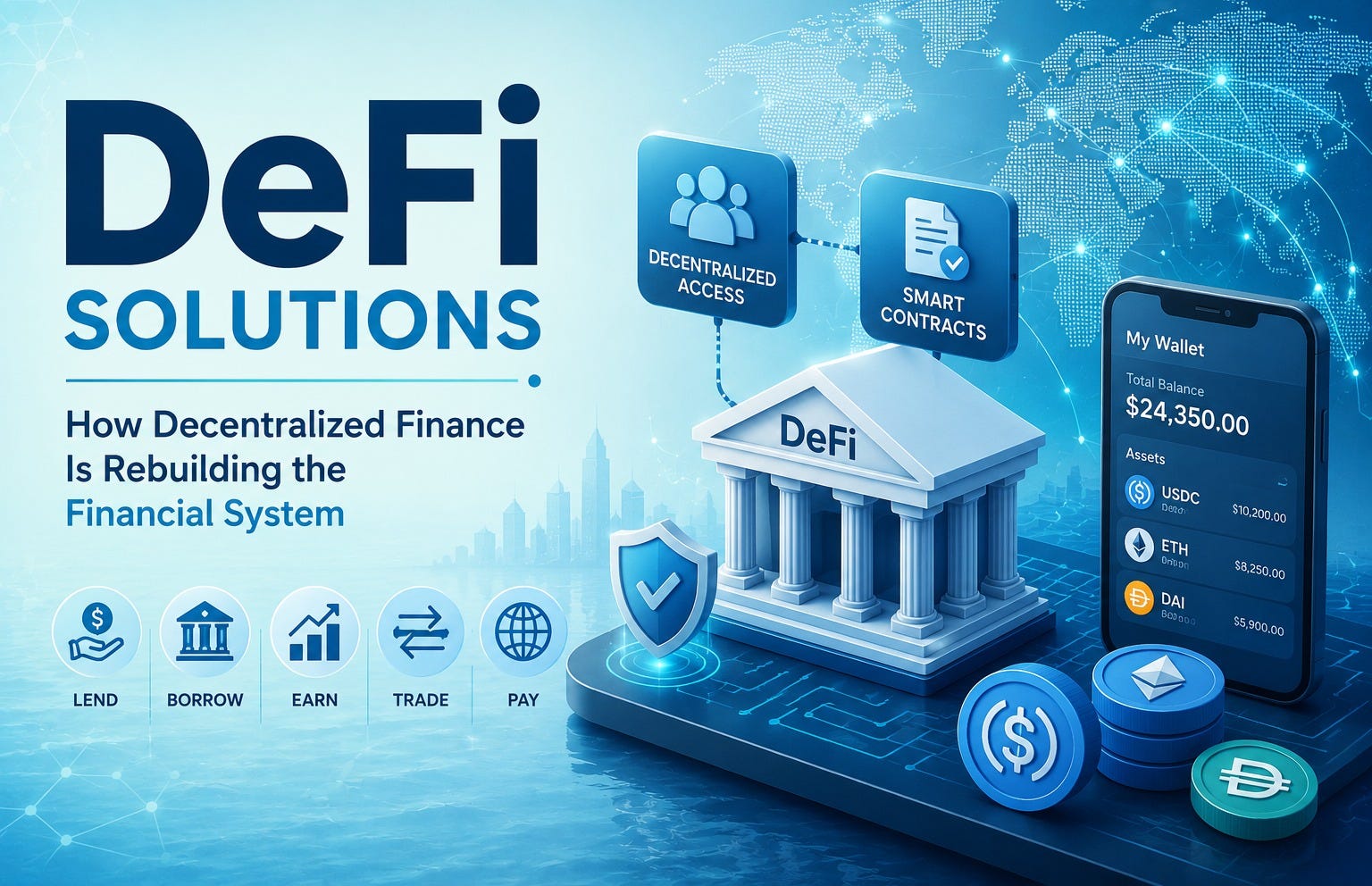
DeFi Solutions: How Decentralized Finance Is Changing The Financial System
 Udbhav Writers8 min read·Just now
--
The Financial Revolution That Is Happening Now
For a long time, money has been moving around the world in a pretty similar way. Banks have been in charge of who gets money and how it is used. Companies that handle payments have decided how transactions happen. Governments and financial institutions have controlled who can borrow money invest and send money to countries. They have been like gatekeepers making sure everything goes through them. This has been the way Things’re for decades but things are starting to change now.
For people this system has worked okay. For millions of people around the world, it has created problems instead of opportunities.
- Think about a freelancer who has to wait five days to get paid.
- Think about a startup that is struggling with banking restrictions in countries.
- Think about a business owner who is denied a loan because they do not have a good credit history.
- Think about a person who has to pay fees just to send money to their family in another country.
These problems have been around for a time and a lot of people just got used to them.
Then something changed when blockchain technology introduced a new idea:
What if financial systems could work without intermediaries like banks?
This led to the creation of Decentralized Finance or DeFi for short.
The world of finance is changing a lot with the emergence of DeFi. DeFi is a way of doing things that is changing how we manage our money. This new system is making it possible for people to borrow lend, save, invest and transfer money around the world with ease and transparency. One of the exciting things about DeFi is that it is creating a level playing field, where everyone has access to financial services no matter where they are in the world. This shift towards an inclusive and transparent financial system is not only making finance more accessible, but also more honest and global. As a result, individuals are gaining control over their financial lives, which is a really empowering thing.
With DeFi the traditional barriers that once limited access to services is being removed and a new era of financial freedom and opportunity is unfolding. This is a deal as it has the potential to change finance and create a more equal financial landscape, where everyone has the chance to participate and thrive. By providing a platform that’s open, transparent and connected DeFi is helping to break down the walls that once separated people from the financial system and creating a brighter financial future for all.
This is not about cryptocurrency anymore.
It is about the future of finance itself.
What Is DeFi?
DeFi refers to applications that are built on blockchain networks and work without traditional intermediaries like banks or payment providers.
Of relying on institutions DeFi platforms use smart contracts. Self-executing programs that are stored on blockchains like Ethereum, Solana, Avalanche and others.
These smart contracts automatically execute transactions when certain conditions are met.
In terms DeFi allows people to:
- Borrow money
- Lend assets
- Earn interest
- Trade currencies
- Send payments globally
- Access services
Without needing to get approval from a bank or any other financial institution.
Everything happens directly between users through blockchain infrastructure.
This change can seem complex. Its impact on individuals is real and can be felt in everyday life making it something that really matters to people.
Why Traditional Finance Is Struggling
To understand why DeFi is growing fast we need to understand the weaknesses of traditional finance.
1. Slow Cross-Border Payments
International bank transfers still take days in parts of the world. Multiple intermediaries increase costs, delays and complexity.
When companies work across the world they can run into problems with getting their money to flow smoothly.
In an economy waiting several days for payments no longer makes sense.
2. Financial Exclusion
According to financial reports millions of adults still do not have access to basic banking services.
Traditional banking systems often require:
- Proof of income
- Credit history
- Government-issued documents
- Minimum account balances
For people especially in developing economies these requirements create barriers instead of opportunities.
DeFi removes many of these limitations by allowing anyone with internet access and a digital wallet to participate.
3. High Fees
Traditional financial systems involve intermediaries:
- Banks
- Card networks
- Payment processors
- Clearing institutions
- Currency conversion services
Each layer adds costs.
It’s really tough for people like freelancers those who work from home in parts of the world companies that operate globally and workers who move to another country and want to send money back to their families.
DeFi platforms significantly reduce these layers.
4. Transparency
Most traditional financial operations happen behind closed systems. Users trust institutions to manage data, transactions and risk responsibly.
In DeFi transactions are recorded publicly on blockchain networks creating transparency.
Anyone can verify transactions, liquidity pools and smart contract activity in time.
How DeFi Actually Works
At the heart of DeFi are contracts.
They’re like contracts that handle money matters all written in a special set of instructions that a computer can understand.
Of a bank manually approving or processing transactions smart contracts execute actions automatically.
For example:
- If collateral requirements are met a loan is issued
- If liquidity is added rewards are distributed
- If assets are swapped an exchange completes instantly
This technology does away with the need for a lot of middlemen making things more straightforward.
The result is:
- Faster transactions
- operational costs
- Increased efficiency
- Global accessibility
And because these systems run on blockchain networks they operate 24/7 without geographical limitations.
The Core DeFi Solutions Transforming Finance
1. Decentralized Lending and Borrowing
Traditional loans often require:
- Credit checks
- Paperwork
- Banking relationships
- Long approval timelines
DeFi lending platforms change this entirely.
Platforms such as:
- Aave
- Compound
- MakerDAO
allow users to borrow funds by providing crypto assets as collateral.
Lenders also have the opportunity to earn interest when they provide liquidity to the protocol.
This creates a new lending ecosystem where access is based on digital assets rather than centralized approval systems.
Why This Matters
For people globally access to credit is one of the biggest financial barriers.
DeFi introduces a model where capital becomes more accessible, borderless and programmable.
2. Decentralized Exchanges (DEXs)
Traditional crypto exchanges hold user funds centrally.
Decentralized exchanges work differently.
DEXs like:
- Uniswap
- PancakeSwap
- Curve Finance
allow users to trade directly from their wallets without giving custody to a platform.
This improves:
- Security
- Transparency
- Ownership control
People are in charge of their money and assets the time they’re being moved or used in a deal.
3. Stablecoins and Global Payments
One of the problems in cryptocurrency has always been volatility.
Stablecoins solve this challenge by maintaining value stability through fiat-pegged systems.
Popular stablecoins include:
- USDC
- USDT
- DAI
These assets are becoming increasingly important for:
- border payments
- Global payroll
- International business settlements
- Remittances
- Digital commerce
Stablecoins are quietly becoming one of the bridges between traditional finance and decentralized infrastructure.
Real Human Impact of DeFi
Technology is only really useful when it makes a difference in people’s everyday lives.
This is where DeFi becomes powerful.
The Freelancer Economy
Remote work has created a global workforce.
Payment systems have not evolved fast enough.
Many freelancers still face:
- Delayed payments
- transaction fees
- Currency conversion losses
- Platform restrictions
With DeFi and stablecoin payments freelancers can now receive funds globally within minutes of days.
That changes flexibility dramatically.
Small Businesses and Startups
Many startups struggle with banking limitations during early growth stages.
Opening accounts managing multi-currency operations or processing cross-border transactions often becomes difficult.
DeFi infrastructure creates financial rails that are faster more scalable and globally accessible.
This is especially important, for:
- SaaS startups
- Digital businesses
- first companies
- Emerging market entrepreneurs
Financial Inclusion
Perhaps the important contribution of DeFi is financial inclusion.
In regions people are excluded from traditional banking because of:
- Location
- Documentation
The thing about DeFi that gets me excited is that we are still in the days.
What we have now is probably the beginning of something much bigger.
What could the future of DeFi look like?
1. Tokenized real-world assets.
This means things like estate, stocks and commodities could be turned into tokens on blockchain networks.
This would make it a lot easier for people around the world to buy and sell these things.
2. Borderless banking.
One day digital wallets might replace a lot of the things that traditional banks do.
People could use these wallets to save money invest, lend and make payments from anywhere in the world.
3. Finance.
Companies might be able to use contracts to automate things like payroll and lending.
This would make it easier for them to get things done.
4. Hybrid financial systems.
I do not think the future will be about decentralized finance or all about traditional finance.
Instead, we will probably see a mix of both.
This means that banks might start using blockchain technology and fintech companies might start using DeFi.
We might also see stablecoins being used to make payments and traditional rules being used with decentralized technology.
This could change the way the whole financial system works.
If you are new to DeFi you should start by learning about it.
Here are some things you can do to get started:
Use trusted wallets.
Some popular options are MetaMask, Trust Wallet and Coinbase Wallet.
Start with stablecoins.
Stablecoins are a way to learn about DeFi without taking on too much risk.
Research platforms carefully.
Do not use a platform if you do not understand how it works.
Look for things like security audits, a good reputation and clear documentation.
Never invest in something just because it is popular.
It is better to take your time and do your research.
DeFi is not another trend in finance.
It is a new way of thinking about money and financial systems.
For the time millions of people can use financial services without having to rely on banks and other institutions.
This is a deal.
Yes, there are still risks. The rules are still being figured out.
It is clear where things are headed.
- Finance is becoming more open, programmable and accessible to people around the world.
- Whether people realize it or not DeFi is already changing the way the financial system works.
- The future of money might not be controlled by banks, governments or tech companies.
It might be controlled by networks of people who are connected and working together.
That is the promise of DeFi.
DeFi is changing the way we think about finance. It is changing the way financial systems work.
DeFi is making finance more accessible to people around the world and that is a powerful thing.
The future of DeFi is exciting. It is full of possibilities.
DeFi is the future of finance. It is an important part of the digital age.
DeFi is a way of thinking about money and it is a new way of thinking about financial systems.
It is a way that’s more open more programmable and more accessible to people all, around the world.
That is what makes DeFi so exciting. That is what makes it so important.
The future of finance is DeFi and DeFi is the future of money.