DeFi Market Intelligence Report (GMX-ARBITRUM BLOCKCHAIN)
--
INTRODUCTION
Decentralized Finance(DeFi) has introduced new ways to trade and manage assests without intermediaries like Binance, Bitget, etc. with on-chain derivatives being one of the fastest growing sectors. GMX is one of the leading perpetual exchange allowing users to trade crypto assets with leverage directly from their wallets while still maintaining full custody of their funds.
This report analyses the behaviours and risk analysis of various markets/pairs being traded on the GMX perpetual DEX using a custom built market intelligence dashboard. The analysis focuses on trades made on the arbitrum blockchain.
EXECUTIVE SUMMARY:
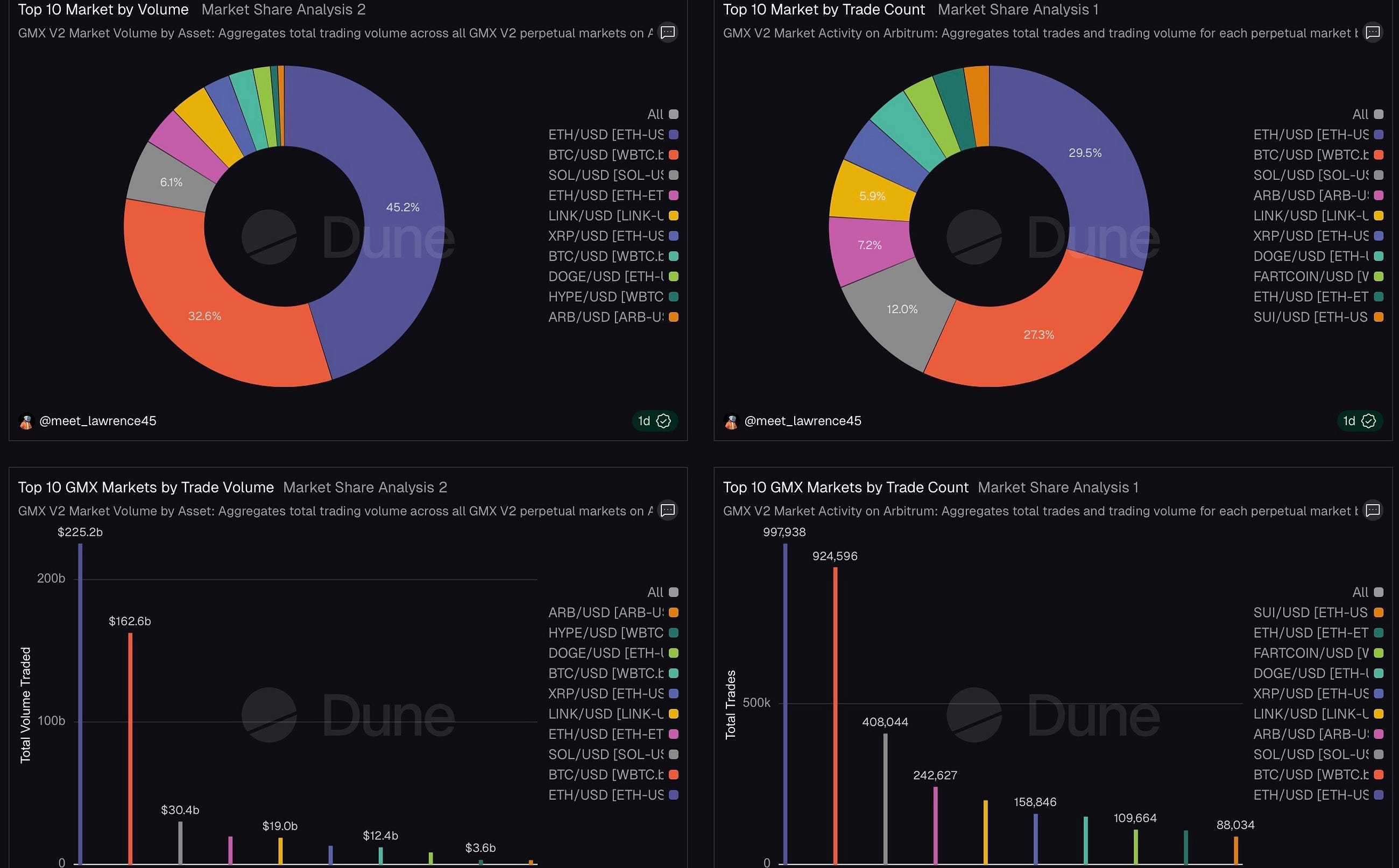
The GMX perpetual trading ecosystem is highly concentrated, with ETH/USD, BTC/USD, and SOL/USD dominating both trading activity and capital allocation. ETH/USD leads in trading volume (45.2%), indicating strong participation from large-sized traders, while BTC/USD shows the highest open interest (~$45B), reinforcing its role as the primary leverage hub.
Despite this concentration, risk and trader behaviour vary significantly across markets. WETH emerges as the most risk-exposed asset, recording the highest liquidation count and total capital lost, signaling heavy positioning and frequent leverage resets. At the same time, smaller markets like LINK exhibit disproportionately high liquidation rates relative to their size, highlighting inefficiencies and elevated risk per trade.
Positioning data reveals a structurally bullish but selective market, where long positions dominate but are concentrated in a few major assets, while short exposure is more diversified across multiple tokens. Funding rate dynamics further confirm localized overcrowding, with certain assets experiencing extreme long or short pressure.
Overall, GMX reflects a market where capital is concentrated, sentiment is selectively bullish, and risk is unevenly distributed, creating distinct opportunities and vulnerabilities across asset classes.
FINDINGS/ANALYSIS:
Market Share Analysis
The market share analysis reveals a clear concentration of trading activities within few dominant markets being ETH/USD, BTC/USD, and SOL/USD.
From the volume perspective, we can see that ETH/USD accounts for 45.2% of the trading volume while BTC/USD accounts for 32.6% and SOL/USD follows with 6.1%.
When looking at the market from the trade count perspective, we can see that ETH/USD dominance becomes less pronunced. It still leads the market but with a lower percentage of 29.5%, BTC/USD follows closely with a 27.3%, while SOL/USD follows with 12.0%.
No surprise this three pairs a the most traded by volume and trade count because as we all know this three are the most popular cryptocurrency markets hence most traders tend to trade them for the volatility.
The difference between the volume dominance and trade frequency indicates that
- ETH/USD attracts larger-sized traders.
- Other markets contributes more through smaller frequent trades.
Market Specific Longs vs Shorts
The distribution of long and short positions across markets reveals a strong concentration of directional activity, particularly within the WETH market.
From the analysis, we can see that WETH market dominates both the long and short markets by a significant margin. Open long position in WETH (~484K) exceed those in other markets, while open short positions(~304K) are also higher than other markets.
Across all markets, a pattern is seen, long position(714,300) outweighs short position(511,614). This indicates an overall bullish bias among traders for the longest time.
We also notices that the long positions are concentrated on fewer markets totalling 7, while short position are distributed across a wider range of markets.
This goes to show that the bullish bias is highly selective, with traders bullish on just a smaller set of assets particularly WETH, WBTC, LINK, UNI, etc.
In contrast, short positions are more diversified across multiple markets, which suggests a bearish bais on multiple markets.
Market Level Open Interest
The open interest analysis highlights a clear concentration of capital within a few dominant markets with BTC/USD and ETH/USD leading by a significant margin.
From the analysis, BTC holds the highest open interest at approximately $44.6B, closely followed by ETH at $44.5B. This places both markets above all other markets, with SOL holding under $10B and the rest trailing behind. This goes to show that majority of the capital committed to perpetual positions is concentrated in these two major market, BTC and ETH.
Looking at the market growth over time, both BTC and ETH show strong and strong and sustained increase in open interest, this reflects a continuous inflow of capital and rising trader engagements. ETH shows periods of high accelerations where it overtakes BTC which suggest more capital going into ETH.
Other smaller market also demonstrate gradual growth with occasional spikes but significantly lower overall capital accumulation. This goes to show that participation exists across multiple markets but commitment is heavily focused towards major markets.
Funding Rate by Market
The average funding rate across markets reveals clear difference on traders positioning and overcrowding.
Markets with higher positive funding rate indicates dominance of long position, while negative funding rate indicates dominance of short positions. Based on data, MOODENG/USD has the highest average funding rate, making it the most overcrowed long market. While XAUT/USD has the lowest funding rate, making it the least overcrowded short market.
Risk Concentration by Market
The liquidation analysis reveals a strong concentration of risk within few dominant market, particularly WETH. Which leads across all major risk metrics.
WETH records the highest number of liquidations (17,029) and the largest total USD lost (approximately $450M), significantly exceeding all other markets. This indicates that not only is trading activity highest in WETH, but also that the largest amount of capital is exposed to liquidation risk within this market.
However, when examining liquidation intensity, a different pattern emerges. Markets such as LINK shows the highest percentage of trades being liquidated (3.57%), despite having significantly lower overall volume and capital. This suggests that smaller markets may experience more frequent liquidation events relative to their size.
Conclusion
The GMX market is mainly driven by a few big players, especially ETH and BTC. Most traders focus on these because they are popular and have high activity.
However, this doesn’t mean they are the safest. WETH, for example, shows that a lot of traders are taking big risks, leading to many liquidations. At the same time, smaller markets like LINK can be even more dangerous in a different way, as traders get liquidated more often compared to their size.
We also see that most traders are betting on prices going up, but only on a few selected assets. This shows that traders are confident, but careful about where they put their money.