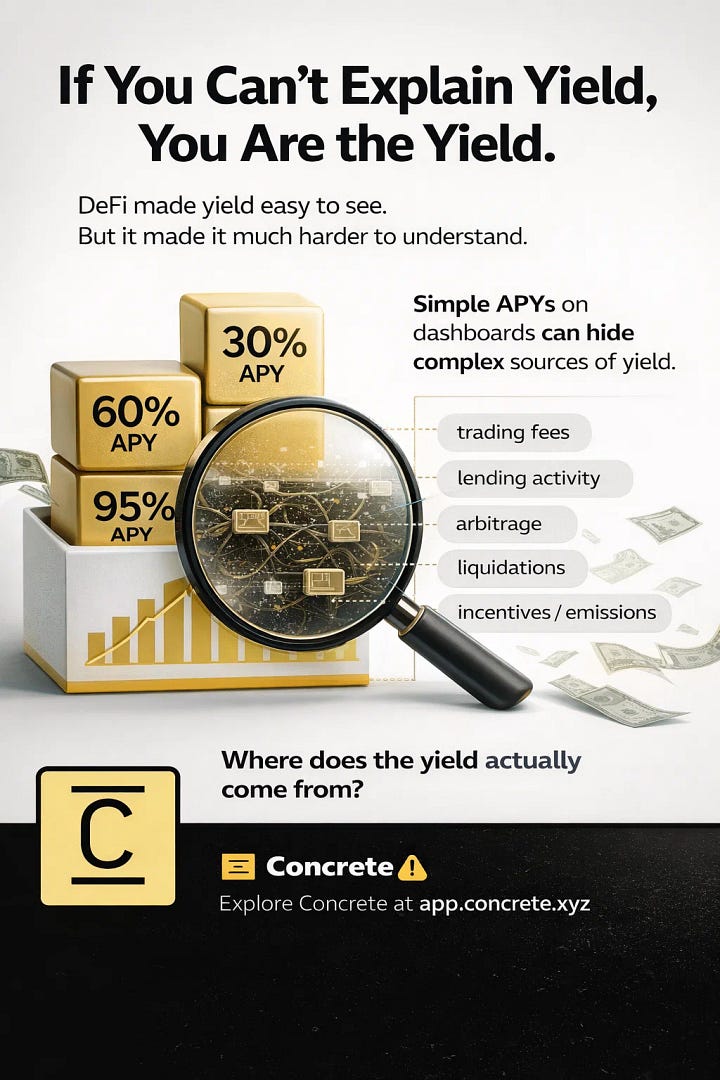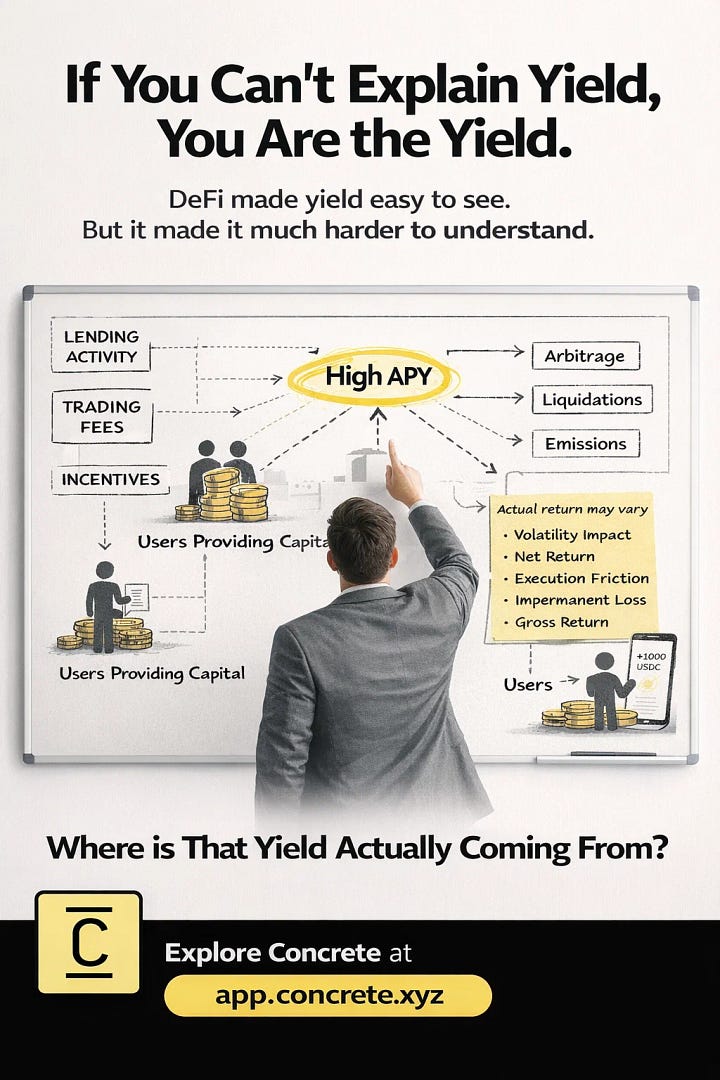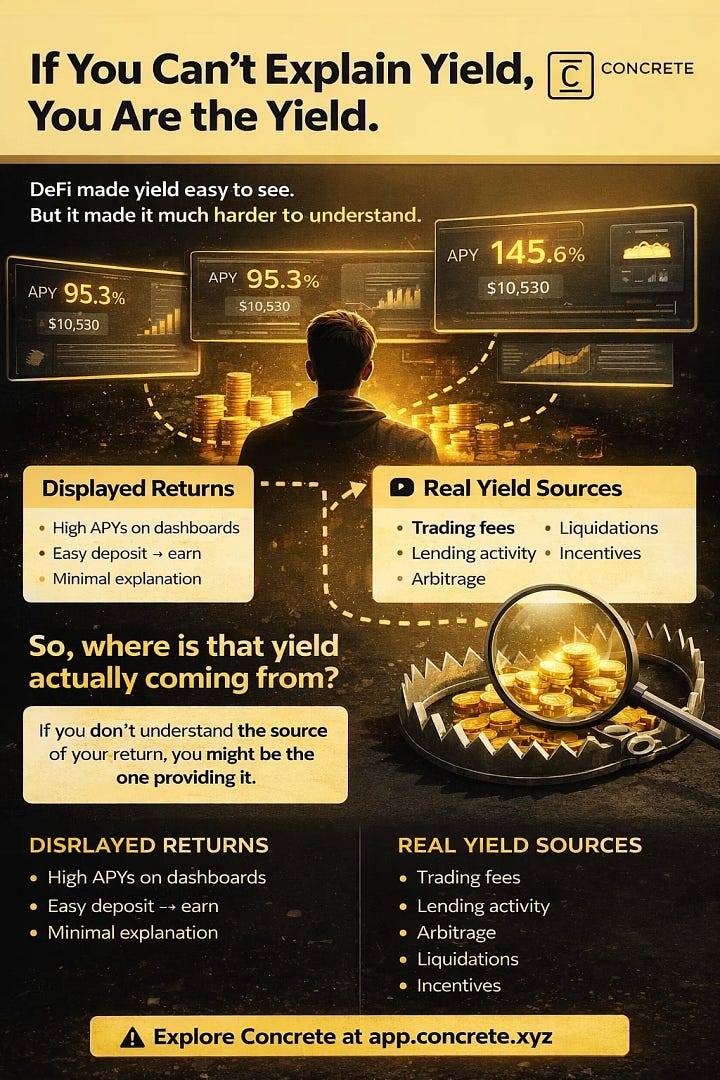
DeFi made yield easy to see. But much harder to understand
 DXxz3 min read·Just now
--
Open any dashboard and you’ll find high APYs, clean interfaces, and simple flows: deposit, wait, earn. Numbers update in real time, and returns appear to compound effortlessly. The experience feels intuitive.
But behind that simplicity lies a question most users never ask:
Where is that yield actually coming from?
>>The Illusion of Easy Yield<<
In today’s DeFi landscape, yield is presented as something straightforward.
You deposit assets.
The system generates returns.
The number goes up.
High APYs dominate dashboards, and the process is reduced to a simple action: deposit → earn. What’s missing is the explanation. The mechanisms behind those returns are rarely visible.
This creates a gap between perception and reality.
Yield looks simple on the surface. Underneath, it’s not.
>>The Gap Between Displayed and Real Yield<<
The APY shown on a dashboard is rarely the full story.
What you see is often a gross figure, not what you actually take home.
Several factors reduce real returns:
- Impermanent loss can offset gains in liquidity provision
- Rebalancing costs eat into profits over time
- Execution friction (slippage, gas fees) impacts efficiency
- Volatility changes the value of both principal and rewards
When these are accounted for, a high APY can compress significantly.
The displayed number is an estimate. The realized outcome is something else entirely.
>>Where Yield Actually Comes From<<
Yield in DeFi is not created out of nothing. It is generated from specific activities:
- Trading fees paid by users swapping assets
- Lending demand, where borrowers pay interest
- Arbitrage, capturing price differences across markets
- Liquidations, where positions are closed under stress
- Incentives or emissions, often used to bootstrap liquidity
Each source has different characteristics.
Some are sustainable, like trading fees from consistent volume.
Others are temporary, like token incentives that decline over time.
Understanding the source determines whether the yield is durable—or not.
>>Hidden Value Transfer<<
Here is the uncomfortable reality:
If you don’t understand the system, you may be the one subsidizing it.
This can happen when:
- You provide liquidity without fully understanding exposure
- You earn incentives while absorbing downside risk
- You participate without modeling possible outcomes
In these cases, your returns may come at the cost of unseen risks.
Or worse—your capital may be enabling others to extract value more efficiently.
This is where the idea becomes clear:
If you can’t explain the yield, you might be the yield.
>>Why Outcomes Differ<<
Not all participants in DeFi achieve the same results—even within the same system.
Some chase high APYs.
Others analyze structure, cost, and risk.
More advanced participants:
- Model expected returns
- Account for volatility and fees
- Optimize capital allocation
The system is the same. The outcomes are not.
The difference is understanding.
>>The Shift Toward Engineered Yield<<
DeFi is evolving.
The focus is moving from yield chasing to yield engineering.
This shift involves:
- Modeling expected outcomes before deploying capital
- Managing risk instead of ignoring it
- Optimizing positions over time
- Focusing on net returns, not just headline APY
Yield is no longer about finding the highest number.
It’s about building a strategy that holds up under real conditions.
>>From Guessing to Structure: Concrete Vaults<<
This is where structured infrastructure becomes important.
Concrete Vaults are designed to reduce the gap between perceived and real yield by:
- Automating capital allocation
- Managing strategies dynamically
- Rebalancing positions as conditions change
- Reducing manual errors and inefficiencies
Instead of relying on assumptions, users gain exposure to strategies that are systematically managed.
This moves participation from guessing to structured execution.
>>The Core Insight<<
Yield is not just a number on a screen.
It is:
revenue
minus cost
adjusted for risk
Understanding this changes how you approach DeFi.
It shifts your focus from chasing returns to evaluating them.
And in doing so, it determines whether you benefit from the system—or unknowingly fund it.
Explore Concrete at app.concrete.xyz