DeFi Isn’t About the Highest Yield — It’s About What Lasts
 Karan malakar4 min read·Just now
--
What Makes a DeFi Strategy Actually Sustainable?
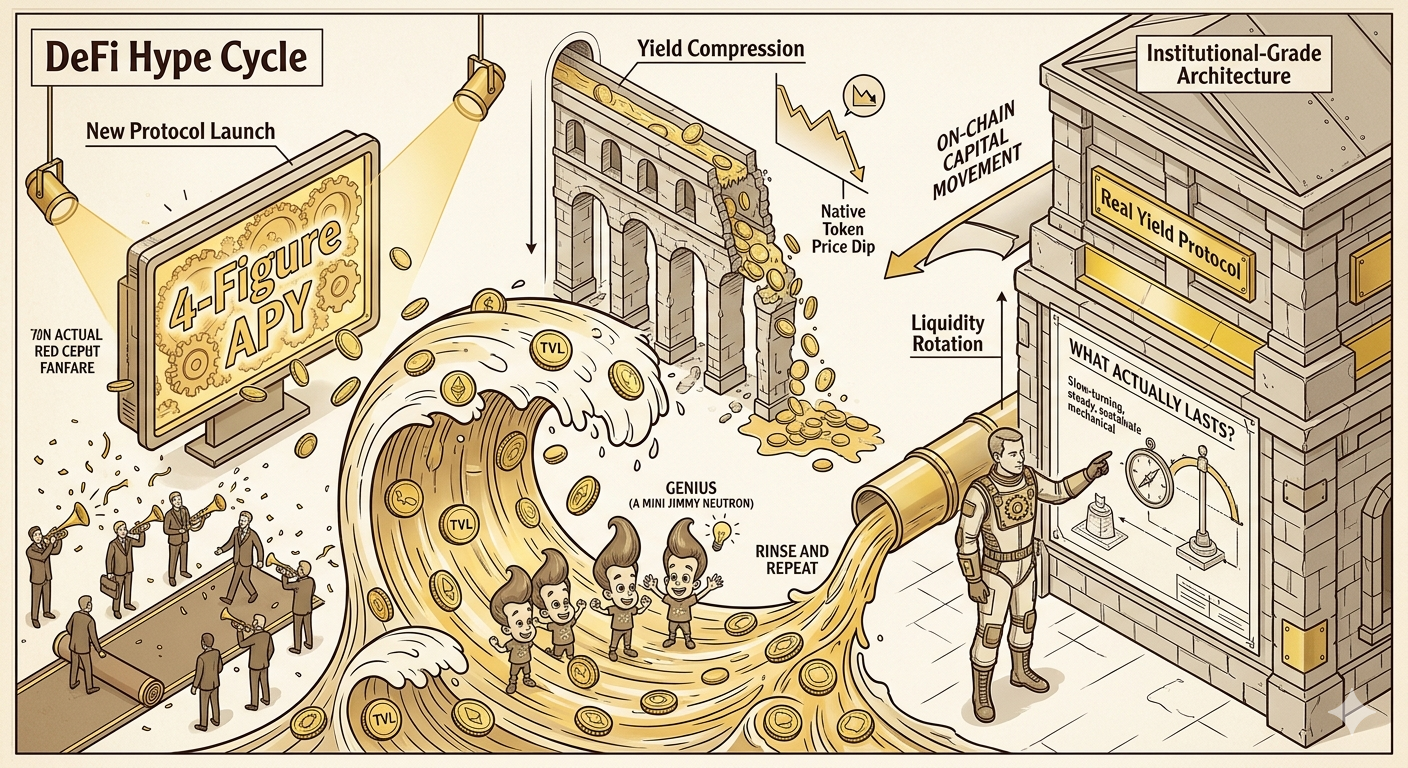
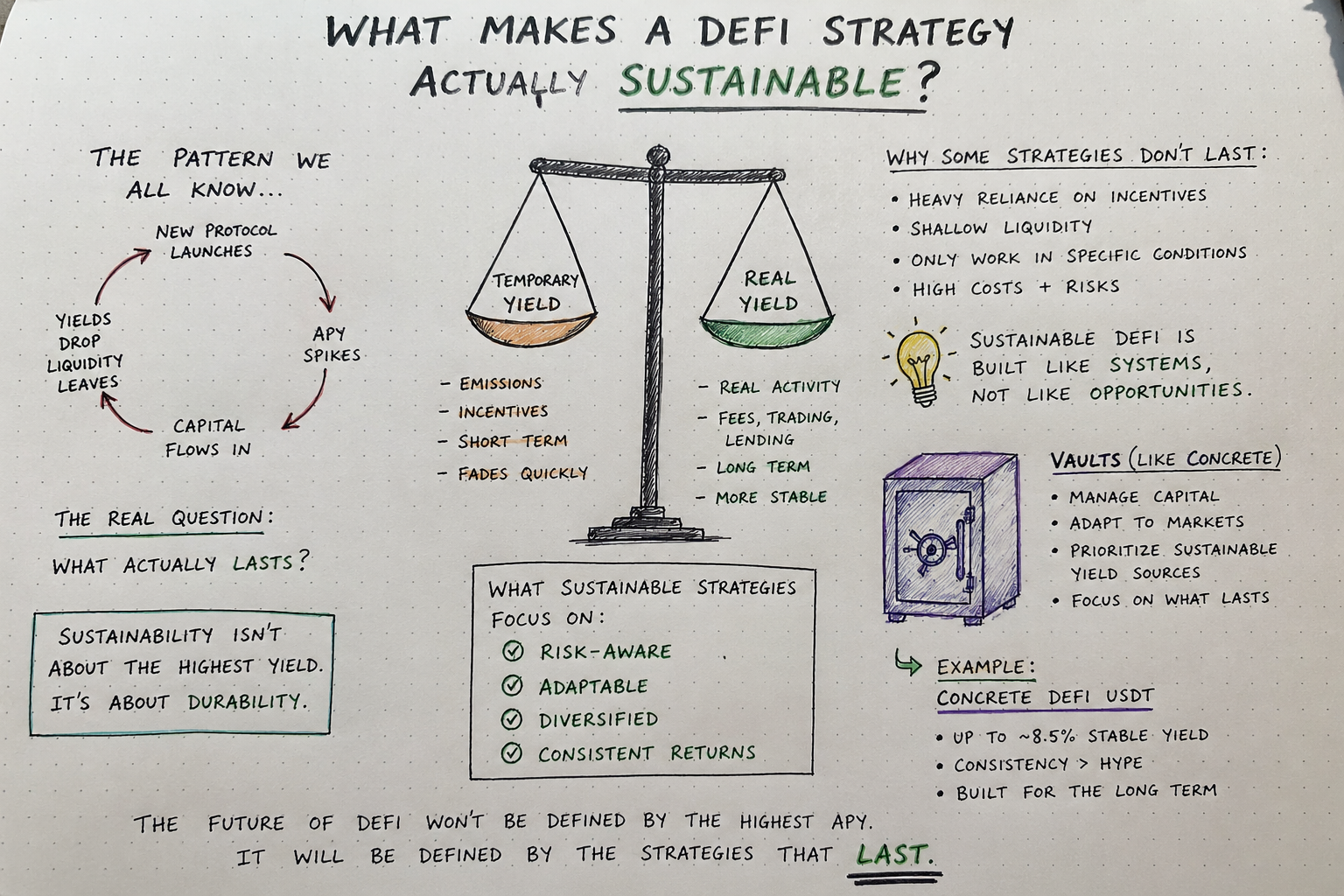
DeFi has a pattern — and if you’ve been around long enough, you’ve seen it repeat more times than you can count.
A new protocol launches.
APYs look irresistible.
Capital floods in almost instantly.
For a brief moment, it feels like easy money.
Then the shift begins.
Yields compress. Rewards get diluted. Liquidity starts to drift elsewhere. And just like that, the “opportunity” that once looked unbeatable becomes just another forgotten pool.
The cycle repeats. Again. And again.
So maybe the real question isn’t what yields the most right now — but something far more important:
Why do most DeFi strategies fade so quickly, and what actually lasts?
The Problem With Chasing Yield
At its core, DeFi has been driven by incentives.
Protocols bootstrap growth by offering high token emissions. These rewards attract liquidity, which creates the illusion of strong returns. But once incentives slow down — or once too much capital piles in — the system naturally rebalances.
And when it does, the yield disappears.
This doesn’t mean DeFi is broken. It just means most strategies were never designed to last.
They were designed to attract attention.
Defining What “Sustainable” Really Means
A sustainable DeFi strategy isn’t necessarily the one with the highest APY.
It’s the one that holds up over time.
That means:
- Returns that are consistent, not just explosive
- Minimal reliance on temporary incentives
- The ability to perform across both bull and bear markets
Sustainability is about durability — not hype.
It’s the difference between something that performs for a week… and something that survives an entire market cycle.
Real Yield vs Temporary Yield
Not all yield is created equal.
Some returns come from real economic activity — trading fees, lending demand, arbitrage inefficiencies. These are tied to actual usage of the protocol.
Others come from emissions — token rewards distributed to attract liquidity.
The difference matters.
Emission-driven yield tends to decline because it’s inflationary by nature. As more tokens are distributed, their value often decreases, and the APY that once looked attractive quickly erodes.
Real yield, on the other hand, is grounded in activity. As long as users continue to trade, borrow, or interact with the system, value continues to flow.
That’s what makes it more stable — and more sustainable.
Liquidity, Market Conditions, and Adaptability
Even strong strategies don’t exist in a vacuum.
Their performance depends heavily on the environment around them.
- Liquidity depth determines how efficiently capital can move
- User activity drives fee generation and demand
- Market volatility can either create or destroy opportunities
- Underlying demand shapes whether a strategy remains relevant
Some strategies only thrive in specific conditions — like high volatility or bull markets.
Others are designed to adapt.
And in the long run, adaptability is what separates temporary opportunities from durable systems.
The Hidden Layer: Risk and Cost
This is where things get more real — and often overlooked.
A strategy might look great on paper, but once you factor in:
- Execution costs
- Slippage
- Rebalancing frequency
- Changing correlations between assets
…the actual returns can look very different.
This is why risk-adjusted yield matters more than headline APY.
Because what you keep is more important than what you’re promised.
Designing for Sustainability
Sustainable DeFi strategies aren’t built around a single opportunity.
They’re built as systems.
That often includes:
- Diversifying across multiple yield sources
- Continuously monitoring performance
- Adjusting allocations as conditions change
- Focusing on net returns after costs and risks
This is where DeFi starts to mature — moving away from isolated bets and toward structured, managed approaches.
Where Vaults Come In
This is exactly the role DeFi vaults are beginning to play.
Instead of requiring users to chase yields manually, vaults are designed to:
- Allocate capital across strategies
- Optimize for sustainable yield
- Adapt to shifting market conditions
- Reduce reliance on short-term incentives
Concrete vaults are built around this idea.
They don’t aim to capture the highest yield in a single moment — they aim to deliver consistent, durable returns over time.
That shift matters.
Because it aligns DeFi more closely with how long-term capital actually thinks.
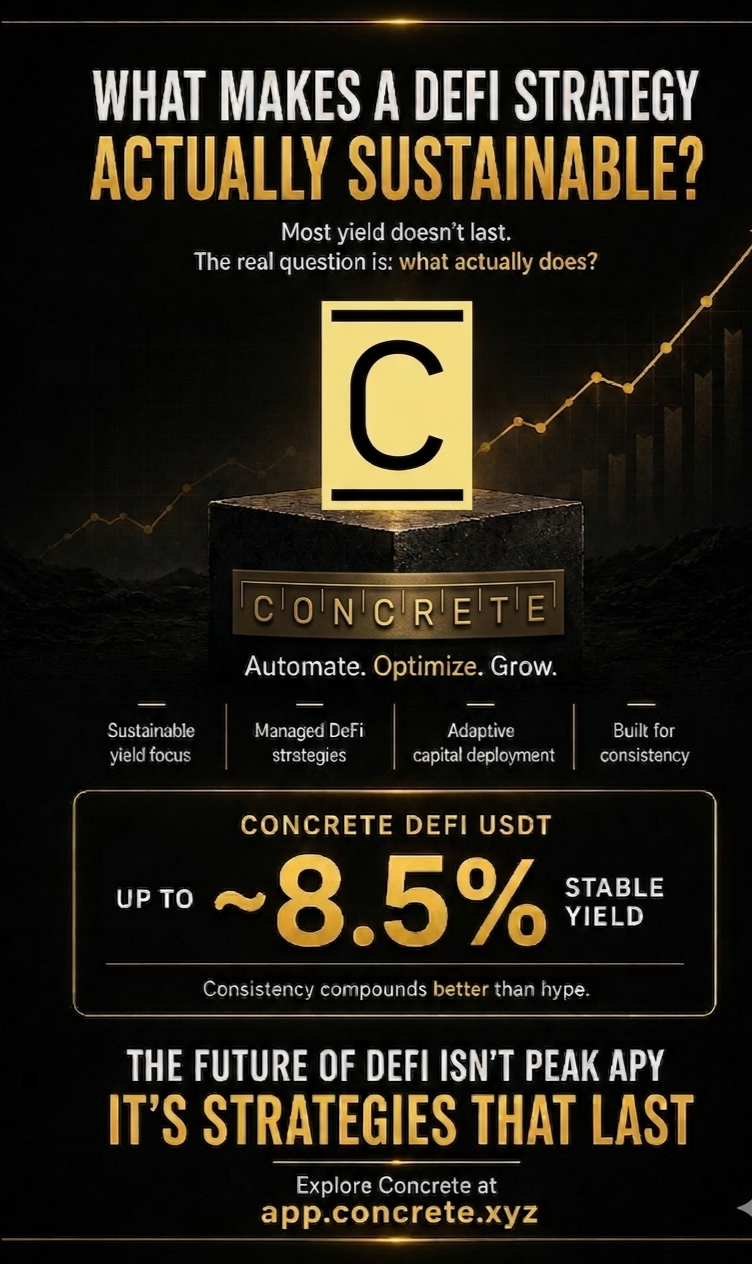
A Practical Example: Concrete DeFi USDT
Take Concrete DeFi USDT as an example.
With yields of up to ~8.5%, it might not compete with the most aggressive opportunities in the market at any given moment.
But that’s the point.
It’s designed for stability.
And over time, stable returns often outperform volatile ones — especially when those high yields can’t be sustained.
Consistency attracts a different kind of capital.
Long-term capital.
Institutional capital.
The kind that doesn’t rotate every week — but compounds over time.
The Bigger Shift in DeFi
We’re starting to see a transition.
DeFi is evolving from:
- Short-term yield chasing
- Incentive-driven growth
- Fragmented opportunities
…toward:
- Sustainable yield
- Risk-adjusted strategies
- Managed DeFi systems
Infrastructure is beginning to matter more than incentives.
And the strategies that last will be the ones built on real activity, thoughtful design, and adaptability.
Because in the end, DeFi won’t be defined by the highest APY.
It will be defined by what survives.
Explore Concrete at: https://app.concrete.xyz/earn