DeFi has never lacked yield.
--
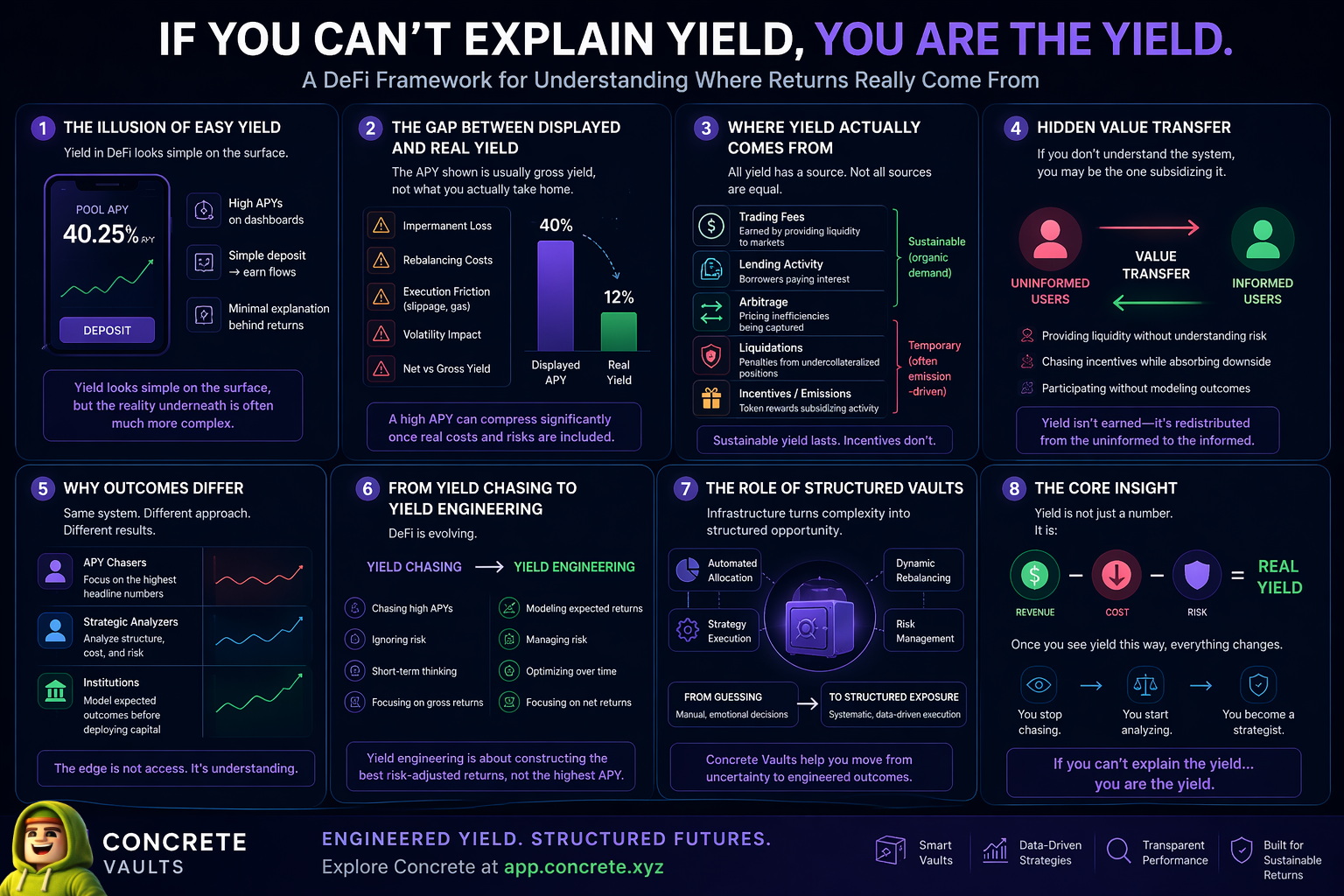
Every week, new strategies emerge promising double-digit APYs. Capital flows in quickly, attracted by the numbers. But just as quickly, yields compress, liquidity rotates, and what looked like an opportunity fades away.
We’ve all seen this cycle repeat.
The real question isn’t which strategy offers the highest yield today — it’s which ones can survive over time.
A sustainable DeFi strategy is not defined by peak performance. It’s defined by consistency. It should generate returns across different market conditions, not rely entirely on incentives, and remain viable even when attention shifts elsewhere.
This brings us to a key distinction: real yield versus temporary yield.
Temporary yield often comes from emissions. Token incentives drive early adoption, but they rarely last. As rewards decrease, so does participation. On the other hand, real yield is generated by actual economic activity — trading, lending, arbitrage. These sources tend to be more stable because they are tied to demand, not distribution.
Not all yield is created equal.
Sustainability also depends on market structure. Liquidity depth, user activity, and volatility all influence how a strategy performs. Some setups only work in specific conditions. Others adapt.
Then there are hidden factors: execution costs, slippage, rebalancing, changing correlations. A strategy might look strong on paper, but once these are considered, performance can degrade significantly.
This is where better design comes in.
Sustainable DeFi strategies focus on diversification, continuous monitoring, and adaptation. Instead of chasing headline APY, they prioritize net returns and long-term viability. Over time, DeFi begins to resemble a system rather than a collection of isolated opportunities.
This is the idea behind managed DeFi and vault-based approaches.
Concrete vaults aim to optimize onchain capital deployment by focusing on sustainable yield sources, dynamically adjusting allocations, and reducing reliance on short-term incentives. The goal is not to maximize spikes — but to maintain durability.
A practical example is Concrete DeFi UST, offering up to ~8.5% stable yield. While this may seem less exciting than volatile opportunities, consistency often outperforms over longer horizons.
Stable, risk-adjusted yield attracts long-term capital.
And that’s where DeFi is heading.
The space is evolving from short-term yield chasing toward structured, institutional DeFi strategies. In the long run, infrastructure will outlast incentives, and sustainable yield will matter more than peak returns.
The future of DeFi won’t be defined by the highest APY.
It will be defined by the strategies that last.
Explore Concrete at app.concrete.xyz