DeFi Engineers Trust
--
DeFi was built on this premise:
"Don’t trust people but trust code."
The idea is cool cause imagine not needing intermediaries, no counterparty risk and no need to trust anyone. Code is law. You can’t cheat anyone.
But this system has evolved, and trust has shifted.
Where Trust Actually Lives right now
Look under the hood of any decentralized protocol. You’ll find trust everywhere:
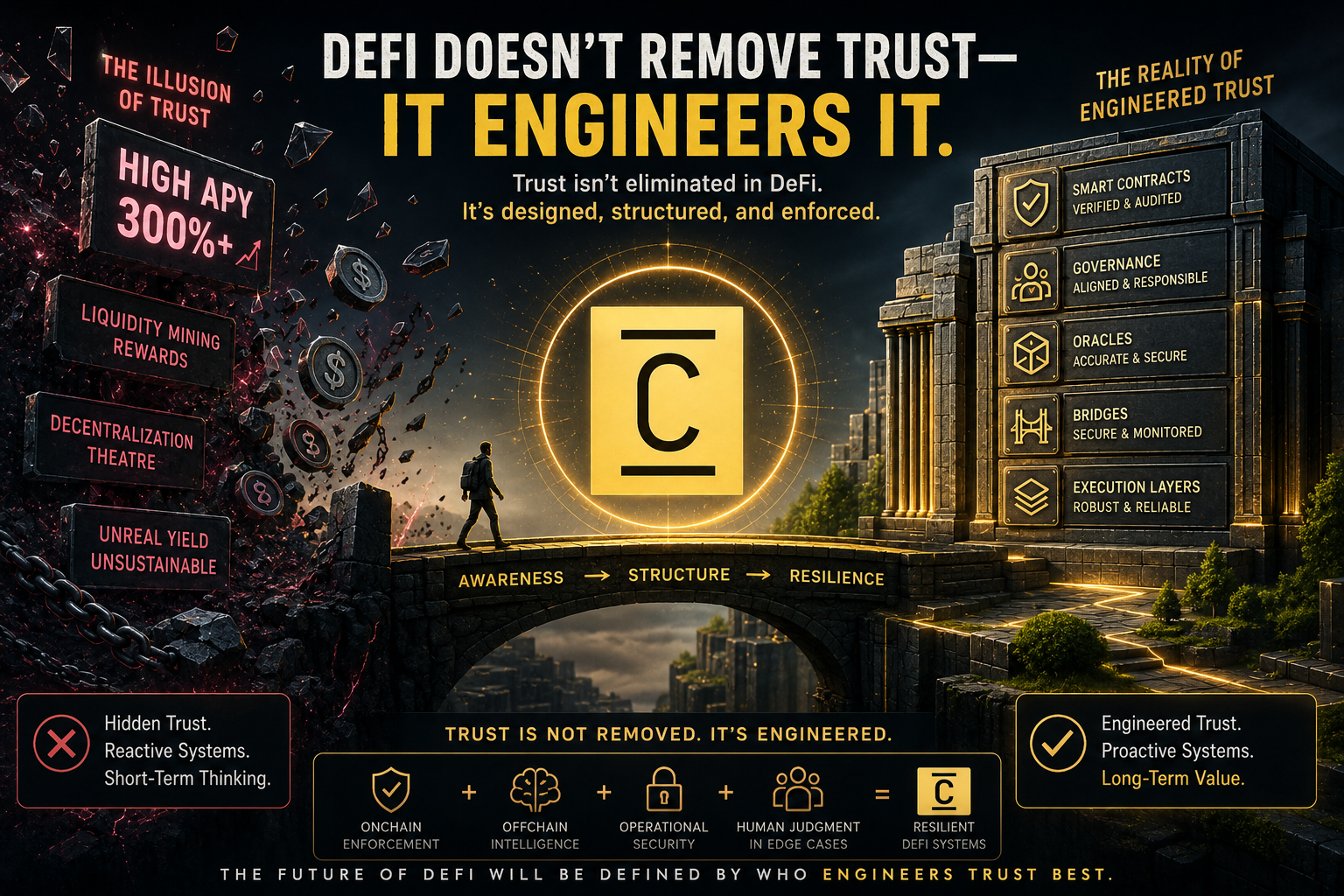
· Smart contract assumptions – You trust that the code has no fatal bugs
· Governance systems – You trust that a majority won’t collude against you
· Oracles – You trust that price feeds are accurate and tamper-proof
· Bridges – You trust that wrapped assets remain backed
· Execution layers – You trust that validators will include your transaction
These layers abstract away trust, but they don’t eliminate it.
There’s a problem with "Decentralization Theatre"
Many systems appear decentralized but aren’t necessarily resilient. A multisig with five signers looks secure until three keys get compromised. A DAO with 0.5% voter turnout claims community governance. Timelocks delay risk but don’t necessarily prevent it.
The illusion of decentralization can be more dangerous than explicit centralization. At least with the latter, you know who's in charge.
Engineered Trust
This is a better model where trust isn’t removed but it’s designed. Engineered trust means:
· Clear roles and responsibilities – Everyone knows who does what
· Defined permissions – No one can act outside their mandate
· Enforced constraints – Rules are codified, not just suggested
· Systems that respond to failure – Not just prevent it
This is how mature financial systems operate. It’s also how Concrete vaults operate.
Operational Security Over Ideology
Real systems need monitoring, rapid response mechanisms, human judgment for edge cases, and layered security. Code alone cannot handle every scenario, especially the ones no one anticipated.
Operational security acknowledges that trust is inevitable and structures it deliberately.
You’re wondering what makes Concrete different and how they engineer Trust
Concrete takes a fundamentally different approach where:
· Trust is explicit and not hidden – You know who the Allocator is, what the Strategy Manager approves, and how the Hook Manager enforces risk
· Systems designed for response – Not just prevention. If something breaks, there’s a path to fix it
· On-chain enforcement + off-chain intelligence – The best of both worlds
· Role-based architecture – Separation of powers, coded into the vault
· Controlled execution environments with no single point of failure
Concrere recognizes that DeFi infrastructure must be resilient, not just ideological.
There’s a Bigger Shift
That shift involves DeFi moving beyond "trustless" narratives.
Infrastructure judged by how it behaves under stress and not by how it markets itself.
The future of DeFi will be with those who engineers trust best and Concrete is one step ahead.
Explore how Concrete engineers trust at concrete.xyz.