DeFi Doesn’t Remove Trust — It Engineers It
--
The Myth of the “Trustless” System
In the early days of crypto, the rallying cry was simple: “Don’t trust, verify.” The promise was a world where trustless systems replaced human intermediaries and “Code is Law” reigned supreme. It’s a compelling narrative, but it’s also a myth.
In any financial system on-chain or off trust is the fundamental substrate. The question isn’t whether trust exists; it’s whether that trust is hidden behind an illusion of decentralization or engineered deliberately to be resilient.
2. Where Trust Actually Lives
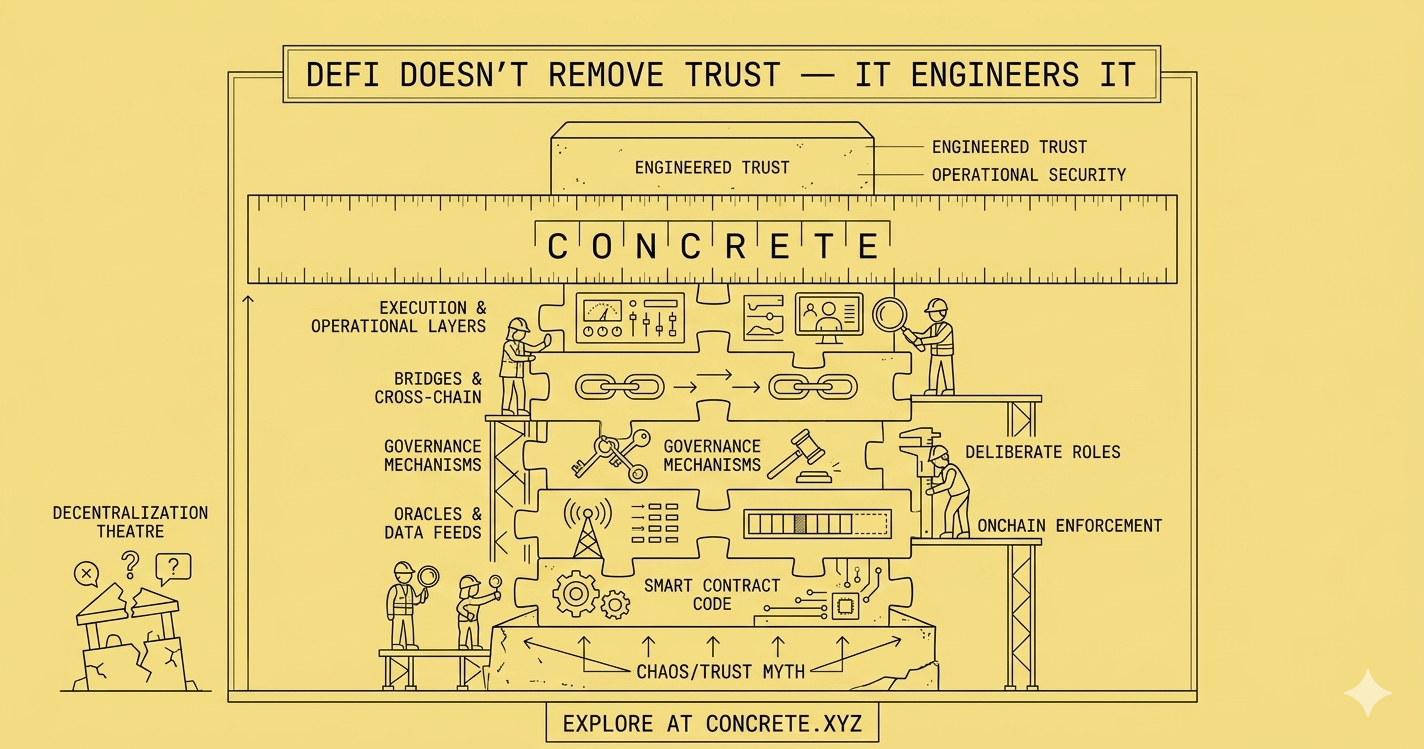
If you think your favorite protocol is “trustless,” look closer. When you deposit into a vault, you are placing trust in:
- Smart Contract Assumptions: You trust that the code is free of logic flaws.
- Oracle Dependencies: You trust that external data feeds are accurate and unmanipulated.
- Bridge Security: You trust that the assets moving between chains are properly backed.
Trust hasn’t disappeared; it has simply been abstracted into the DeFi infrastructure.
3. The Problem with “Decentralization Theatre”
Many protocols engage in what we call “decentralization theatre” — systems that look decentralized on paper but lack actual safety.
- Multisigs as Proxies: A “decentralized” DAO might still rely on a small group of signers who can’t react fast enough during a crisis.
- Passive Governance: Systems with low participation often become vulnerable to capture, making their “security” a facade rather than a feature.
4. Enter Engineered Trust
The next phase of institutional DeFi requires a move away from accidental trust toward engineered trust. This means designing systems with:
- Clear Roles: Defining exactly who can do what (and when).
- Enforced Constraints: Using on-chain enforcement to ensure the system cannot behave outside its safety parameters.
- Active Response: Creating mechanisms that can detect and react to failure in real-time.
5. Operational Security is Not Optional
Code alone cannot handle every scenario, especially in the volatile world of cross-chain liquidity. Real resilience requires operational security — a layer of human judgment, active monitoring, and rapid response mechanisms that protect capital when the “perfect” code meets the “imperfect” market.
6. How Concrete Engineers Trust
Concrete Protocol was built on the realization that trust must be explicit, not hidden. Rather than relying on decentralization theatre, Concrete vaults utilize a sophisticated role-based architecture:
- Separation of Duties: Responsibilities are split between Vault Managers, Strategy Managers, and Withdrawal Managers, ensuring no single entity has unilateral control.
- Institutional Standards: High-impact changes are guarded by multi-party approvals and time-locks.
- Automated Accounting: A three-party verification mechanism ensures that daily NAV (Net Asset Value) updates are accurate and auditable on-chain.
By prioritizing transparency and rigorous audits (with firms like Halborn and Zellic), Concrete creates a controlled execution environment that institutions can actually rely on.
7. The Bigger Shift: Resilience Over Ideology
The future of finance isn’t defined by who claims to remove trust. It will be defined by who engineers it best. As the industry matures, we are moving beyond “trustless” slogans and toward systems that are judged by how they behave under stress.
Resilience isn’t an accident; it’s an engineering choice.
Explore the future of engineered trust at https://concrete.xyz/.