DeFi Doesn’t Remove Trust — It Engineers It
 Kris0nFire4 min read·Just now
--
The biggest lie in DeFi is simple:
“This system is trustless.”
It sounds powerful.
It’s also wrong.
The First Illusion
The first time you use DeFi, it feels like magic.
No banks.
No approvals.
No questions.
Just connect a wallet and move value globally in seconds.
It feels like trust has been removed from the system.
But that illusion doesn’t last long.
Because once you zoom in, the truth becomes obvious:
You are still trusting everything.
You just don’t see it anymore.
The Myth of “Trustless” Systems
DeFi was built on a slogan:
“Don’t trust people. Trust code.”
This narrative scaled the entire industry.
But it also created the biggest misunderstanding in crypto:
There is no trustless system.
There are only systems where trust is:
- visible
- hidden
- or dangerously ignored
The question was never “can we remove trust?”
The real question is:
“Who controls trust, and how?”
Where Trust Actually Lives (Even If You Ignore It)
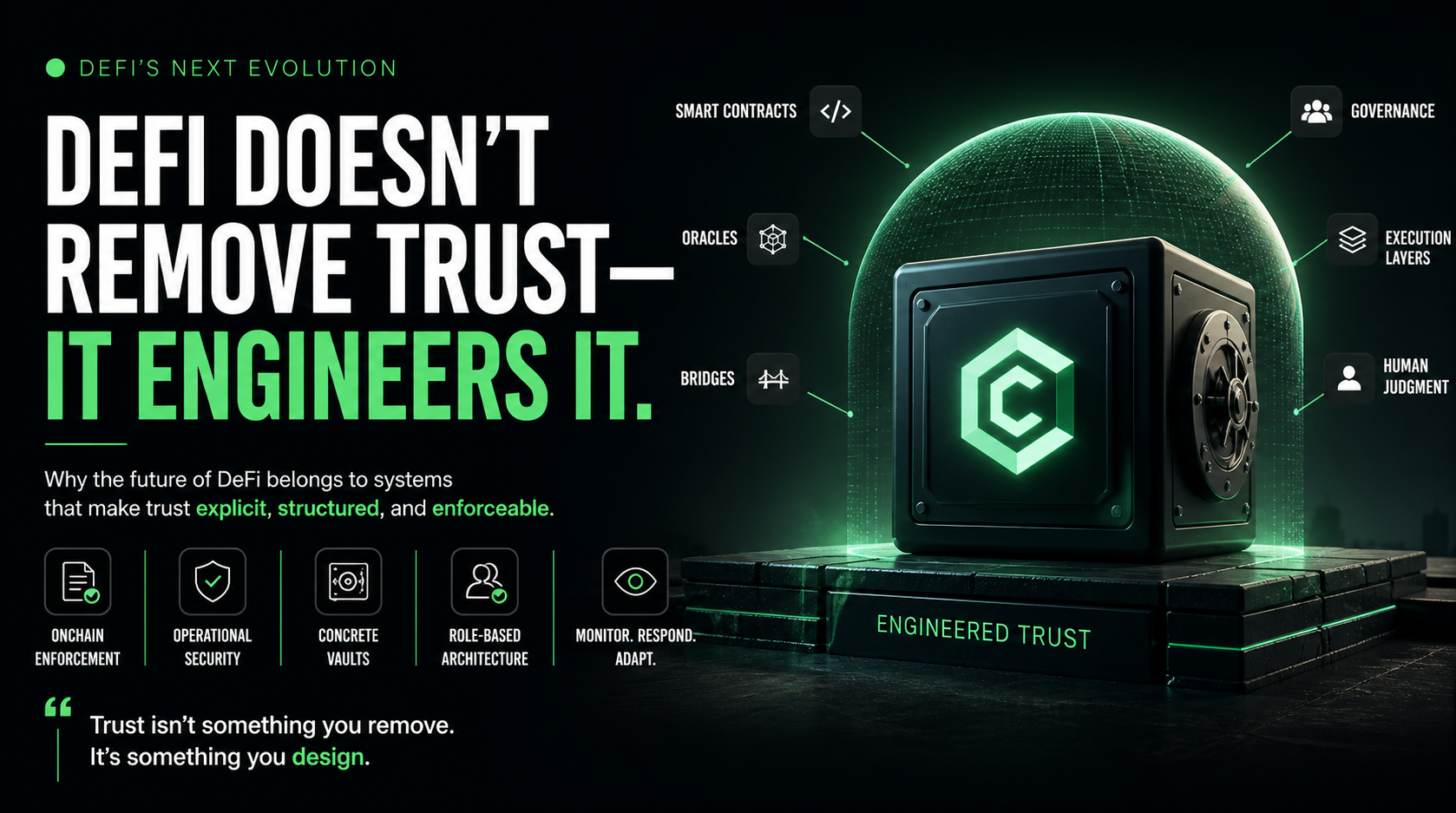
Every DeFi system depends on trust layers:
- smart contracts behaving exactly as intended
- governance not changing rules at the worst time
- oracles not lying under pressure
- bridges not becoming systemic failure points
- execution layers not breaking under stress
This is not theory.
This is architecture.
And when it fails — it doesn’t fail quietly.
It fails in billions.
Invisible Trust Is the Most Dangerous Kind
The worst systems in DeFi don’t say “trust us.”
They say:
“You don’t need to trust anything.”
That is the trap.
Because invisible trust can’t be evaluated.
It’s just assumed.
And assumptions are where systems break first.
We’ve already seen it:
- bridges drained in minutes
- governance captured in hours
- protocols collapsing exactly when needed most
Not because trust didn’t exist.
But because it was never defined.
Decentralization Theatre
A lot of DeFi isn’t decentralized.
It just looks decentralized.
We’ve built systems where:
- control is distributed on paper, centralized in practice
- DAOs exist, but participation is symbolic
- multisigs replace accountability
- timelocks delay failure instead of preventing it
This is not decentralization.
This is decentralization theatre.
And theatre does not survive stress.
Only systems do.
The Real Upgrade: Engineered Trust
The next evolution of DeFi is not “less trust.”
It is designed trust.
Engineered trust means:
- explicit permissions
- defined execution boundaries
- enforced constraints
- clear accountability at every layer
Not “the system is trustless.”
But:
“You know exactly what you are trusting — and why it won’t break.”
This is how real financial infrastructure works.
And it is where DeFi is being forced to go.
Code Is Not Enough
Code is deterministic.
Markets are not.
Attackers are not.
Reality is not.
Code will execute perfectly — even when conditions are wrong.
That gap is where systems fail.
So DeFi security cannot end at smart contracts.
It must include:
- monitoring that sees failure before users do
- response systems that act under pressure
- layered security assumptions
- controlled execution environments
- and human intervention when reality breaks the model
Not because humans are better than code.
But because systems are bigger than code alone.
How Concrete Changes the Model
Explore Concrete at 👉concrete.xyz👈
Concrete is built on a simple idea:
Stop pretending trust doesn’t exist. Start engineering it properly.
Instead of hiding assumptions, Concrete makes them explicit — and enforceable.
At the center are Concrete vaults:
Execution environments where every action is governed by strict, defined logic.
This enables:
- role-based architecture → no ambiguous authority
- onchain enforcement → rules cannot be bypassed
- controlled execution environments → actions happen inside defined risk boundaries
- operational security by design → systems respond, not just prevent
But the real shift is this:
onchain enforcement + offchain intelligence working together
Not ideology.
Not purity.
Functioning systems under real-world stress.
The Shift DeFi Can’t Avoid
DeFi is moving past its teenage ideology phase.
“Trustless” is not a destination.
It was a marketing phase.
The next phase is harder:
Systems will be judged by:
- how clearly they define trust
- how strictly they enforce it
- how they behave under stress
- and how they fail when failure is unavoidable
Because failure is not optional. It is guaranteed.
The only question is:
Does the system understand itself well enough to survive it?
Final Truth
If you can’t point to where trust lives in a system,you are not in a trustless system.
You are in a system where trust is unmanaged.
And unmanaged trust is just another word for risk.
The future of DeFi will not belong to systems that remove trust.
It will belong to systems that engineer it better than everyone else.