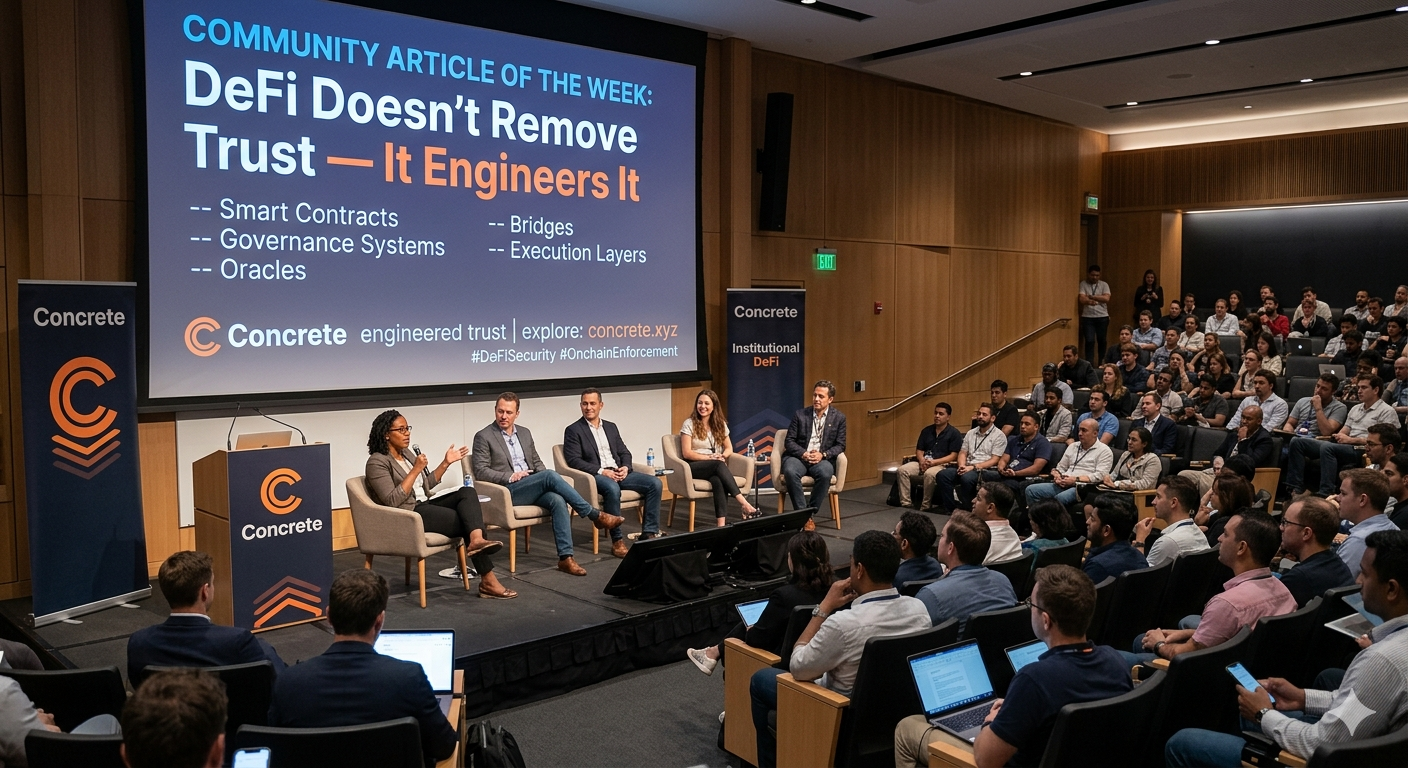
DeFi Doesn’t Remove Trust It Engineers It
--
For years, the rallying cry of the decentralized finance movement has been a simple, almost religious mantra: “Don’t trust, verify.” We were told that we were entering an era of “trustless” systems where the fallible, greedy, or simply incompetent middleman would be replaced by the cold, impartial logic of a machine. “Code is law” became the slogan of a revolution, promising a world where your financial security didn’t depend on a banker’s handshake or a regulator’s oversight, but on the immutable execution of a smart contract.
It was a beautiful vision. For a while, it even felt like it was working. But as the industry has matured, weathered multi-billion dollar exploits, and attempted to scale toward institutional adoption, a sobering reality has set in.
The truth is that DeFi doesn’t remove trust. It engineers it.
The Myth of the Trustless System
The phrase “trustless” is one of the most successful, yet misleading, marketing terms in the history of technology. It suggests a vacuum where trust used to be. But in any complex system — especially one involving the movement of billions of dollars — trust is like energy: it cannot be destroyed, only transformed or relocated.
When we say a protocol is trustless, what we really mean is that we have shifted our trust away from traditional institutions (like banks) and redistributed it across a new, highly technical stack. You are no longer trusting a CEO, but you are absolutely trusting:
- The Developers: That the smart contract logic is sound and free of “backdoors” or catastrophic bugs.
- The Oracles: That the data feeds providing price information are accurate and haven’t been manipulated.
- The Governance: That a small group of whale voters won’t change the rules of the game mid-stream.
- The Bridges: That the infrastructure moving your assets between chains is actually collateralized and secure.
Trust hasn’t vanished; it has been abstracted. The danger arises when we pretend this trust doesn’t exist, leading to what many now call “Decentralization Theatre.”
The Hidden Layers: Where Trust Actually Lives
To understand how to build better systems, we have to stop closing our eyes to where the dependencies lie. In the current DeFi landscape, trust is often buried under layers of complexity.
Take Smart Contract Assumptions, for example. We treat code as a static truth, but code is written by humans. Every time you deposit into a “trustless” vault, you are placing immense trust in the audit firm’s thoroughness and the developers’ ability to foresee every possible edge case.
Then there are Oracle Dependencies. A lending protocol is only as “trustless” as the price feed it relies on. If an oracle is manipulated, the “law” of the code will happily liquidate an honest user based on a lie. Finally, consider Governance. Many DAOs operate under the guise of decentralization, but in reality, a handful of multisig signers or a few large token holders hold the keys to the kingdom.
When we ignore these realities, we create brittle systems. We build “castles in the sky” that look decentralized on paper but collapse the moment a real-world crisis demands a rapid, coordinated response.
The Problem with Decentralization Theatre
Decentralization is a means to an end — resilience and censorship resistance — but it is not a magic wand for safety. In fact, “Decentralization Theatre” can often make a system less secure.
We see this in protocols that lack clear emergency response mechanisms because “manual intervention isn’t decentralized.” We see it in DAOs with such low participation that a malicious actor can easily capture the vote. Or in timelocks that give the appearance of security but actually just delay the inevitable, leaving users trapped in a slow-motion train wreck because there is no empowered role to hit the brakes.
In these cases, the appearance of decentralization acts as a mask for operational fragility. Mature financial systems require more than just “unstoppable” code; they require operational security that can survive the chaos of a live market.
Moving Toward Engineered Trust
If trust is unavoidable, the goal of the next generation of DeFi infrastructure shouldn’t be to remove it, but to engineer it deliberately.
Engineered trust is the transition from “hope-based” security to “structure-based” security. It means moving away from the illusion that code can handle every possible reality and moving toward systems that have:
- Explicit Roles and Permissions: Knowing exactly who can do what, and under what constraints.
- Enforced Constraints: Using onchain enforcement to ensure that even if a human makes a mistake (or a malicious move), the system’s architecture prevents a total collapse.
- Rapid Response Mechanisms: Acknowledging that “code is law” doesn’t help if the law takes three days to vote on an emergency fix while a drain is in progress.
This is how Institutional DeFi will eventually scale. Institutions don’t need “trustless” systems; they need systems where the risks are quantified, the roles are clear, and the enforcement is guaranteed by the tech stack.
How Concrete Changes the Game
This philosophy — that trust must be engineered rather than ignored — is the foundation of Concrete.
Concrete rejects Decentralization Theatre in favor of rigorous operational security. Instead of hiding trust behind complex jargon, Concrete makes it explicit and structured. The architecture is built on the reality that real-world financial operations require a blend of onchain enforcement and off-chain intelligence.
- Beyond Prevention: Most DeFi protocols focus solely on prevention (audits and static code). Concrete focuses on response. By utilizing controlled execution environments, the system can react to market volatility or anomalies in real-time.
- Role-Based Architecture: Concrete uses a sophisticated permissioning system. It doesn’t rely on a single “admin” key, nor does it hide behind a slow, ineffective DAO vote during a crisis. It defines clear roles that allow for safe, automated management of Concrete vaults.
- Intelligent Infrastructure: By combining off-chain monitoring with onchain triggers, Concrete ensures that the infrastructure behaves predictably under stress.
At its core, Concrete is built for the “Day 2” of DeFi — the period after the deposit is made, when the market gets volatile and the code needs to perform. It is designed to be resilient, not just “decentralized” in name.
The Bigger Shift: Resilience Over Ideology
The industry is reaching a turning point. The initial “cypherpunk” era of DeFi was necessary to prove that we could build financial tools outside of the legacy system. But the next era — the era of mass adoption and institutional integration — will be defined by a different set of values.
We are moving beyond the simplistic “trustless” narratives. The future of DeFi belongs to the builders who acknowledge that trust is a component of every system and choose to engineer it with precision. Resilience matters more than ideology. A system that is “100% decentralized” but loses all its TVL in a flash loan attack is a failure. A system that uses engineered trust to protect its users and maintain uptime under pressure is a success.
The infrastructure of tomorrow won’t be judged by how many “trustless” buzzwords it can fit into a whitepaper. It will be judged by how it behaves when the lights go out and the market crashes.
The future isn’t trustless. The future is engineered.
To learn more about how we are building the next generation of DeFi infrastructure, explore Concrete at https://concrete.xyz/.