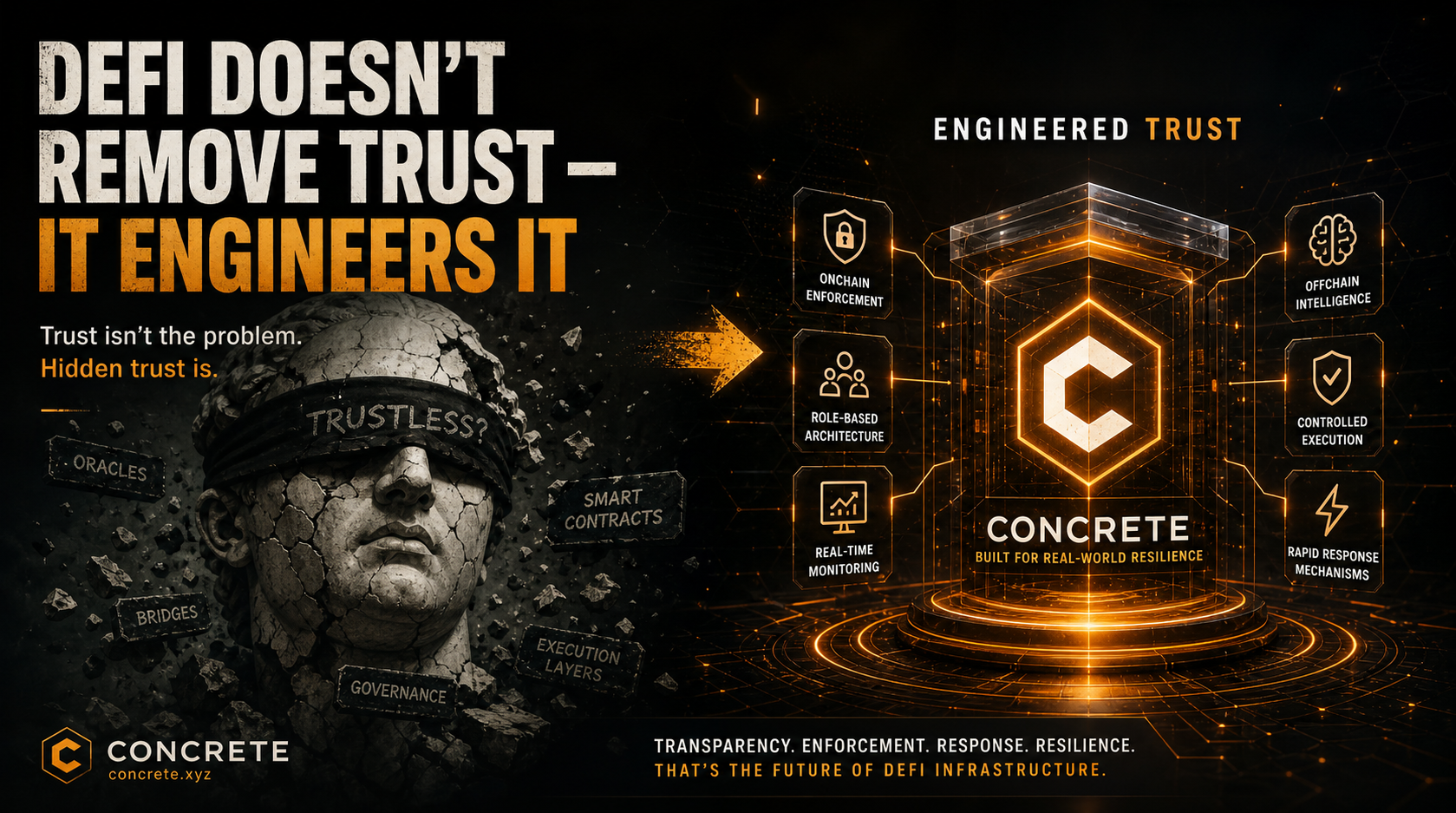
DeFi Doesn’t Remove Trust — It Engineers It
--
DeFi didn’t remove trust.
It just made it harder to see.
For years, the industry sold a clean, powerful idea:
“Don’t trust people. Trust code.”
It sounded like a breakthrough.
No banks.
No intermediaries.
No human risk.
Just math.
But then reality hit.
Billions lost in exploits.
Bridges collapsing overnight.
Governance manipulated in plain sight.
And suddenly, the narrative started to crack.
Because if DeFi was truly trustless…
Why does failure still look so human?
The Lie That Worked
“Trustless systems.”
It’s one of the most successful narratives in crypto history.
Not because it’s true — but because it’s comfortable.
It gives you the feeling that risk has been removed.
That responsibility has been outsourced to code.
That nothing unexpected can happen.
But that’s not how systems work.
Not in finance.
Not anywhere.
Every system depends on trust.
The only difference is whether you can see it.
Trust Never Left — It Went Underground
Here’s what actually happens when you use DeFi:
You trust that the smart contract isn’t flawed.
You trust that governance won’t turn against you.
You trust that oracles aren’t being manipulated.
You trust that bridges won’t become attack vectors.
You trust that execution layers won’t exploit your transaction.
That’s not trustless.
That’s trust, fragmented across layers you don’t control.
And the most dangerous kind of trust is the one you don’t realize you’re giving.
Decentralization Theatre Is the Real Risk
This is where things get uncomfortable.
Because a lot of DeFi isn’t built to be resilient.
It’s built to look decentralized.
- Multisigs marketed as security
- DAOs with no real participation
- Timelocks that create delay, not protection
- Systems that freeze when they should respond
This is decentralization as branding.
Not as infrastructure.
And branding doesn’t protect capital.
The Shift: From “Trustless” to Engineered Trust
Here’s the uncomfortable truth:
You don’t remove trust.
You decide where it lives — and how dangerous it is.
The next phase of DeFi isn’t about eliminating trust.
It’s about designing it intentionally.
Engineered trust means:
- Power is defined — not implied
- Permissions are enforced — not assumed
- Constraints are real — not theoretical
- Failure is expected — and planned for
This is what mature systems do.
Not because they’re perfect — but because they assume they won’t be.
Code Is Deterministic. Reality Isn’t.
Smart contracts execute perfectly.
Right up until the moment they don’t.
They can’t:
- interpret unexpected behavior
- react to novel attacks
- make decisions under uncertainty
That’s why so many systems fail the same way:
They work flawlessly — until the exact moment resilience matters.
And then they have no idea what to do.
Concrete: What Engineered Trust Actually Looks Like
👉 Explore Concrete at concrete.xyz
Concrete doesn’t pretend trust doesn’t exist.
It treats trust as something that must be designed, exposed, and enforced.
Instead of hiding assumptions, it structures them.
- Explicit roles — no invisible power centers
- Onchain enforcement — rules that actually hold
- Offchain intelligence — the ability to react in real time
- Controlled execution environments — fewer unknowns, tighter boundaries
- Operational security first — because failure is not hypothetical
This is closer to where institutional DeFi is heading.
Not trustless.
Trust-aware.
What Actually Defines the Future
The next generation of DeFi won’t be defined by ideology.
It will be defined by behavior under stress.
Not:
“Is it decentralized?”
But:
- What happens when something breaks?
- Who can act — and how fast?
- What is enforced vs assumed?
- Where does trust actually sit?
Because that’s what determines survival.
Final Thought
DeFi didn’t eliminate trust.
It buried it under complexity, UX, and narratives.
But buried trust doesn’t disappear.
It accumulates risk.
Invisible trust fails silently — until it fails catastrophically.
Engineered trust does something different:
It makes risk visible.
It constrains it.
It prepares for it.
And in the long run, only one of those approaches survives.