DeFi Doesn’t Remove Trust — It Engineers It
--
Most people in DeFi say the same thing:
“It’s trustless.”
That’s the pitch.
That’s the belief.
That’s the illusion.
Because if you look closely, DeFi didn’t remove trust.
It just changed where you place it.
And if you don’t understand where that trust lives, you’re not eliminating risk — you’re mispricing it.
The Myth That Built DeFi
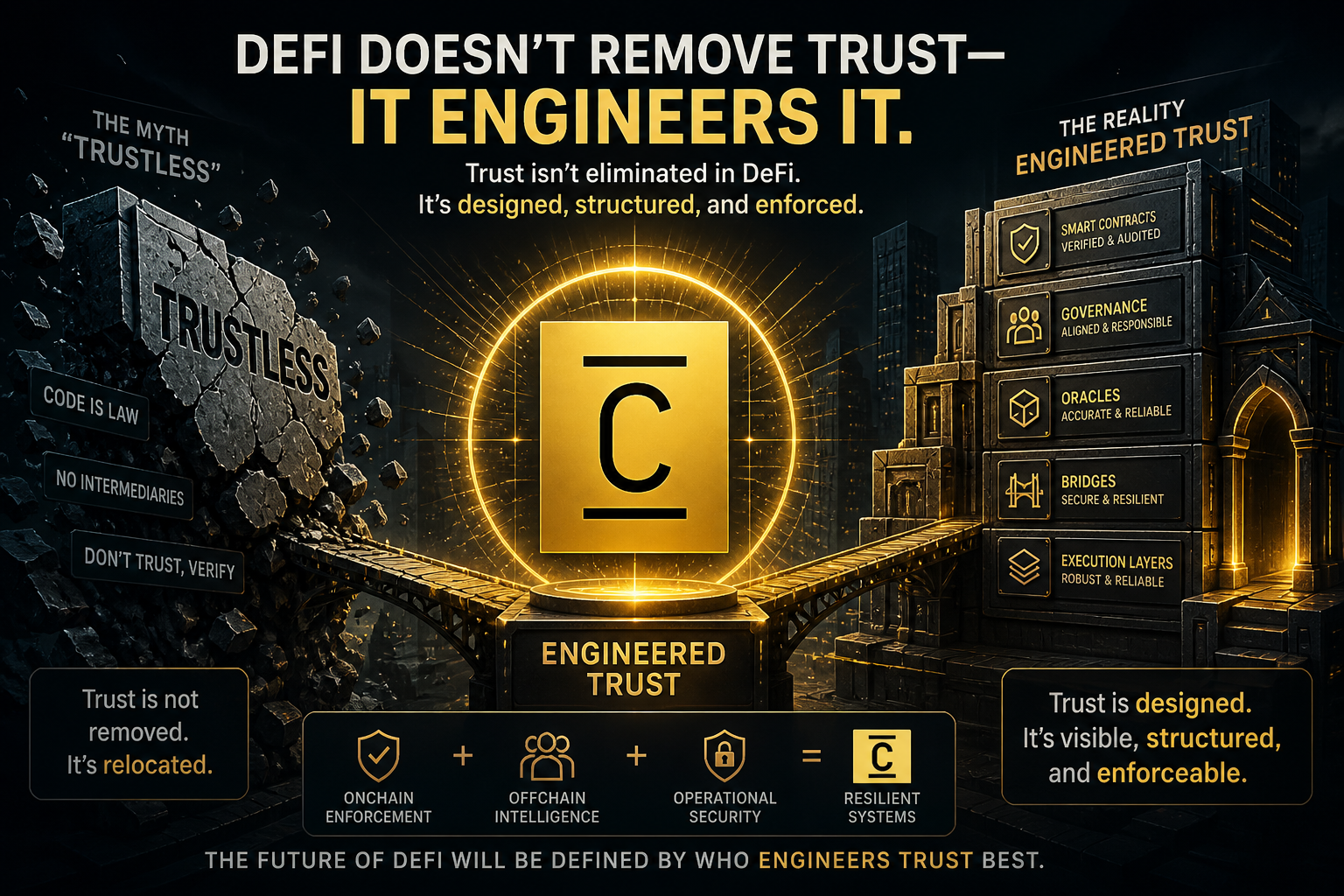
“Code is law.”
“No intermediaries.”
“Don’t trust, verify.”
These ideas shaped the early identity of DeFi. They made it feel fundamentally different from traditional finance.
And to some extent, they were right.
Code replaced some human discretion.
Execution became more transparent.
Access became permissionless.
But none of that removed trust.
It only redistributed it.
> DeFi didn’t eliminate trust — it fragmented it across systems most users don’t fully see.
Where Trust Actually Lives
Every DeFi interaction rests on layers of trust — whether acknowledged or not.
You trust that:
smart contracts behave exactly as written
governance decisions won’t act against you
oracles deliver accurate data
bridges won’t fail under stress
execution layers will process transactions reliably
Each of these is a dependency.
Each dependency is a risk surface.
And each risk surface requires trust.
The system isn’t trustless. It’s trust-distributed.
The Danger of Decentralization Theatre
Here’s where things get uncomfortable.
Some systems look decentralized.
But appearance is not the same as resilience.
A multisig can still concentrate power.
A DAO can exist without meaningful participation.
A timelock can delay failure without preventing it.
These structures often signal safety without guaranteeing it.
> Decentralization is not defined by how a system looks — but by how it behaves under stress.
And that’s where many systems break.
Hidden Trust Is the Real Risk
The most dangerous form of trust is not explicit trust.
It’s hidden trust.
When users believe a system is trustless, they stop asking critical questions.
They stop asking:
Who controls this?
What happens if something breaks?
Who can intervene — and how?
At that point, risk doesn’t disappear.
It becomes invisible.
And invisible risk is the hardest to manage.
From Trustless to Engineered Trust
The next phase of DeFi is not about removing trust.
It’s about engineering it.
Engineered trust means:
roles are clearly defined
permissions are intentionally scoped
constraints are enforced, not assumed
systems are designed to respond, not just operate
This is how mature financial systems function.
They don’t rely on the absence of trust.
They rely on the structure of trust.
Why Operational Security Matters More Than Ideology
Code is powerful, but it is not sufficient.
Markets are dynamic.
Failures are unpredictable.
Edge cases always exist.
A system that cannot respond is a system that will eventually fail.
That’s why operational security matters.
Real systems require:
monitoring
rapid response mechanisms
human judgment in critical moments
layered defenses across infrastructure
Because resilience is not just about preventing failure.
It’s about handling it when it happens.
How Concrete Engineers Trust
This is where Concrete takes a fundamentally different approach.
Instead of hiding trust behind narratives, Concrete makes it explicit.
Trust is not assumed.
It is designed.
Concrete combines:
onchain enforcement
role-based architecture
controlled execution environments
off-chain intelligence for decision-making
This creates systems that are not just decentralized in appearance, but structured in behavior.
The goal is not to eliminate trust.
It is to make it visible, measurable, and enforceable.
The Shift That Defines the Next Phase of DeFi
DeFi is growing up.
The industry is moving away from slogans and toward systems.
From:
“Trustless by design”
To:
“Trust, engineered deliberately.”
Because in real markets, what matters is not what a system claims.
It’s how it performs when things go wrong.
> The future of DeFi won’t be built by those who deny trust exists — but by those who design it correctly.
Explore Concrete
Explore Concrete at:
https://concrete.xyz/