DeFi Doesn’t Remove Trust — It Engineers It
 Jayanta Debnath4 min read·1 hour ago
--
1️⃣ The Myth of “Trustless” Finance:
DeFi was built on a powerful idea:
> “Don’t trust people. Trust code.”
For years, the crypto industry promoted the belief that decentralized systems could eliminate trust entirely. Smart contracts would replace intermediaries, automation would replace institutions, and “code is law” would become the foundation of modern finance.
But as DeFi evolved, reality exposed an important truth:
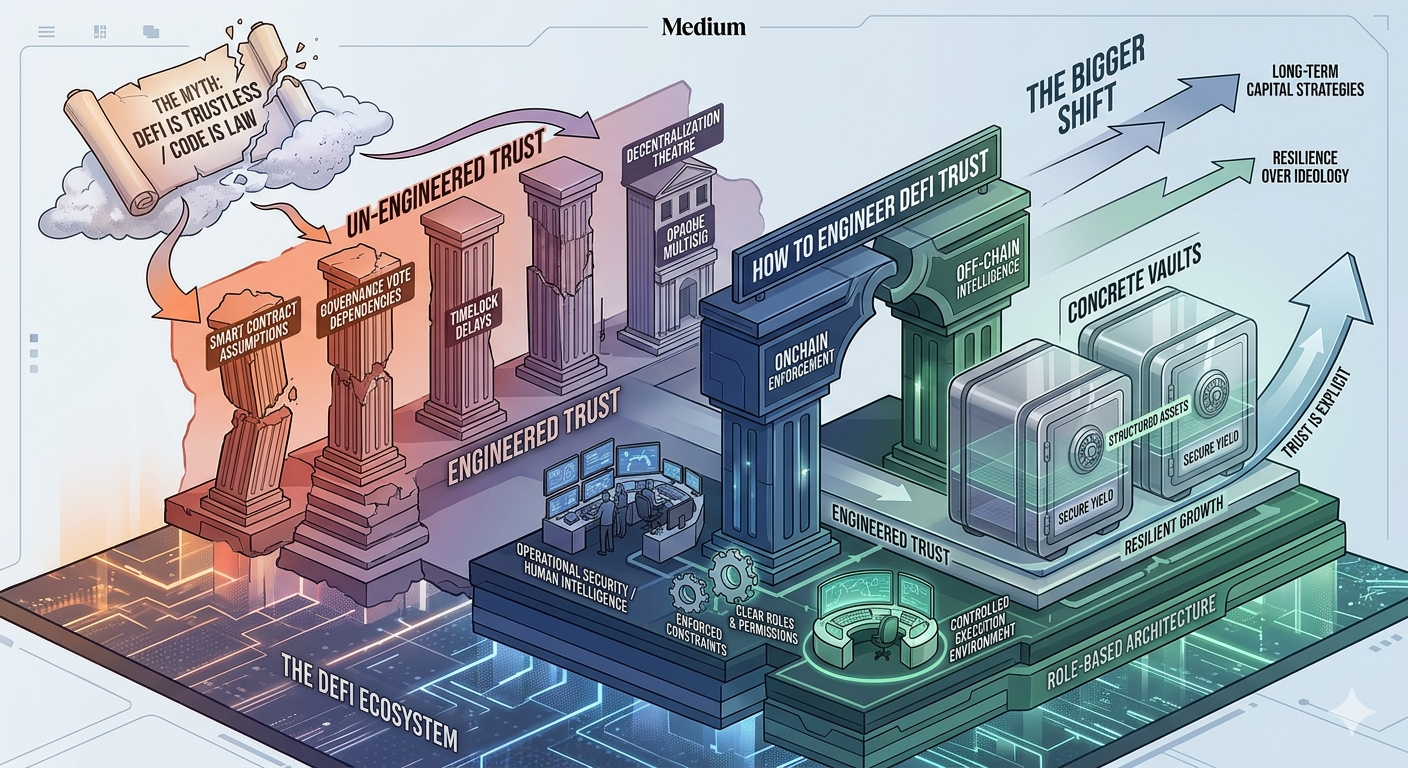
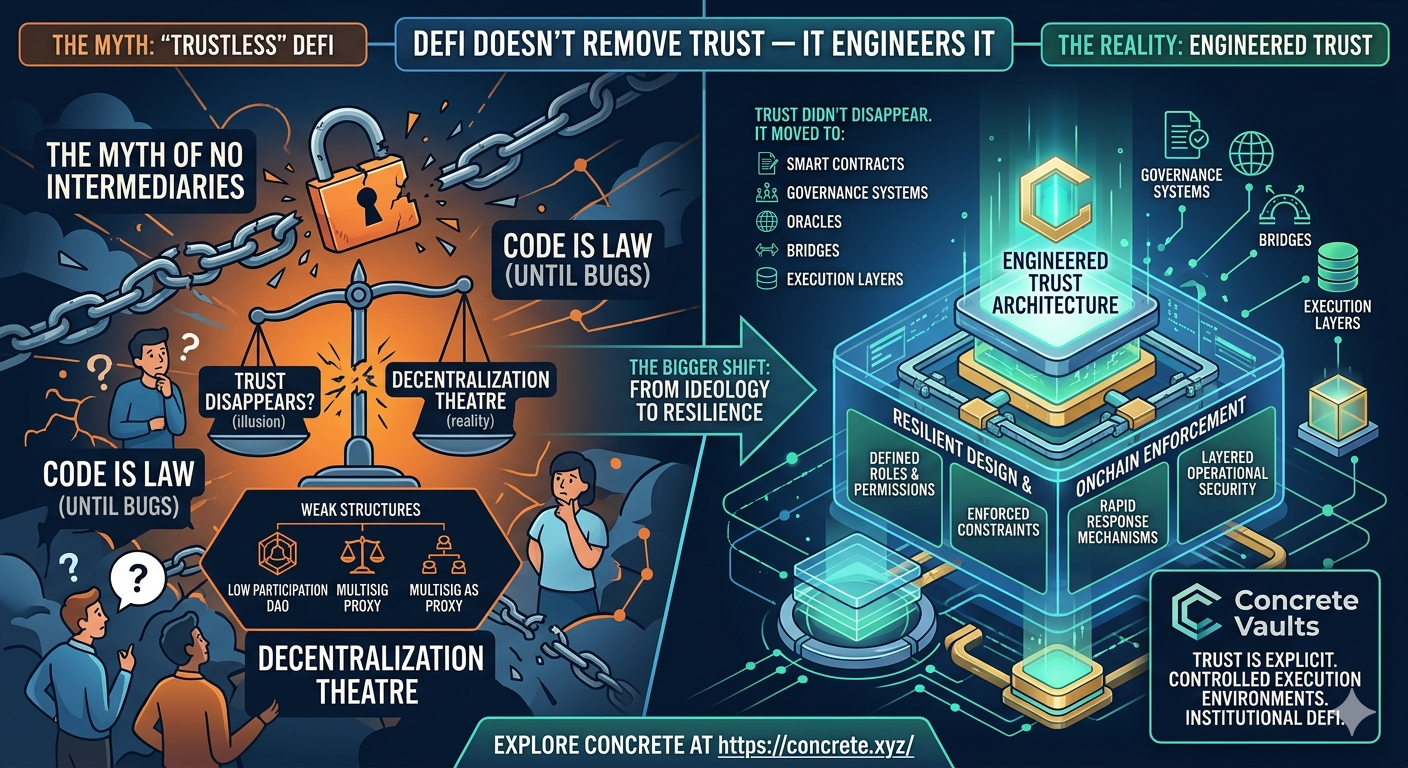
Trust never disappeared. It simply moved.
Today’s DeFi ecosystem still depends on trust in:
>Smart contracts
>Governance systems
>Oracles
>Bridges
>Execution layers
The real question is no longer whether trust exists.
The question is: Where does trust live, and how is it engineered?
2️⃣ Where Trust Actually Exists in DeFi:
Many protocols market themselves as “trustless,” but every system still relies on critical trust assumptions behind the scenes.
Smart Contracts:
Smart contracts are the backbone of DeFi infrastructure. However, contracts are only as secure as their design, testing, and auditing process.
One exploit or overlooked vulnerability can compromise an entire protocol.
Governance Systems:
DAOs are designed to decentralize decision-making, but many governance systems suffer from:
>Low participation
>Concentrated voting power
>Slow coordination during emergencies
In practice, a small number of contributors often guide critical decisions.
Oracles:
DeFi protocols depend heavily on accurate external data.
If an oracle fails or gets manipulated, lending markets, derivatives, and vault strategies can collapse instantly.
Bridges:
Cross-chain bridges introduce another major trust layer.
Many bridge systems rely on multisigs or centralized validators, creating hidden points of failure despite decentralized branding.
DeFi did not remove trust.
It redistributed it across infrastructure layers.
3️⃣ The Problem With “Decentralization Theatre”:
One of the biggest issues in modern DeFi is the rise of what many call:
“Decentralization Theatre”
Some systems appear decentralized on the surface but lack true operational resilience underneath.
Examples include:
>Multisigs marketed as complete security
>DAOs with inactive governance participation
>Timelocks that delay risk but cannot stop it
>Immutable systems that cannot respond during emergencies
This creates an illusion of safety.
A protocol may look decentralized while remaining extremely fragile under stress.
True resilience is not measured by slogans or governance optics.
It is measured by how systems perform during:
>Market volatility
>Security incidents
>Infrastructure failures
>Unexpected edge cases
4️⃣ Engineered Trust: A Better Model for DeFi:
The future of DeFi is not about pretending trust no longer exists.
The future is about engineering trust deliberately.
Engineered trust means:
>Clearly defined roles
>Transparent permissions
>Enforced operational constraints
>Structured risk management
>Systems designed to respond during failures
This is how mature financial infrastructure operates in traditional finance.
And increasingly, it is how institutional-grade DeFi infrastructure must operate as well.
The strongest systems are not the ones claiming to remove trust entirely.
They are the ones making trust:
>Visible
>Enforceable
>Auditable
>Operationally secure
5️⃣ Why Operational Security Matters:
Pure automation sounds ideal in theory.
But real-world systems require adaptability.
Markets evolve. Threats evolve. Infrastructure fails.
That is why resilient DeFi systems require:
>Continuous monitoring
>Layered security models
>Rapid response mechanisms
>Human oversight during edge cases
>Controlled execution environments
Code alone cannot predict every scenario.
Operational security is what allows infrastructure to survive under pressure.
6️⃣ How Concrete Approaches Engineered Trust:
Concrete takes a fundamentally different approach to DeFi infrastructure.
Instead of hiding trust assumptions behind marketing narratives, Concrete focuses on making trust explicit and operationally structured.
Concrete prioritizes:
>Operational security over decentralization theatre
>Explicit trust models instead of hidden assumptions
>Role-based architecture
>Controlled execution environments
>Systems designed for response, not just prevention
Concrete combines:
>Onchain enforcement
>Off-chain intelligence
>Structured operational controls
>Continuous monitoring frameworks
This creates infrastructure designed not only for efficiency but for resilience.
In institutional DeFi, reliability matters more than ideology.
Infrastructure must be capable of:
>Handling volatility
>Managing operational risk
>Responding to threats
>Maintaining continuity during stress events
That is the foundation of engineered trust.
7️⃣ The Future of DeFi Will Be Defined by Resilience:
The industry is entering a new phase.
The early “trustless everything” narrative is slowly evolving into something more mature.
The future of DeFi security will belong to protocols that:
>Structure trust transparently
>Engineer operational resilience
>Prioritize security over optics
>Build systems capable of adapting under stress
Because in the end, infrastructure is not judged by marketing.
It is judged by how it behaves during difficult conditions.
The future of DeFi will not be defined by who claims to remove trust.
It will be defined by who engineers it best.