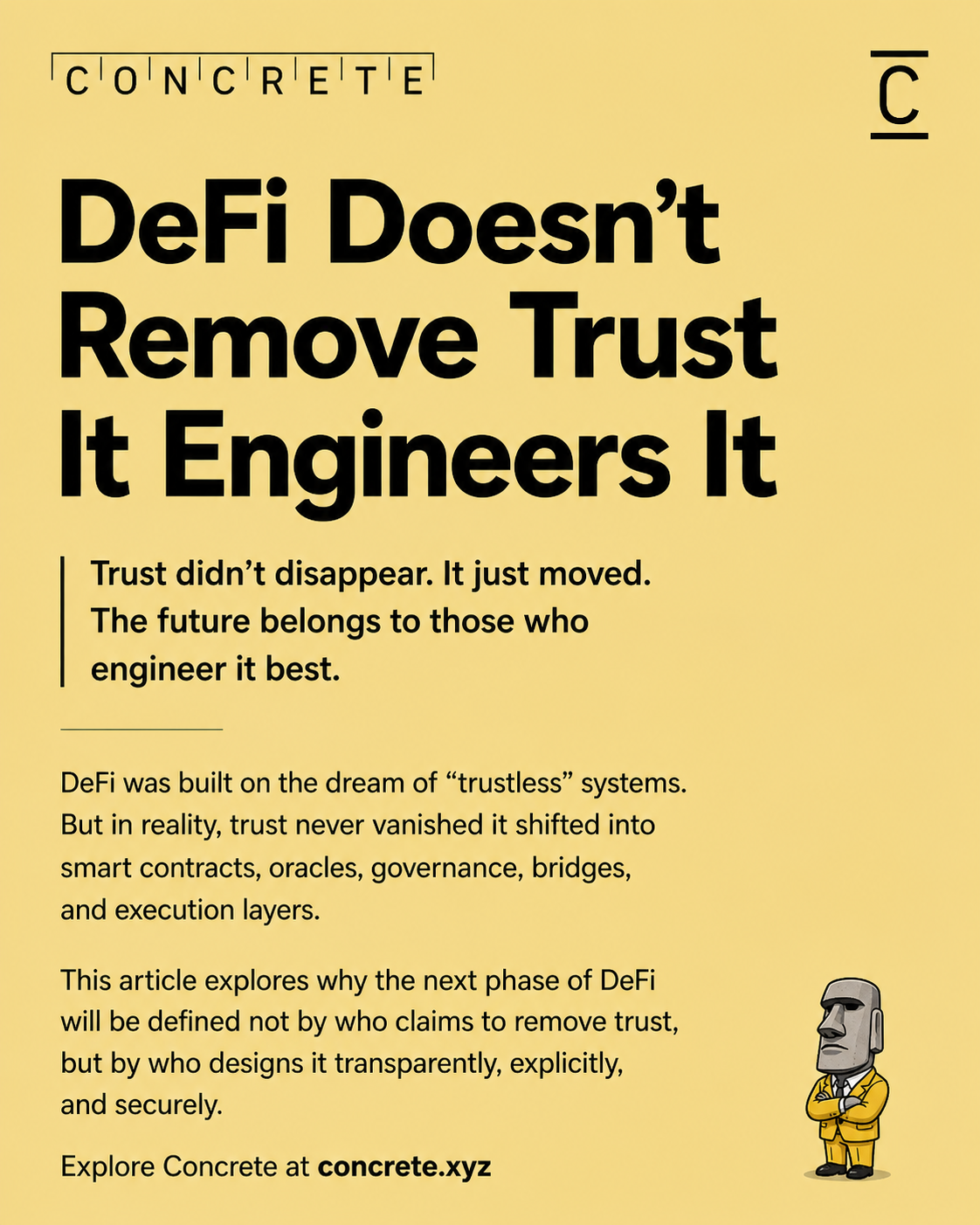
DeFi Doesn’t Remove Trust — It Engineers It
 Capten TEN3 min read·Just now
--
Why the “Trustless” Narrative is Evolving into a New Era of Operational Security
1. Starting With the Myth
Since its inception, Decentralized Finance (DeFi) has been sold on a singular, revolutionary promise: Don’t trust, verify.
The core belief was simple — DeFi is trustless. We were told that “Code is Law,” intermediaries are obsolete, and human error has been coded out of existence. For a while, this narrative was enough to fuel an entire movement.
But as the ecosystem matures, a hard truth is emerging: No system is fully trustless. The real question isn’t whether trust exists — it’s where that trust lives and how it is managed.
2. Where Trust Actually Lives
If you look beneath the surface of any “trustless” protocol, you’ll find hidden layers of dependency. Trust hasn’t been eliminated; it has been abstracted.
When you interact with DeFi, you are placing your trust in:
Smart Contract Assumptions:
- Smart Contract Assumptions: Trusting that the logic is flawless and free of exploits.
- Oracle Dependencies: Trusting that external data feeds are accurate and manipulation-resistant.
- Governance Decisions: Trusting that token holders or multisig signers will act in the system’s best interest.
- Bridges & Execution Layers: Trusting the underlying infrastructure to remain solvent and secure.
Trust didn’t disappear — it just moved from bankers to builders and from contracts to code.
3. The Problem With “Decentralization Theatre”
The industry is currently plagued by “Decentralization Theatre” — systems that appear decentralized to satisfy an ideology but lack actual resilience.
We see this in:
- Multisigs acting as a manual proxy for security.
- DAOs with such low participation that they are easily hijacked.
- Timelocks that provide a sense of security but cannot prevent a flash-loan attack in real-time.
There is a dangerous gap between the appearance of decentralization and actual safety. Rigid, “trustless” code often breaks when faced with edge cases that the original developers didn’t foresee.
4. Introducing Engineered Trust
The next phase of DeFi is moving toward Engineered Trust. This is the realization that trust isn’t a bug to be removed — it’s a component to be designed.
Engineered Trust means:
- Defining clear roles and responsibilities.
- Enforcing granular permissions and constraints.
- Building systems that can explicitly respond to failure rather than just hoping it doesn’t happen.
This is how mature financial systems operate, and it is exactly how Concrete is redefining the landscape.
5. The Necessity of Operational Security
Real-world systems require more than passive code; they require Operational Security (OpSec). Static code cannot handle every market volatility spike or black swan event.
True resilience requires active monitoring, rapid response mechanisms, and layered security. By acknowledging that code alone isn’t a silver bullet, we can build infrastructure that uses human judgment and off-chain intelligence to protect on-chain assets.
6. How Concrete Leads the Way
Concrete is moving beyond the “trustless” narrative to offer a superior model of Engineered Trust. Instead of hiding trust behind complex abstractions, Concrete makes it explicit and enforceable.
Here is how Concrete changes the game:
- Explicit Architecture: Trust is structured and visible, not buried in thousands of lines of code.
- Response-First Design: Concrete systems are designed to react to anomalies, ensuring safety even in unpredictable markets.
- On-Chain Enforcement + Off-Chain Intelligence: By combining the two, Concrete creates a controlled execution environment that protects users.
- Concrete Vaults: Prioritizing institutional-grade operational security over the fragility of decentralization theatre.
Concrete doesn’t just promise security; it engineers the environment where security is a guaranteed outcome.
7. The Bigger Shift: Resilience Over Ideology
The future of DeFi will not be defined by who claims to be the most “trustless.” It will be defined by who engineers trust the best.
As we move toward Institutional DeFi, the industry is shifting its focus from ideology to resilience. Infrastructure will be judged by how it behaves under stress, how it manages risk, and how transparently it handles trust.
The “trustless” era was a necessary start, but the era of Engineered Trust is where DeFi finally grows up.
Explore the future of engineered trust at https://concrete.xyz/