DeFi Doesn’t Remove Trust — It Engineers It
 Massih OG4 min read·Just now
--
Start With the Reality
DeFi was built on a simple but powerful idea:
“Don’t trust people. Trust code.”
At first glance, this changes everything.
No banks
No intermediaries
No human decision-making
Just smart contracts executing logic exactly as written.
For early users, this felt like a new financial system where trust was no longer needed.
But as DeFi evolved, something important became clear:
Trust didn’t disappear.
It just moved to different layers.
The “Trustless” Myth
You’ve probably heard these before:
“DeFi is trustless”
“Code is law”
“No intermediaries”
These ideas are attractive because they suggest a system with minimal risk and no reliance on humans.
But in practice, no system is truly trustless.
Every system relies on assumptions.
Every protocol depends on components.
Every interaction carries some form of trust.
So the real question is not:
Is DeFi trustless?
The real question is:
Where does trust exist, and how is it designed?
Where Trust Actually Exists in DeFi
In traditional finance, you trust institutions.
In DeFi, you trust systems.
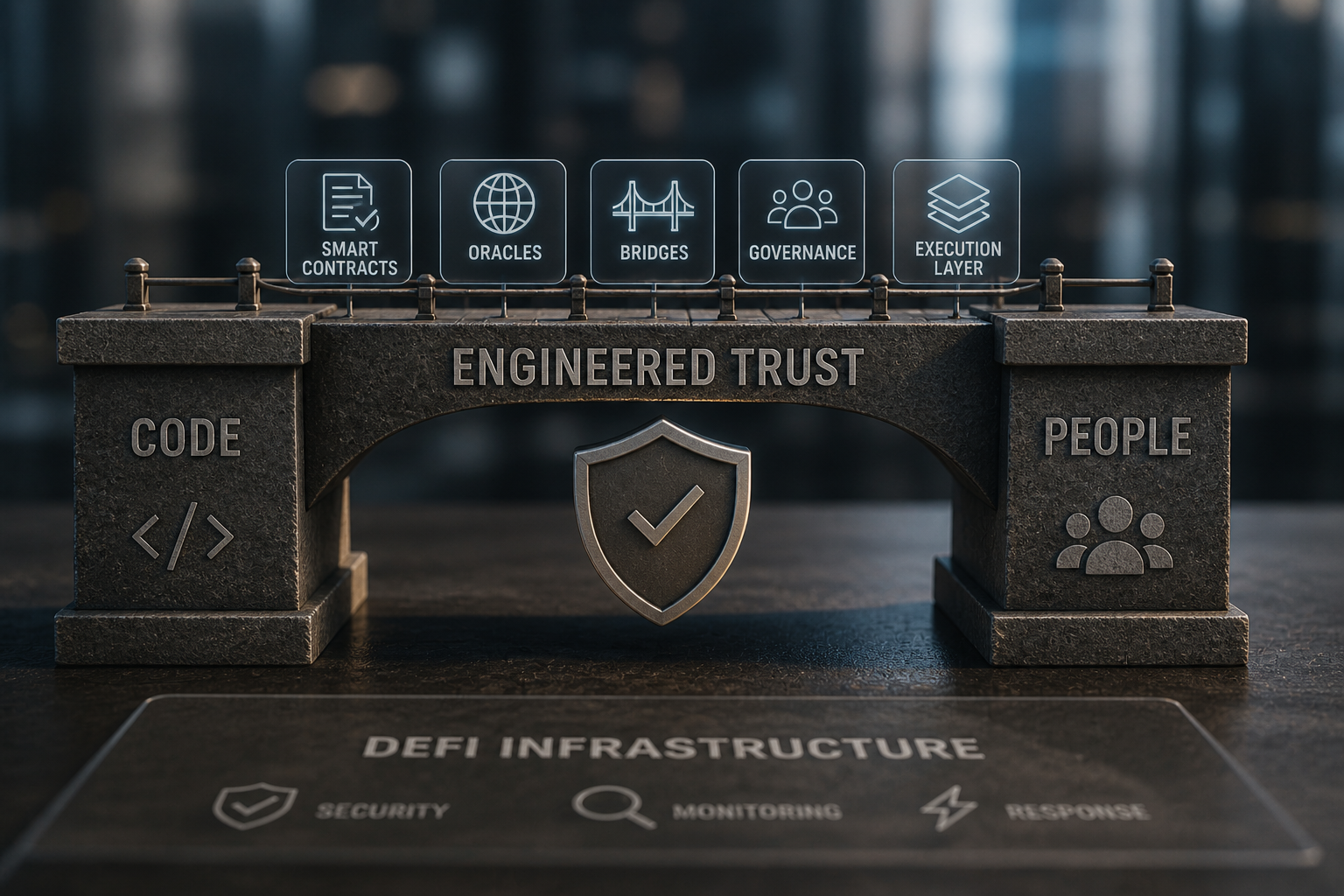
When you interact with a protocol, you are trusting multiple layers at once:
Smart contracts
You trust that the code is secure, audited, and behaves correctly under all conditions
Governance systems
You trust that decisions made by token holders are rational and not captured by a small group
Oracles
You trust that external data (like prices) is accurate and cannot be manipulated
Bridges
You trust that assets moving across chains remain secure
Execution layers
You trust that transactions are processed fairly and consistently
This is not the removal of trust.
This is the redistribution of trust across infrastructure.
Instead of trusting one centralized entity, you are trusting a stack of systems working together.
The Problem: Decentralization Theatre
Here’s where things start to break.
Some protocols claim decentralization, but don’t actually deliver real security.
This is what people call:
Decentralization theatre
It looks decentralized.
It sounds decentralized.
But it’s not resilient.
Common examples:
Multisigs presented as decentralization
In reality, a small group still controls critical actions
DAOs with low participation
Governance exists, but most users don’t vote
Timelocks as “security”
They delay actions, but don’t prevent bad decisions
Fully rigid automation
Systems that cannot react when something goes wrong
These designs create the appearance of safety.
But appearance is not the same as robustness.
Real security is about how a system behaves under stress, not how it looks on paper.
The Shift: From Removing Trust to Engineering It
If trust cannot be removed, the solution is not to ignore it.
The solution is to design it properly.
This is where the concept of engineered trust comes in.
Engineered trust means:
Trust is explicit, not hidden
Trust is structured, not assumed
Trust is enforced, not optional
In practice, this looks like:
Clear roles and responsibilities
Defined permissions and boundaries
On-chain enforcement of rules
Systems designed to handle failure scenarios
This is how mature systems operate.
Not by eliminating trust, but by controlling it.
Why Operational Security Is Critical
One of the biggest mistakes in DeFi is believing that code alone is enough.
But real systems are dynamic.
Markets change fast
Attacks evolve constantly
Edge cases always exist
Smart contracts can enforce rules, but they cannot:
React to new attack vectors
Handle unexpected market behavior
Make judgment calls in uncertain situations
That’s why strong systems require operational security.
This includes:
Continuous monitoring of positions and risks
Rapid response mechanisms when something breaks
Human oversight for edge cases
Layered security across multiple components
Code defines the rules.
Operations protect the system.
How Concrete Approaches This Differently
This is where Concrete takes a more advanced approach.
Instead of hiding trust behind “trustless” narratives, Concrete makes it:
Explicit, structured, and enforceable
Concrete is built around the idea of:
Engineered trust over assumed trust
Its system design includes:
Role-based architecture with clear responsibilities
Controlled execution environments
On-chain enforcement combined with off-chain intelligence
Active monitoring and response capabilities
Instead of relying only on prevention, Concrete systems are designed to:
Detect → Respond → Adapt
This is a major shift.
Because real-world systems don’t just avoid failure.
They are built to handle it when it happens.
Concrete prioritizes operational security over decentralization theatre.
The Bigger Shift in DeFi
DeFi is entering a new phase.
The industry is moving away from:
“Trustless” narratives
Surface-level decentralization
And moving toward:
Structured trust systems
Operational resilience
Institutional-grade infrastructure
In this phase:
Systems will be judged by performance under stress
Security will matter more than ideology
Reliability will attract serious capital
The winners will not be the protocols that claim to remove trust.
They will be the ones that:
Engineer it better than anyone else.
Explore More
Explore Concrete:
https://concrete.xyz/
In the end
Trust was never removed.
It was just hidden.
Now, the next generation of DeFi is bringing it back into the open and designing it properly.
Because in the end:
The strongest systems aren’t trustless.
They are trust-aware.