DeFi Doesn’t Remove Trust — It Engineers It
--
Decentralized Finance was born from a powerful narrative:
“Don’t trust people. Trust code.”
For early adopters, this idea felt revolutionary. Smart contracts replaced intermediaries, transactions became transparent, and financial systems appeared to operate without human bias. The promise was simple: a trustless system where code is law and participation is permissionless.
But as DeFi matured, a more nuanced reality emerged.
Trust was never eliminated.
It was relocated.
The Myth of “Trustless” Systems
The phrase “trustless” suggests a system free from reliance on any entity. In practice, however, no financial system — on-chain or off-chain — operates without trust.
Even in DeFi, users implicitly trust that:
- Smart contracts are written correctly and audited thoroughly
- Governance participants act in the protocol’s best interest
- Oracles provide accurate, tamper-resistant data
- Bridges securely transfer assets across chains
- Execution layers function reliably under stress
The real question is no longer whether trust exists.
It’s where that trust resides — and how well it is managed.
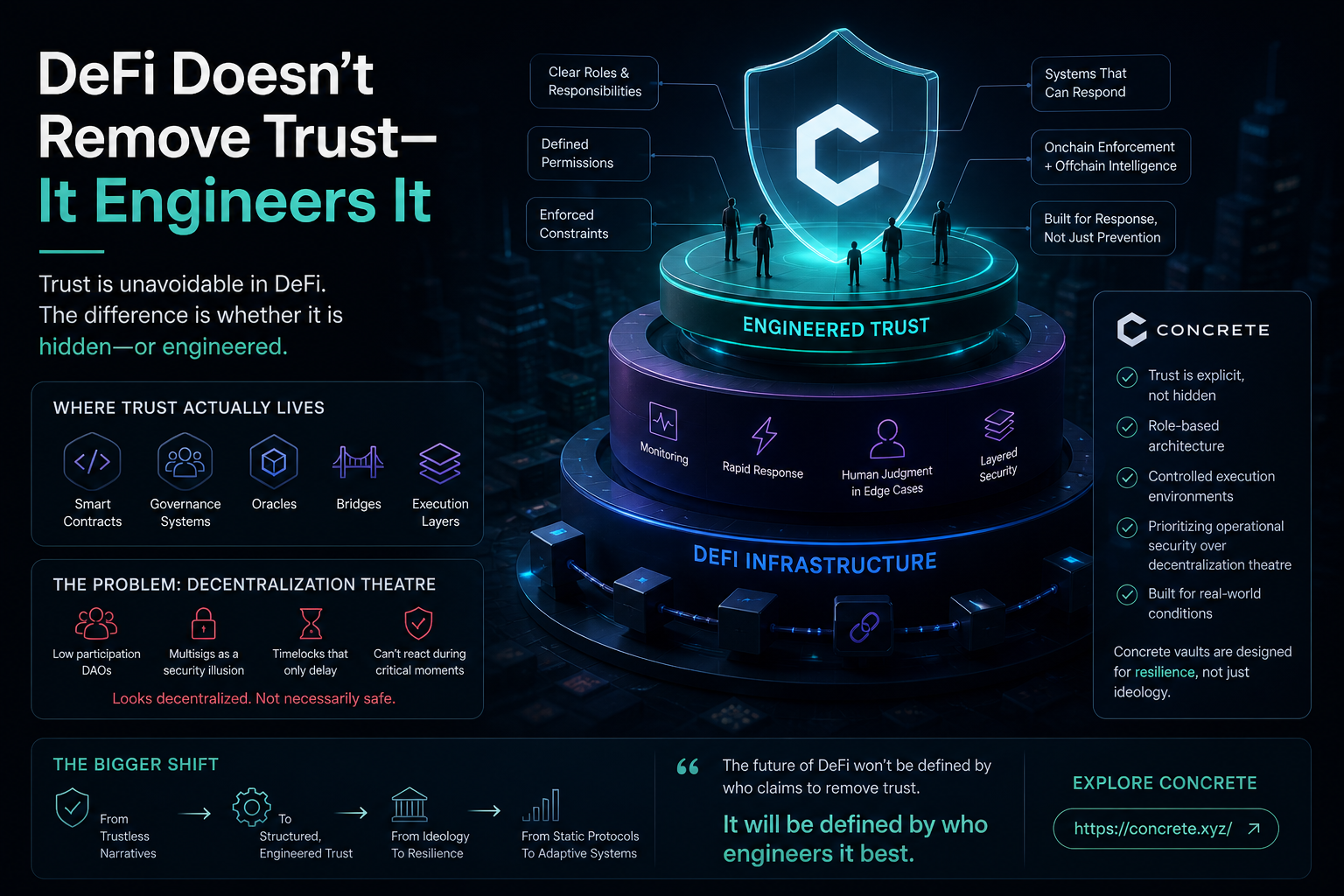
Where Trust Actually Lives in DeFi
DeFi abstracts trust into multiple layers, often making it less visible but no less critical.
Smart Contracts
Users trust that contract logic is secure, immutable, and free of exploitable bugs. Yet history has shown that even audited contracts can fail.
Governance Systems
Token-based voting introduces human decision-making back into the system. Low participation rates or concentrated voting power can distort outcomes.
Oracles
Protocols rely on external data feeds for pricing and events. If an oracle fails or is manipulated, entire systems can collapse.
Bridges
Cross-chain infrastructure remains one of the most vulnerable areas in DeFi, often requiring complex trust assumptions.
Execution Layers
Validators, sequencers, and infrastructure providers introduce additional dependencies that impact reliability and fairness.
Trust hasn’t disappeared — it has been distributed across technical and social components.
The Problem With Decentralization Theatre
As DeFi evolves, a new issue has surfaced: the illusion of decentralization.
Some systems appear decentralized on the surface but lack true resilience.
Examples include:
- Multisig wallets acting as centralized control points
- DAOs with minimal active governance participation
- Timelocks that delay actions but don’t mitigate systemic risk
- Protocols unable to respond effectively during crises
This creates what can be called decentralization theatre — a system that looks trustless but still relies on fragile, opaque trust assumptions.
The distinction becomes critical:
Decentralization in appearance does not equal security in practice.
From Trustless to Engineered Trust
A more mature perspective is emerging — one that acknowledges trust as a fundamental component rather than something to eliminate.
This is where engineered trust comes in.
Engineered trust is not about removing reliance. It is about structuring it deliberately.
It includes:
- Clearly defined roles and responsibilities
- Explicit permission systems
- Enforced constraints within execution environments
- Mechanisms to respond to failures, not just prevent them
Traditional financial systems have long operated this way. DeFi is now beginning to converge toward similar principles — without sacrificing transparency.
Why Operational Security Matters
Code alone cannot anticipate every edge case.
Real-world systems require:
- Continuous monitoring
- Rapid response capabilities
- Human judgment during abnormal conditions
- Layered security models
DeFi security is no longer just about preventing exploits — it is about maintaining system integrity under unpredictable conditions.
Operational security becomes the bridge between theoretical design and real-world reliability.
How Concrete Approaches Trust
Concrete represents a shift toward explicitly engineered trust within DeFi infrastructure.
Rather than hiding trust assumptions, it makes them visible, structured, and enforceable.
Key principles include:
- Explicit trust design instead of implicit assumptions
- Systems built for response, not just prevention
- Onchain enforcement combined with offchain intelligence
- Role-based architecture that defines who can act and how
- Controlled execution environments to reduce unpredictable risk
Concrete vaults are designed with operational security at their core, prioritizing resilience over superficial decentralization.
This approach reflects a broader evolution in institutional DeFi — where reliability, clarity, and control matter as much as transparency.
Explore Concrete at https://concrete.xyz/
The Bigger Shift in DeFi
The industry is moving beyond the simplicity of “trustless” narratives.
The next phase of DeFi infrastructure will be defined by:
- Systems that acknowledge trust rather than obscure it
- Architectures that structure and enforce trust relationships
- Platforms that perform reliably under stress
In the end, DeFi won’t be judged by who claims to remove trust.
It will be judged by who engineers it best.