 SYED MINHAJUL ISLAM3 min read·Just now
--
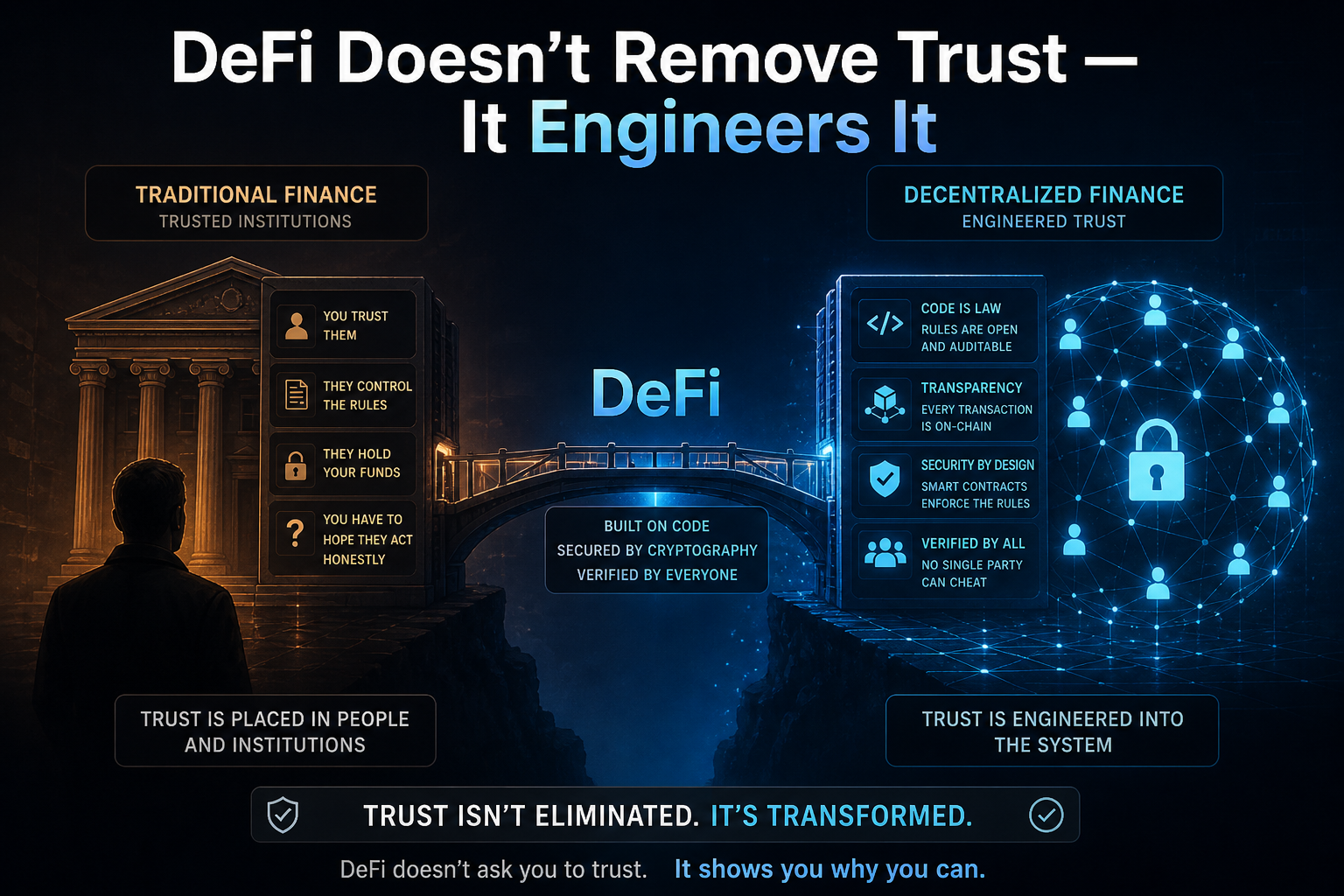
DeFi Doesn’t Remove Trust — It Engineers It
For years, DeFi has been framed around a powerful narrative: “Don’t trust people. Trust code.”
The promise of trustless systems, autonomous execution, and permissionless access captured the imagination of builders and institutions alike.
But as DeFi matured, a quieter truth emerged:
Trust never disappeared. It just changed form.
The Myth of “Trustless” Systems
At its core, DeFi promotes ideas like:
- “Code is law”
- “No intermediaries needed”
- “Trustless execution”
These principles suggest a world where human discretion is removed entirely. Yet, in practice, no financial system — on-chain or off-chain — operates without trust.
The real question isn’t whether trust exists.
It’s where it lives, and how well it’s designed.
Where Trust Actually Lives in DeFi
Even the most sophisticated DeFi infrastructure depends on multiple layers of trust:
- Smart contracts — You trust that the code is secure, audited, and free of exploits
- Governance systems — You trust token holders or multisigs to act responsibly
- Oracles — You trust external data feeds to be accurate and manipulation-resistant
- Bridges — You trust cross-chain systems to safely custody and transfer assets
- Execution layers — You trust validators and infrastructure providers to behave correctly
In each case, trust is not eliminated — it is abstracted behind technical systems.
The Problem With Decentralization Theatre
Not all decentralization leads to resilience.
Many systems today create the appearance of safety without delivering it:
- Multisigs often concentrate control in a small group
- DAOs suffer from low participation and voter apathy
- Timelocks delay actions but rarely prevent failures
- Fully automated systems struggle to react in real-time crises
This creates what can be called “decentralization theatre” — where systems look decentralized, but fail under stress.
True security is not about optics. It’s about behavior under pressure.
From Trustless to Engineered Trust
A more mature model is emerging:
Trust is not removed. It is engineered.
Engineered trust means:
- Clearly defined roles and responsibilities
- Explicit permission structures
- Enforced constraints on system behavior
- Built-in mechanisms to respond to failure
This mirrors how traditional financial systems evolved — through layered controls, oversight, and adaptability.
And increasingly, it’s how modern DeFi infrastructure is being designed.
Why Operational Security Matters
Code alone cannot anticipate every edge case.
Real-world systems require:
- Continuous monitoring
- Rapid response capabilities
- Human intervention when needed
- Layered defenses across components
This is the foundation of operational security — a critical pillar for institutional DeFi.
Without it, even the most elegant smart contract can become a single point of failure.
How Concrete Engineers Trust
Concrete represents this shift toward explicit, structured trust in DeFi infrastructure.
Instead of hiding trust assumptions, Concrete makes them visible and enforceable:
- Trust is explicit, not implied
- Systems are built for response, not just prevention
- Onchain enforcement combined with offchain intelligence
- Role-based architecture with defined permissions
- Controlled execution environments for critical operations
Concrete vaults are designed with operational security at their core, prioritizing resilience over ideology.
This approach moves beyond “trustless” narratives and toward systems that can actually withstand real-world conditions.
The Bigger Shift in DeFi
DeFi is entering a new phase.
The industry is moving past simplified narratives toward deeper infrastructure realities:
- Trustless systems are giving way to engineered trust
- Ideological purity is giving way to practical resilience
- Infrastructure is judged by how it performs under stress
The future of DeFi won’t belong to those who claim to remove trust.
It will belong to those who design it best.
More details : app.concrete.xyz