DeFi Doesn’t Remove Trust — It Engineers It
--
The myth of the trustless system is collapsing. The question was never whether trust exists in DeFi — it’s whether it’s designed deliberately, or hidden behind the illusion of decentralization.
— -
The Myth Everyone Believed
DeFi was born from a powerful idea: “Don’t trust people. Trust code.”
Remove the intermediaries. Eliminate the gatekeepers. Let math govern money.
For a while, this narrative held. Smart contracts executed without bias. Protocols ran without human approval. People moved value across borders without asking permission from a bank.
But as the ecosystem evolved — as billions flowed in and protocols stacked on top of each other — something became impossible to ignore:
Trust didn’t disappear. It just moved.
The question was never whether trust exists in DeFi. It always did.
The real question is: where does it live, and who is managing it?
— -
Where Trust Actually Lives
Every DeFi interaction rests on layers of implicit assumptions. Strip back the narrative of “trustless systems” and you’ll find trust distributed across the entire stack.
You trust that smart contracts are bug-free — even though history proves they’re not. The DAO hack, the Poly Network exploit, Wormhole, Ronin Bridge — each one was a lesson in misplaced trust hiding inside code that looked fine on the surface.
You trust oracle price feeds aren’t manipulated. You trust bridges won’t be exploited. You trust that multisig holders behind a protocol act in alignment with users.
Consider the hidden layers:
→ Smart contract assumptions (the code has no bugs and was audited thoroughly)
→ Governance decisions (DAO voters are informed and aligned)
→ Oracle dependencies (price feeds reflect reality)
→ Bridge security (assets crossing chains are protected)
→ Execution layers (the infrastructure beneath it all behaves as expected)
In DeFi infrastructure, trust isn’t eliminated.
It’s abstracted away — embedded in code, spread across stakeholders, and quietly assumed until something breaks.
— -
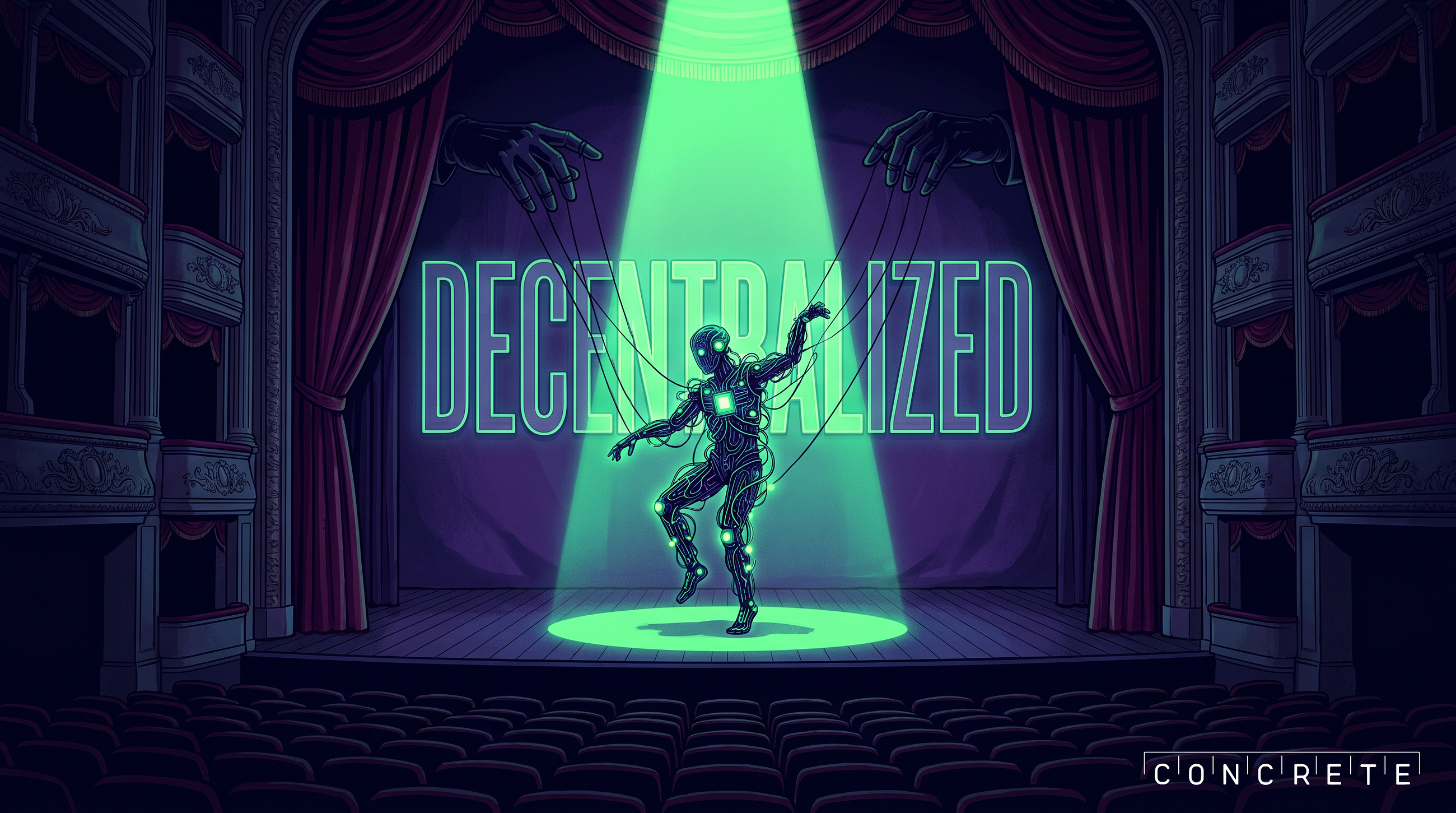
The Problem With Decentralization Theatre
Some systems look decentralized. They have DAOs, token votes, community calls, timelocks.
But appearance and resilience are not the same thing.
This is decentralization theatre — the performance of trustlessness without the substance of security.
Here’s what it looks like in practice:
→ Multisigs presented as security guarantees — when in reality, three keys held by the same entity or close associates changes nothing about the actual risk profile.
→ DAOs with sub-5% participation rates making decisions on billions in total value locked. The crowd is technically sovereign; in practice, a handful of insiders decide.
→ Timelocks that delay risk but cannot stop it — especially when there’s no response mechanism in place for when an exploit is detected mid-timelock.
→ Systems that freeze or fail silently during high-stress market events, when rapid response matters most.
> When a hack happens or an oracle misfires at 3 AM, a “decentralized” label on a protocol doesn’t prevent damage. Operational security does.
— -
What Engineered Trust Actually Looks Like
Mature financial systems don’t pretend trust doesn’t exist. They design it explicitly.
Engineered trust means:
→ Clear roles and responsibilities — every actor in the system has defined permissions, no ambiguity, no informal control.
→ Enforced constraints — rules embedded in the protocol itself, not dependent on good behavior or social trust.
→ Defined failure responses — knowing in advance what happens when something goes wrong, not improvising under pressure.
→ Layered security — multiple overlapping defenses, so no single failure point collapses the entire system.
Engineered trust doesn’t mean centralization.
It means knowing exactly who can do what, under which conditions, with what limitations — and having systems that enforce those boundaries automatically, even under pressure.
This is how mature systems in every high-stakes industry operate: aviation, nuclear energy, traditional finance. Not by pretending risk doesn’t exist, but by designing for it explicitly.
— -
Why Code Alone Isn’t Enough
Even the most battle-tested smart contract cannot handle every edge case.
DeFi security requires more than prevention — it requires rapid response capability.
Real operational security includes monitoring systems that detect anomalies before they become disasters. It includes human judgment at critical moments — not to replace code, but to act where code cannot react fast or intelligently enough.
A protocol with perfect code but zero incident response is still a liability waiting to happen.
The Euler Finance hack in 2023, for example, saw $197M drained before any coordinated response was possible. The protocol was audited. The code had been reviewed. But the operational layer wasn’t there.
The gap between prevention and response is where most DeFi losses actually occur.
— -
How Concrete Does It Differently
This is precisely the gap that Concrete was designed to close.
Instead of hiding trust inside opaque systems or pretending it doesn’t exist, Concrete makes trust explicit, structured, and enforceable.
Where most DeFi protocols abstract trust away, Concrete surfaces it. Every role in the architecture is defined. Every permission is scoped. Every execution environment is controlled.
Here’s what that looks like in practice:
→ Role-based architecture — no actor in the system has undefined permissions. The scope of what each participant can do is encoded at the protocol level, not dependent on informal norms.
→ On-chain enforcement — constraints are embedded in Concrete’s vault design itself. The rules don’t bend because someone asks nicely.
→ Off-chain intelligence — real-time monitoring and human judgment layer over the on-chain foundation, providing the rapid response capability that code alone cannot.
→ Controlled execution environments — Concrete’s institutional vault architecture operates within strict, defined boundaries, protecting capital without sacrificing composability.
> Concrete doesn’t ask users to trust a narrative. It gives them a system where trust is verifiable — where the rules are written on-chain, the roles are enforced at the protocol level, and the response mechanisms exist before something goes wrong.
This is how infrastructure earns the confidence of institutional capital. Not by claiming to be trustless, but by making trust legible and enforceable at every layer.
— -
The Bigger Shift Coming
DeFi is moving beyond the “trustless” era — not because the ideal was wrong, but because the industry has learned what it costs to ignore the reality of trust.
The next phase will be defined by infrastructure that performs under stress.
Not just during bull markets and clean conditions — but during exploits, depegs, liquidity crises, and oracle failures. The protocols that survive and scale will be the ones that took operational security seriously from day one.
Resilience will matter more than ideology.
Infrastructure will be judged not by its whitepaper, but by how it behaves when everything else is breaking.
> The future of DeFi won’t be won by whoever claims to remove trust. It will be won by whoever engineers it best — making trust explicit, structured, layered, and designed to hold under pressure.
That’s not a betrayal of DeFi’s original vision. It’s the natural maturation of it.
Decentralization as ideology is giving way to decentralization as engineering — and the infrastructure of tomorrow is being built right now.
— -
Explore how Concrete builds DeFi infrastructure where every role, constraint, and execution environment is designed for resilience — not just prevention.
Explore Concrete at → https://concrete.xyz/