
DeFi Doesn’t Remove Trust. It Engineers It
--
Reframing Trust Assumptions in Decentralized Financial Systems
Abstract
Decentralized Finance (DeFi) is often framed as a trustless alternative to traditional financial systems, replacing institutional intermediaries with deterministic code. However, this characterization is incomplete. Trust is not eliminated in DeFi. It is redistributed across technical, governance, and operational layers.
This article argues that the next phase of DeFi will not be defined by attempts to remove trust, but by the ability to explicitly engineer, structure, and enforce it. Systems that acknowledge and design for trust dependencies are more likely to achieve resilience, particularly in the context of institutional capital and long term infrastructure development.
1. Introduction: The Trustless Narrative
The foundational narrative of DeFi rests on a simple premise:
“Don’t trust institutions. Trust code.”
This paradigm positioned smart contracts as deterministic substitutes for human discretion, enabling transparent and permissionless financial interactions. The notion of trustless systems became central to DeFi’s identity, reinforcing ideas such as “code is law” and the removal of intermediaries.
However, as DeFi systems have scaled in complexity, this narrative has proven insufficient as a descriptive model.
No financial system, decentralized or otherwise, operates without trust assumptions. The critical distinction lies not in the absence of trust, but in its distribution and enforcement.
2. The Distribution of Trust in DeFi Systems
In practice, DeFi architectures rely on multiple interdependent layers, each introducing implicit trust assumptions:
- Smart contracts
Users assume correctness, security, and immutability of deployed code - Governance mechanisms
Protocol evolution depends on collective decision making, often subject to participation asymmetry and incentive misalignment - Oracle systems
External data feeds introduce dependencies on accuracy, latency, and resistance to manipulation - Cross chain bridges
Interoperability layers expand attack surfaces and concentrate risk in validator or relayer sets - Execution environments
Transaction ordering, MEV dynamics, and network level behavior influence outcomes beyond contract logic
These components collectively form a distributed trust model. Abstraction reduces perceived complexity, but it does not eliminate underlying dependencies.
3. Decentralization Theatre and Structural Fragility
A key risk emerging within DeFi is the prevalence of decentralization theatre. These are systems that signal decentralization without achieving corresponding resilience.
Common patterns include:
- Multisignature control structures
Often presented as decentralized governance, yet effectively concentrated among a small group of signers - Low participation DAOs
Governance frameworks that exist formally but lack meaningful engagement or oversight - Timelock mechanisms
Providing delayed execution without fundamentally mitigating adverse actions - Inflexible protocol architectures
Systems unable to respond dynamically to market stress or exploit conditions
These structures create an illusion of safety while leaving critical vulnerabilities unaddressed. The distinction between decentralization and security becomes particularly visible during periods of systemic stress.
4. Toward Engineered Trust
A more robust framework for DeFi design is the concept of engineered trust.
Engineered trust does not attempt to eliminate trust assumptions. Instead, it seeks to:
- Make trust relationships explicit
- Define roles, permissions, and constraints clearly
- Enforce boundaries through both technical and procedural mechanisms
- Incorporate response capabilities alongside preventative controls
This approach aligns more closely with mature financial systems, where risk is managed through layered controls rather than abstracted away.
Within this paradigm, trust becomes a design variable that can be optimized, audited, and stress tested.
5. Operational Security as a Core Requirement
Purely deterministic systems are insufficient in environments characterized by uncertainty and adversarial behavior.
As such, operational security emerges as a critical component of DeFi infrastructure. This includes:
- Continuous system monitoring and anomaly detection
- Rapid response mechanisms to mitigate emerging risks
- Integration of human oversight in non deterministic scenarios
- Layered defense strategies across contracts, infrastructure, and processes
The limitation of “code is law” becomes evident in edge cases where predefined logic cannot anticipate real world complexity.
Resilient systems therefore combine automated enforcement with adaptive response capabilities.
6. Concrete and the Implementation of Engineered Trust
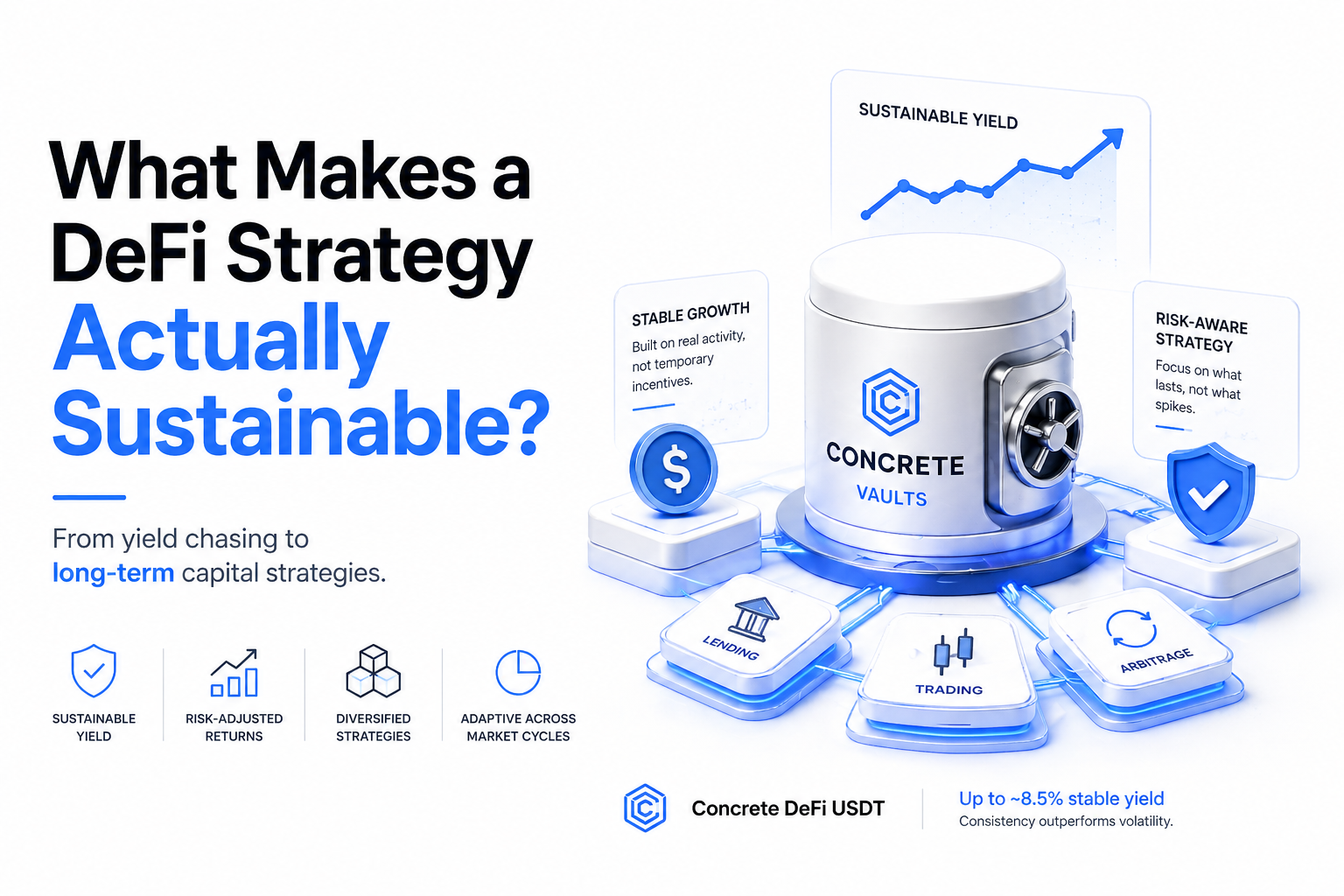
Within this evolving landscape, Concrete vaults represent an applied model of engineered trust in DeFi.
Rather than relying on implicit assumptions, the system is designed around explicit trust structures and operational resilience. Key characteristics include:
- Transparent trust models
Trust assumptions are surfaced and defined, rather than abstracted behind trustless narratives - Onchain enforcement with off chain intelligence
Combining deterministic execution with adaptive decision making layers - Role based architecture
Clearly delineated permissions and responsibilities across system participants - Controlled execution environments
Reducing unpredictability in capital deployment and strategy execution
This design reflects a shift toward DeFi security as a function of system architecture, rather than ideological alignment with decentralization.
7. Implications for Institutional DeFi
As DeFi attracts larger pools of capital, particularly within institutional DeFi, the requirements for infrastructure evolve significantly.
Institutional participants prioritize:
- Predictability of outcomes
- Clarity of risk exposure
- Robust security and response mechanisms
- Verifiable enforcement of constraints
In this context, systems that obscure trust assumptions are less viable than those that explicitly structure and manage them.
Engineered trust becomes a prerequisite for scalability.
8. Conclusion: From Ideology to Infrastructure
The evolution of DeFi reflects a broader transition:
- From trustless narratives to explicit trust design
- From decentralization as ideology to resilience as a metric
- From experimental systems to financial infrastructure
The defining systems of the next phase will not be those that claim to remove trust entirely, but those that demonstrate the ability to engineer it effectively.
Trust, in this sense, is not a weakness of DeFi.
It is an architectural reality. One that, when properly designed, becomes a source of strength.
Explore Concrete at https://concrete.xyz/