DeFi Doesn’t Remove Trust , It Engineers It
 Daemon8 min read·Just now
--
DeFi was built on a simple, seductive idea:
"Don’t trust people. Trust code."
For a while, that worked or at least, it felt like it did.
Smart contracts settled trades without brokers. Liquidity pools replaced market makers. Governance tokens handed voting power to anonymous strangers on the internet. The dream was clean: a financial system where trust was unnecessary because code was law, immutable and incorruptible.
But as the industry matured, something became unmistakably clear. Trust didn’t disappear, It just moved.
The Myth: Trustless Systems
The "trustless" narrative was never just a technical claim. It was a philosophical declaration. It said: humans are the problem. Remove the humans, and you remove the risk.
This is a compelling story. It is also incomplete.
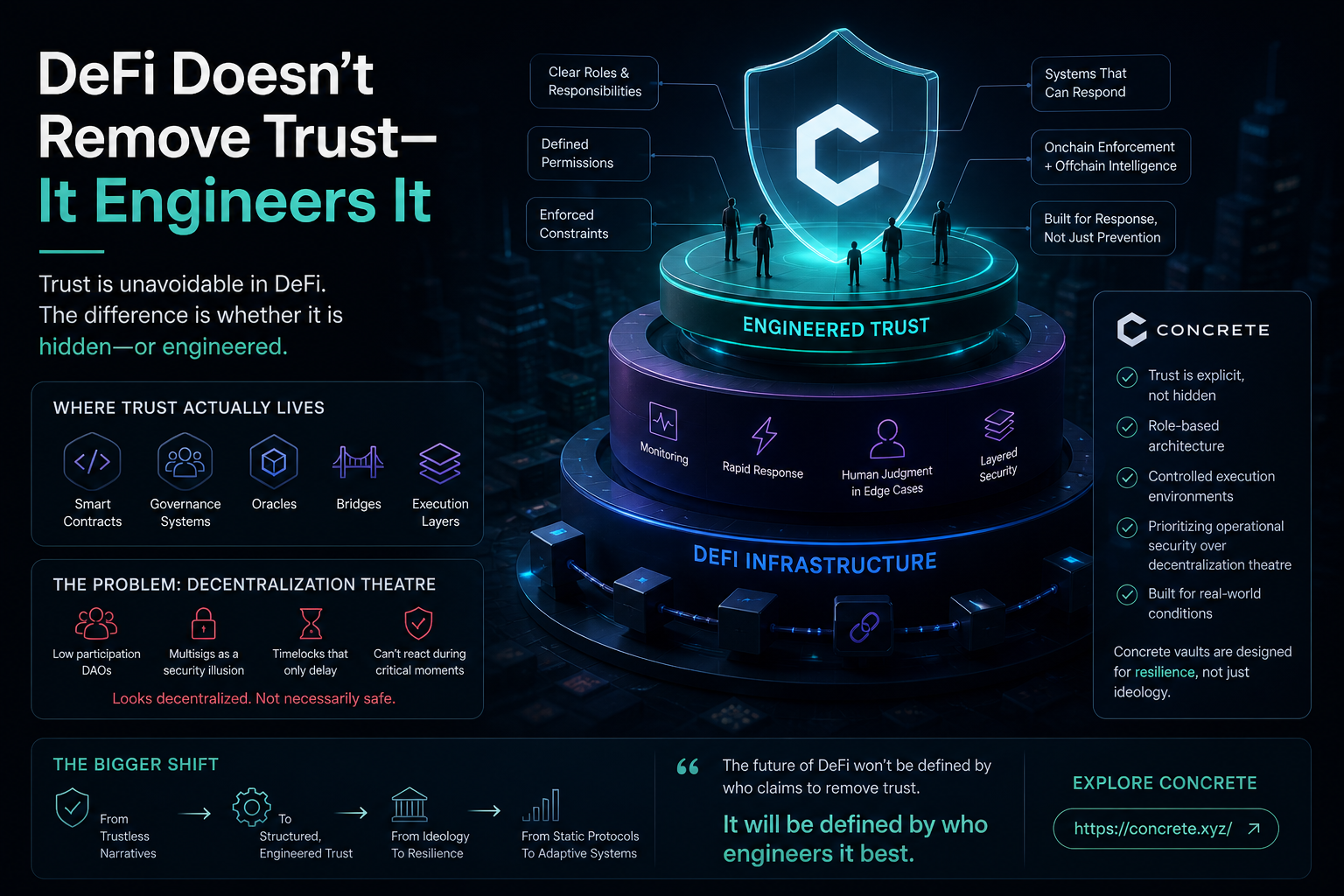
When you deposit into a DeFi protocol today, you are trusting the smart contract was written correctly, the governance system won’t be manipulated, the oracle feeding price data hasn’t been compromised, the bridge between chains won’t be exploited, and the execution layer processes your transaction as intended.
Every one of these is a trust relationship. The intermediary changed. The trust didn’t.
The real question was never whether trust exists in DeFi. The question is where it lives , and whether it is managed deliberately or hidden behind the comforting illusion of decentralization.
Where Trust Actually Lives
To understand engineered trust, you first have to map where unengineered trust hides.
Smart Contracts:- Every smart contract is a set of assumptions baked into code. Those assumptions reflect the beliefs of the developers who wrote them. Bugs in those assumptions have cost the industry billions. According to research on DeFi security incidents, in 2025 alone, attacks on DeFi protocols resulted in over $3.1 billion in losses, with smart contract vulnerabilities and access-control flaws among the leading causes. "Audited" is not the same as "correct." An audit is a snapshot, not a guarantee.
Governance Systems:- DAOs were supposed to democratize financial decision-making. In practice, research from the Hebrew University of Jerusalem found that governance tokens are frequently not used as intended voting rates are low, participation is negatively correlated with gas prices, and voting power tends to be highly centralized. When token holders don’t vote, a small group of insiders effectively controls the protocol. The DAO exists. The decentralization doesn’t.
Oracles:- DeFi protocols don’t live in a vacuum. They need real-world data prices, interest rates, asset values. Oracles supply that data. But oracles, as external entities, sit outside the decentralized governance structure of blockchains. Oracle manipulation is one of the most well-documented attack vectors in DeFi, with a landmark 2020 case involving Dai stablecoin price manipulation leading to roughly $89 million in liquidations on the Compound platform alone.
Bridges:- Cross-chain bridges are among the most dangerous chokepoints in all of DeFi infrastructure. They concentrate enormous value in contracts that span multiple security assumptions simultaneously. The Binance Bridge alone was exploited for $570 million in 2022. Every bridge is a trust relationship with a cross-chain execution environment you cannot fully verify from a single chain.
Execution Layers. MEV, transaction ordering, sequencer centralization execution layers introduce their own trust dependencies. Who determines what gets processed and when? The answer is rarely "no one."
In each case, trust has not been removed. It has been abstracted. Abstraction is not elimination.
The Problem With Decentralization Theatre
There is a category of DeFi system that deserves a specific name:
decentralization theatre:-
These are systems that perform the aesthetics of decentralization without delivering its substance. They use the vocabulary DAOs, multisigs, timelocks, governance but arrange these elements in ways that leave critical vulnerabilities intact.
Consider the multisig. Many protocols advertise their multisig as a security feature. And it can be. But a 3-of-5 multisig controlled by team members who know each other, travel together to conferences, and share access to the same Telegram group is not meaningfully decentralized. It is five people pretending to be a trustless system. The compromise of one person’s key , through phishing, coercion, or social engineering can cascade into catastrophic loss.
Consider the DAO with low participation. When quorum is rarely reached and a small fraction of token supply decides every vote, the protocol is functionally controlled by a handful of large holders.
This isn’t governance , it’s the illusion of governance.
Consider timelocks. Timelocks create a delay between a governance decision and its execution. This is useful. But a timelock delays risk , it does not prevent it. If a malicious proposal passes governance, a timelock buys time for community reaction, but only if someone is watching, organized, and capable of mobilizing a counter-response in time.
The gap between the appearance of decentralization and actual systemic resilience is where disasters incubate. A system that looks decentralized but cannot respond to failure is not safer than a centralized system. It is often more dangerous, because the illusion of safety is harder to see through.
Introducing Engineered Trust
Here is the insight that separates the next generation of DeFi infrastructure from the last:
Trust is not something to eliminate. It is something to design.
Every real financial system no matter how sophisticated, how automated, how decentralized operates on layers of trust.
The difference between a resilient system and a fragile one is not whether trust exists. It is whether trust is explicit, structured, and enforceable.
This is what mature financial systems have always understood. Banks have separation of duties. Asset managers have investment committees, risk teams, and compliance functions. Trading desks have portfolio managers, strategy approvers, and execution systems operating at different speeds with different permission levels. None of these roles overlap. None can unilaterally act outside their mandate.
This is not bureaucratic overhead. It is the operational architecture that makes institutional finance function under stress.
Engineered trust in DeFi means the same principles, encoded on-chain:
Clear roles with bounded authority. Not one multisig that controls everything, but distinct functions that cannot exceed their scope.
Defined permissions enforced by code. Not guidelines. Contracts.
Visible risk parameters. Not marketing promises. On-chain, auditable, real-time.
Systems designed to respond to failure. Not just to prevent it.
The shift is fundamental. From "trust nobody" to "trust the architecture."
Operational Security: Why Code Alone Isn’t Enough
This is where many technically sophisticated DeFi participants still get stuck: the belief that a well-written smart contract is sufficient protection.
It isn’t.
Smart contracts handle known scenarios elegantly. They do not handle unknown scenarios at all. Novel attack vectors, protocol-level edge cases, market conditions that no model anticipated these require something contracts cannot provide: judgment.
Real operational security in DeFi demands a layered approach. Continuous, real-time monitoring to detect anomalous behavior before it becomes an exploit. Rapid response mechanisms that don’t require a governance vote to activate. Human judgment in edge cases where automated systems lack sufficient context. And layered security architectures that assume any single layer can fail.
Consider what Hypernative one of the most respected real-time threat detection systems in Web3 actually does: it flags abnormal on-chain activity before the first hack transaction completes, enabling automated and human responses that can prevent loss rather than merely confirm it. This kind of infrastructure acknowledges a reality that pure "code is law" thinking cannot: some threats require response faster than governance, and smarter than automation alone.
The protocols that will survive the next stress test are not the ones with the most elegant contracts. They are the ones with the most capable operational layers around those contracts.
How Concrete Engineers Trust
This is the question the industry is now answering in practice: what does engineered trust actually look like at the infrastructure level?
Concrete.xyz represents one of the most architecturally deliberate answers to this question in institutional DeFi today.
The design philosophy is explicit: trust is not outsourced and not hidden. It is replaced with verifiable structure. As Concrete’s own documentation puts it, the architecture "doesn’t assume integrity it enforces it."
Role-Based Architecture. Concrete vaults map real-world financial roles directly onto on-chain infrastructure. The Allocator manages capital allocation, rebalancing, and withdrawals operating at market speed without governance delays for routine operations. The Strategy Manager defines the investable universe, approves strategies, and sets exposure limits but cannot move funds day-to-day. The Hook Manager acts as the automated compliance layer, enforcing pre- and post-deposit logic, controlling withdrawal conditions, and ensuring no strategy exceeds its risk envelope. Each role is a discrete smart contract capability, permissioned separately. The Allocator cannot approve new strategies. The Strategy Manager cannot move funds. Safety is baked in, not bolted on.
On-Chain Enforcement, Not Promises. Allocation caps, risk thresholds, and whitelisted protocols are encoded into contracts not listed in a whitepaper. Curators interact only with approved protocols and cannot move funds off-chain or exceed allocation caps. Any off-chain components require explicit depositor consent, with all risks transparently recorded on-chain.
Independent Oversight. TRES provides continuous, independent accounting reconciliation. Hypernative delivers real-time monitoring and policy enforcement across all vault operations. This creates a separation that ensures vault safety doesn’t rely on curator behavior, but on contract enforcement.
Transparent Exposure. Every vault position is directly traceable to real, verifiable on-chain holdings. Collateral can be inspected, reconciled, and withdrawn within the same contract system that manages yield. Synthetic exposure is permitted only when explicitly defined, risk-disclosed, and observable on-chain.
Audited Foundation:- Concrete’s modular smart contract system has been audited by Halborn, Zellic, and Code4rena with public reports replacing marketing claims. The architecture was specifically designed to avoid storage collisions, upgrade risks, and legacy contract pitfalls.
The result is what Concrete describes as not "trust-by-branding" but "trust-by-enforcement." Vaults turn "risk management" from a promise into protocol logic. This is what it looks like when a DeFi protocol stops performing decentralization and starts engineering resilience. The system has managed over $800 million in stablecoin strategies, with backers including Polychain Capital, YZi Labs, and VanEck institutional capital that does not flow toward theatre.
The Bigger Shift
DeFi is growing up. Not loudly there is no single announcement, no consensus moment. But the trajectory is unmistakable.
The early era proved that decentralized finance was possible. It demonstrated that code could settle trades, that liquidity could be pooled permissionlessly, that protocols could operate without traditional intermediaries. These were real achievements.
But the next phase demands something harder: not just possibility, but reliability. Not just ideology, but infrastructure. Not just the claim of decentralization, but the substance of resilience.
The industry will increasingly be judged not by what protocols claim in bull markets, but by how they behave under stress. A governance system that works when everything is fine tells you very little. A governance system that holds together during a market crisis, an exploit attempt, or a liquidity crunch that is real infrastructure.
The "trustless" narrative served a purpose. It differentiated DeFi from centralized finance at a time when the primary enemy was the intermediary. But that era is giving way to something more sophisticated: a recognition that trust is not the enemy. Unaccountable, hidden, and unstructured trust is the enemy.
The future of DeFi won’t be defined by who makes the boldest claims about removing trust.
It will be defined by who engineers it best , who can make trust explicit, bounded, auditable, and responsive under pressure.
The protocols that earn that distinction won’t be the loudest. They will be the most reliable.
That is a higher standard. It is also the right one.
Explore Concrete at https://concrete.xyz/