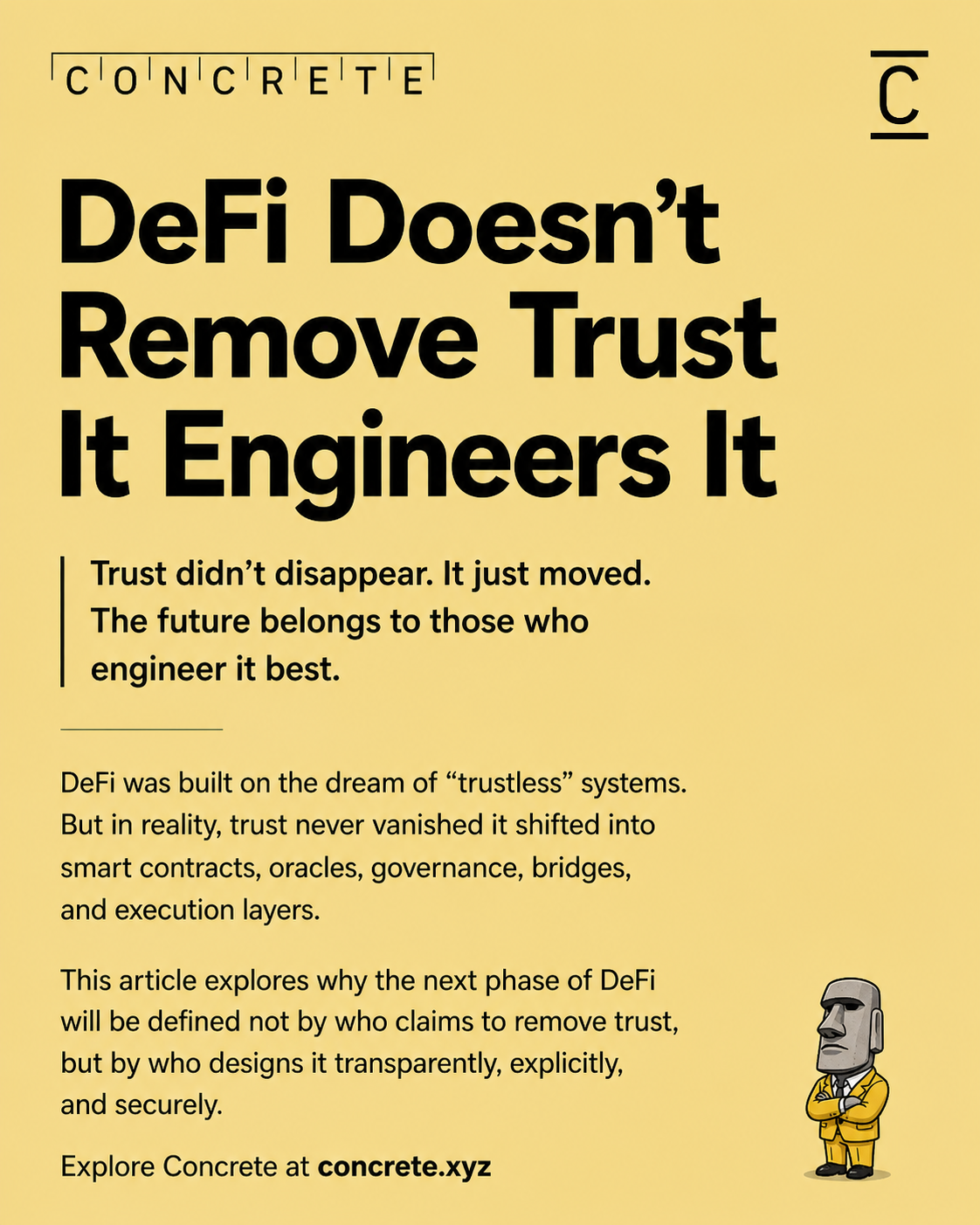
DeFi Doesn’t Remove Trust — It Engineers It
 Voke Olomu3 min read·Just now
--
DeFi was built on a simple idea:
Don’t trust people.
Trust code.
For a while, that felt like a breakthrough.
Smart contracts replaced intermediaries.
Transactions executed automatically.
Systems ran without human involvement.
It looked like trust had been removed entirely.
But as DeFi evolved, something became clear:
Trust didn’t disappear.
It moved.
The Myth of “Trustless” Systems
“Trustless” became one of the most repeated ideas in DeFi.
Code is law.
No intermediaries.
No need to rely on anyone.
But no real system operates without trust.
Not even in DeFi.
Because every interaction still depends on assumptions:
That contracts behave as expected
That data inputs are correct
That systems respond under stress
The difference isn’t the absence of trust.
It’s where that trust is placed — and whether you can see it.
Where Trust Actually Lives
In practice, DeFi systems rely on multiple layers.
Each one introduces its own form of trust.
You trust smart contracts
to execute logic correctly.
You trust oracles
to provide accurate data.
You trust governance systems
to make sound decisions.
You trust bridges
to move assets securely across chains.
You trust execution layers
to process transactions reliably.
None of this is optional.
It’s foundational.
But most of it is abstracted away — hidden behind interfaces that make everything feel simple.
Deposit.
Wait.
Earn.
The system works.
Until it doesn’t.
The Problem With Decentralization Theatre
As DeFi grew, so did the narrative around decentralization.
But not all decentralization is equal.
Some systems appear decentralized — without actually being resilient.
A multisig can secure funds
but still concentrate control.
A DAO can exist
but operate with minimal participation.
A timelock can delay changes
but not prevent harmful ones.
These structures create the appearance of safety.
But under pressure, they don’t always hold.
Because decentralization alone doesn’t guarantee security.
What matters is how a system behaves when something goes wrong.
From Trustless to Engineered Trust
This is where the model begins to shift.
Not away from trust —
but toward designing it properly.
Engineered trust means:
Clear roles
Defined permissions
Enforced constraints
Systems that can respond in real time
Instead of assuming nothing will fail,
you build systems that handle failure well.
This is how mature financial infrastructure works.
Not by eliminating trust —
but by structuring it.
Why Code Alone Isn’t Enough
Smart contracts are powerful.
But they are static.
They execute exactly as written — nothing more.
They don’t adapt.
They don’t interpret edge cases.
They don’t respond to unexpected conditions.
Real systems require more than execution.
They require awareness.
That’s where operational security comes in.
Monitoring systems
detect anomalies.
Response mechanisms
act quickly when needed.
Human judgment
handles situations code cannot anticipate.
Security becomes layered —
not just programmed, but managed.
How Concrete Approaches Trust
This is the approach Concrete takes.
Instead of hiding trust behind interfaces,
it makes it explicit — and designs around it.
Concrete Vaults operate as structured DeFi infrastructure:
Trust is defined, not assumed
Roles and permissions are clearly set
Execution environments are controlled
Systems are built to respond — not just prevent
Onchain enforcement ensures rules are followed.
Off-chain intelligence allows systems to adapt.
Capital is not just deployed.
It is actively managed within a framework designed for stability.
This is a different model of DeFi.
Not trustless —
but intentionally structured.
Beyond Ideology
DeFi is maturing.
The early phase focused on removing intermediaries
and maximizing decentralization.
The next phase is different.
It focuses on resilience.
How systems behave under stress
How risks are contained
How quickly they can respond
Because in real markets, failure isn’t theoretical.
It’s inevitable.
The systems that last are not the ones that claim to remove trust —
They are the ones that engineer it properly.
The Bigger Shift
The narrative is changing.
From:
Trustless systems
To:
Engineered trust
From:
Decentralization as ideology
To:
Security as infrastructure
From:
Static code
To:
Adaptive systems
In this environment, the question is no longer:
“Can trust be removed?”
It’s: “How is trust designed, enforced, and managed?”
Because the future of DeFi won’t be defined by who claims to eliminate trust.
It will be defined by who builds systems that handle it best.
🚨 Explore Concrete at https://concrete.xyz/ 🚨