DeFi Doesn’t Remove Trust, It Engineers It
 Tpaco3 min read·Just now
--
For years, DeFi has been framed around one idea:
“Don’t trust people. Trust code.”
It’s a powerful message. It explains why decentralized systems matter — and why they attracted so much attention in the first place.
But as DeFi has grown, that idea has been tested in practice.
And the reality is more nuanced:
Trust didn’t disappear. It became part of the system design.
The Comfort of “Trustless”
Calling DeFi trustless systems makes things feel simple.
- no intermediaries
- no reliance on institutions
- everything governed by code
It suggests that once a smart contract is deployed, the system runs independently.
But that’s only part of the story.
Because even in these systems, you’re still relying on multiple layers working as expected.
So the real shift isn’t the removal of trust.
It’s the relocation of it.
Where Trust Actually Sits
Every DeFi interaction depends on a network of components.
And each one introduces its own assumptions.
When you use DeFi, you’re trusting:
- smart contracts to execute correctly
- governance systems to evolve protocols responsibly
- oracles to provide accurate external data
- bridges to securely move assets between chains
- execution layers to process transactions reliably
These layers form the foundation of modern DeFi infrastructure.
They don’t eliminate trust.
They distribute it.
The Gap Between Decentralization and Resilience
Decentralization is often used as a signal of safety.
But in practice, not all decentralized systems are equally robust.
Some rely on structures that look decentralized but behave differently under stress.
For example:
- multisigs acting as central control points
- DAOs with limited participation in key decisions
- timelocks that delay actions but don’t prevent risk
- systems that lack mechanisms to respond in real time
This creates a disconnect between perception and reality.
A system can appear decentralized — but still be fragile.
That’s where the idea of decentralization theatre comes in.
From Removing Trust to Designing It
Instead of trying to eliminate trust entirely, a more practical approach is to design it intentionally.
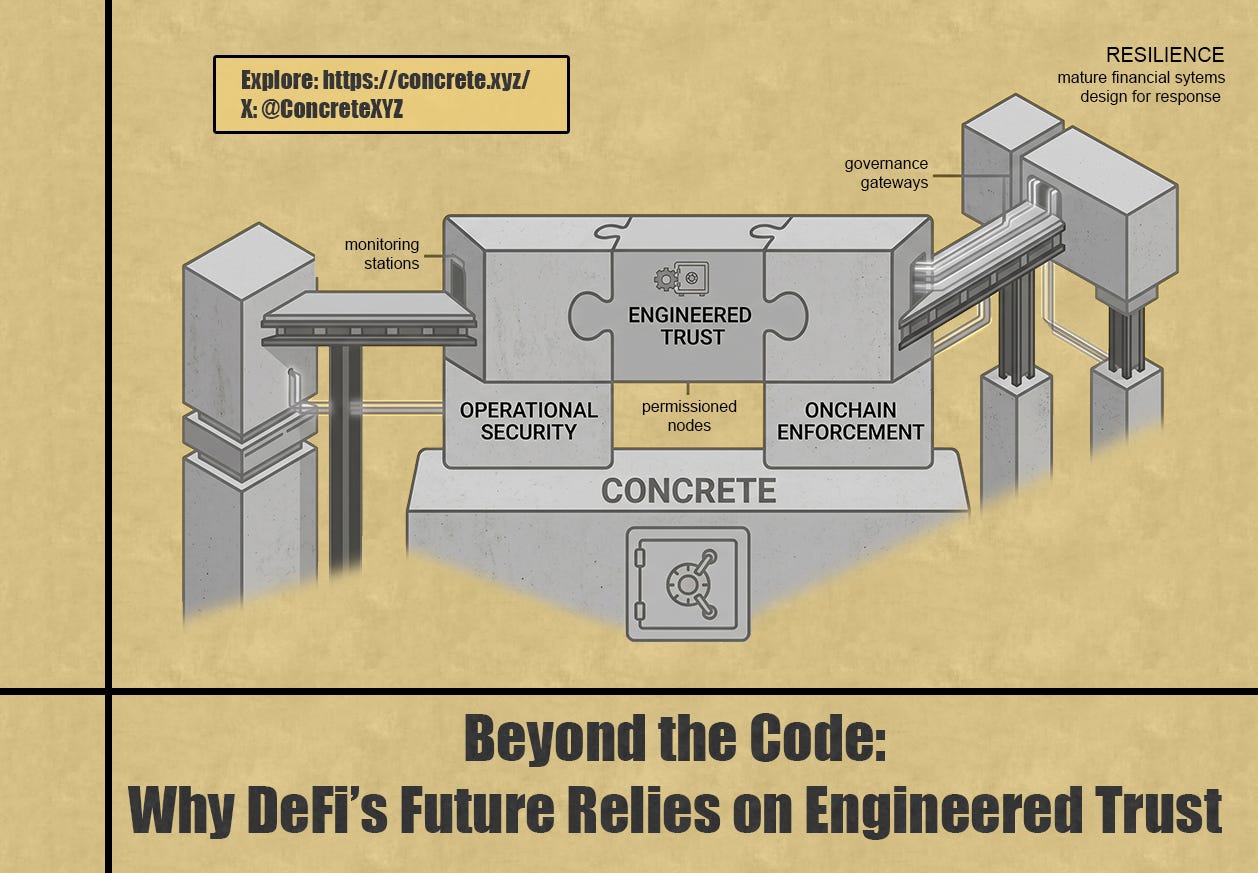
This is what engineered trust means.
It involves:
- defining clear roles and responsibilities
- setting explicit permissions
- enforcing constraints within the system
- building mechanisms to respond when things go wrong
This approach doesn’t reject decentralization.
It strengthens it by making assumptions visible and manageable.
Why Operational Security Is Essential
Smart contracts are deterministic.
They execute exactly as written.
But real-world systems are not always predictable.
Unexpected conditions, edge cases, and market stress can expose limitations in purely automated systems.
That’s why operational security is critical.
It adds:
- monitoring to track system behavior
- response mechanisms for critical situations
- human oversight when necessary
- layered defenses across components
Because resilience isn’t just about preventing failure.
It’s about handling it when it happens.
Concrete’s Approach to Engineered Trust
This is where Concrete vaults take a different direction.
Rather than relying on the idea that systems can be fully trustless, Concrete focuses on building structured, resilient DeFi infrastructure.
The approach includes:
- making trust assumptions explicit
- combining onchain enforcement with off-chain intelligence
- implementing role-based architecture with defined permissions
- operating within controlled execution environments
- designing systems that prioritize response as much as prevention
The goal is to improve DeFi security by aligning design with real-world complexity.
Not just ideal conditions — but stressed ones too.
The Shift Toward More Mature Systems
DeFi is evolving beyond early narratives.
The focus is moving toward:
- understanding how systems behave under pressure
- structuring trust instead of hiding it
- building infrastructure that can adapt
- prioritizing resilience over ideology
This is where institutional DeFi begins to take shape.
It’s not about removing trust entirely.
It’s about making it reliable.
Final Thought
Trust has always been part of financial systems.
DeFi didn’t eliminate it.
It redistributed it across code, infrastructure, and governance.
The next step is making that trust explicit — and designing systems that can enforce it.
Because in the end, the systems that last won’t be the ones that claim to remove trust.
They’ll be the ones that engineer it well.
Explore Concrete at https://concrete.xyz/