DeFi Doesn’t Remove Trust, It Engineers It
 Furkan6 min read·Just now
--
The Architecture of Trust: Securing the Next Era of DeFi
Decentralized finance was built on a beautifully simple, revolutionary premise. The cypherpunk dream promised a world where we could finally say, “Don’t trust people. Trust code.”
For a while, this felt like a massive breakthrough. We watched as smart contracts replaced slow, rent-seeking intermediaries. Transactions became universally transparent on public ledgers. Financial systems appeared to run autonomously without human intervention or centralized control. The concept of trustless systems quickly became the strongest, most heavily marketed narrative in the entire cryptocurrency space.
But as DeFi evolved from simple token swaps into a multi-billion dollar web of complex financial engineering, a very uncomfortable truth became impossible to ignore.
Trust did not disappear. It simply moved.
Today, users do not trust traditional bank tellers or Wall Street brokers. Instead, they place their faith in a highly complex, often opaque stack of code and human coordination. The question for the next era of finance is no longer whether trust exists. The real question is where that trust lives, who wields it, and exactly how it is managed.
The Myth of the Trustless Utopia
The idea of trustless finance is undeniably compelling. The narrative promises no banks, no intermediaries, and zero reliance on centralized authority. Just pure, immutable code.
But in reality, no financial system, decentralized or otherwise, can ever completely remove trust. Even in the most idealized DeFi protocols, trust is a constant requirement:
- You trust that the smart contract developers did not leave a hidden logic flaw.
- You trust that subsequent protocol upgrades will not introduce new vulnerabilities.
- You trust that the anonymous governance token holders will not act maliciously to drain the treasury.
- You trust that the external data feeds dictating your liquidations are completely accurate.
Code may reduce certain types of localized human trust, but it does not eliminate the concept of trust entirely. It merely redefines and redistributes it.
Exposing Where Trust Actually Lives
To truly understand DeFi security, we need to look past the marketing and dive deeper into the technical architecture. Trust exists across multiple, highly sensitive layers:
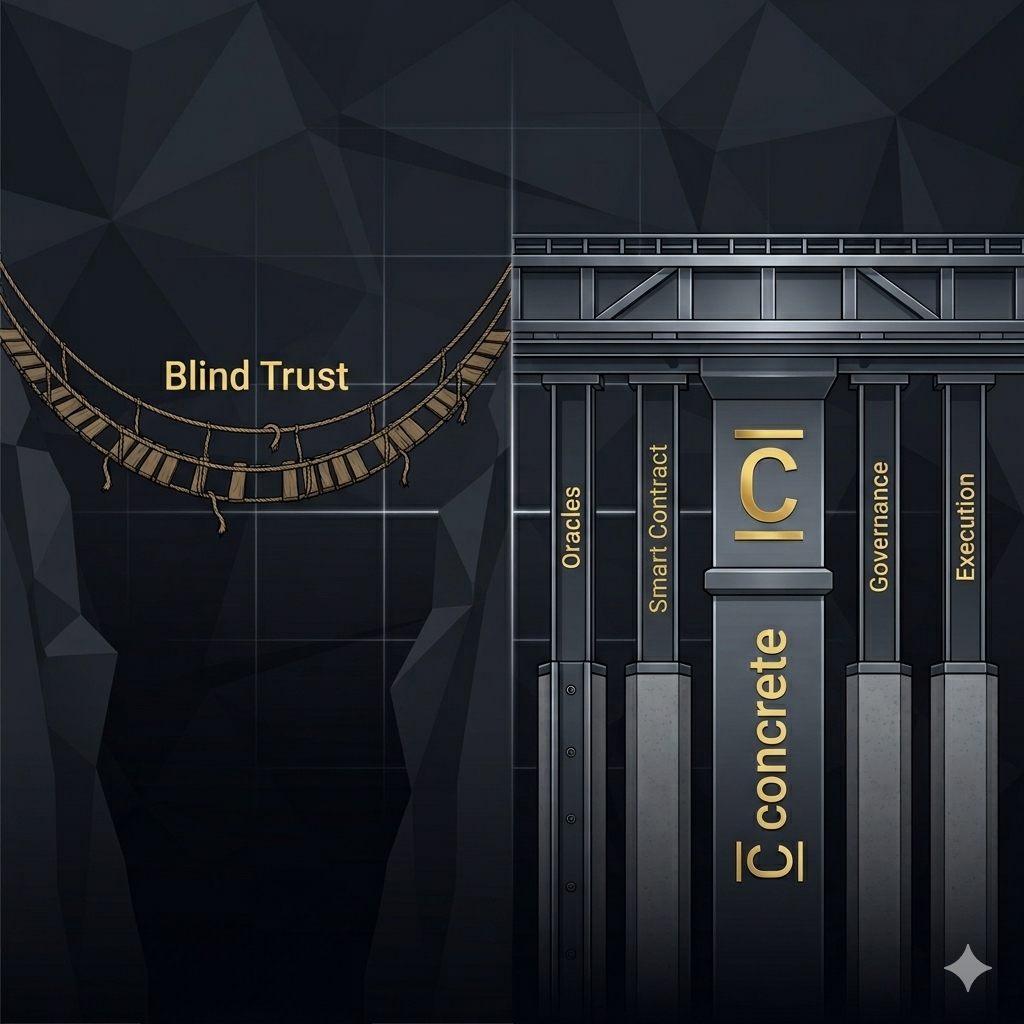
- Smart Contract Assumptions: Users inherently trust that the smart contracts holding their capital are secure, audited, and behave exactly as advertised. But code is written by humans, and humans make errors. A single missed edge case, a rounding error, or a reentrancy vulnerability can lead to catastrophic loss in a matter of seconds.
- Governance Systems: Decentralized Autonomous Organizations (DAOs) and governance mechanisms control critical protocol upgrades and risk parameters. However, voter participation in DAOs is notoriously low. This means the direction of a protocol can easily be dictated by a small, concentrated group of whales. You are trusting that this minority will always act in the best interest of the community.
- Oracle Dependencies: Smart contracts cannot see the outside world. They rely on oracles to provide external data, such as the real-time price of Ethereum or stablecoins. If an oracle’s data feed is manipulated or simply goes offline during a market crash, the entire lending and borrowing system can fail instantly, triggering unwarranted liquidations.
- The Core DeFi Infrastructure: This is where the physical reality of the ecosystem comes into play. DeFi infrastructure is not just the app you interact with; it is the entire underlying foundation. You are trusting cross-chain bridges to secure billions of dollars using complex cryptographic proofs. You are trusting the network validators, the sequencing mechanisms, and the block builders to process your transactions reliably and fairly, without extracting malicious value or censoring your actions. If this foundational DeFi infrastructure fails, the applications built on top of it collapse immediately.
Trust is not removed. It is simply distributed across these layers and often hidden behind the abstraction of a sleek user interface.
The Problem With Decentralization Theatre
This habit of hiding trust leads to one of the most dangerous phenomena in the industry today: decentralization theatre.
Some systems are designed to appear heavily decentralized on the surface simply to satisfy a philosophical narrative, but they are not truly resilient or safe. Examples of this theatre include:
- Using multi-signature wallets controlled by a few anonymous developers as a proxy for true security.
- Operating DAOs where the illusion of community voting masks the reality that a single entity holds the majority of voting power.
- Implementing timelocks that delay protocol changes by 48 hours. While this gives users a warning, it does absolutely nothing to prevent a live, mid-transaction exploit from draining a pool.
- Building systems that are so rigidly decentralized that nobody has the authority to pause the contract and respond quickly during a live emergency.
These structures create the appearance of safety without guaranteeing it. There is a massive, critical difference between looking decentralized and actually being secure. True security is not about optics; it is about how a financial system behaves under extreme stress.
The Paradigm Shift to Engineered Trust
If we accept that trust cannot be entirely removed, then our fundamental goal as an industry must change. Instead of pretending trust does not exist, we must engineer it properly.
This is the concept of engineered trust.
Engineered trust means:
- Building systems with clearly defined roles and responsibilities.
- Requiring explicit, hard-coded permissions and boundaries.
- Relying on enforceable constraints baked directly into the architecture.
- Demanding the ability to respond dynamically when things inevitably go wrong.
This is exactly how mature, trillion-dollar financial systems operate. They do not attempt to eliminate trust; they structure, limit, and manage it. Decentralized finance is finally beginning to move in the exact same direction.
The Unforgiving Necessity of Operational Security
One of the biggest limitations of the pure “code is law” ideology is that static code cannot possibly anticipate every future scenario. Markets are highly dynamic. Attack vectors evolve daily. Unexpected edge cases and black swan events always appear when you least expect them.
This is why operational security is absolutely critical in modern infrastructure. Real, durable systems require:
- Continuous, real-time monitoring of on-chain activity.
- Rapid response mechanisms that can isolate a threat before capital is lost.
- Layered security approaches.
- Crucially, the application of human judgment in complex, unprecedented situations.
Code is incredibly powerful, but it is not enough on its own. Resilient systems must combine the speed of code with intelligent, operational oversight.
How Concrete Engineers the Future of Trust
This is exactly where Concrete vaults take a fundamentally different approach to capital allocation and protection.
Instead of hiding trust behind vague claims of decentralization, Concrete makes trust explicit, structured, and enforceable. Concrete is built entirely around the philosophy that security must be actively engineered, not passively assumed.
Its architecture focuses heavily on several key pillars:
- Explicit Trust Models: Roles and permissions are clearly defined, limiting the blast radius of any single failure.
- Onchain Enforcement: Risk parameters and boundaries are strictly enforced directly through smart contracts, ensuring the rules cannot be broken.
- Off-chain Intelligence: Advanced systems monitor market conditions in real time, providing the situational awareness that static contracts lack.
- Controlled Execution Environments: Capital is managed in environments designed to drastically reduce unnecessary risk exposure.
- Response-Driven Design: Prioritizing operational readiness and resilience, ensuring the system can actually react to a crisis.
This architecture creates a new standard of managed DeFi, where capital is not just blindly deployed into the void, but actively protected. Instead of relying on utopian assumptions, Concrete builds systems designed to function securely under real-world conditions.
The Horizon: The Rise of Institutional DeFi
As the cryptocurrency ecosystem matures, we are entering a pivotal new phase. The next major wave of adoption is institutional DeFi.
Institutional capital requires predictability, security, structured risk management, and relentlessly reliable infrastructure. Institutions do not deploy billions of dollars based on ideological narratives like trustless systems. They require environments where trust is clearly defined, risks are mathematically measurable, and rapid responses are built directly into the system’s DNA.
This is where engineered trust transitions from a novel concept to an absolute necessity.
The Bigger Shift
DeFi is finally evolving beyond its early ideology. The overarching narrative is permanently shifting from the pursuit of trustless systems to the reality of engineered trust systems.
In this new phase of the internet of money:
- Trust is acknowledged and managed, not ignored.
- Systems are deliberately designed to handle failure, not just success.
- Absolute resilience matters infinitely more than decentralization theatre.
- Going forward, financial infrastructure will be judged solely by its performance under stress.
The future of decentralized finance will not be defined by who claims to remove trust the loudest. It will be defined by who engineers it the best.
Explore Concrete at https://concrete.xyz/