DeFi Doesn’t
Remove Trust —
It Engineers It
--
“The "trustless" promise was never the destination. It was the starting point. Here’s what comes next.”
There's a phrase baked into the founding mythology of crypto: "Don't trust people. Trust code." It became a rallying cry. A design philosophy. In the early days, it was clean, compelling, and — at first glance — correct.
Then DeFi happened. Billions locked on-chain. Complex protocols stacked on other protocols. And slowly, unavoidably, the cracks in the narrative appeared. Not because the technology failed. But because the narrative was incomplete. Trust didn't disappear from financial systems. It never does. It just moved — quietly, structurally — into places most users couldn't see.
What DeFi actually built wasn’t a trustless system. It built a system where trust is distributed differently. And in that distinction lies one of the most important conversations in crypto today.
01
The Myth of the Trustless Machine
The original pitch was seductive in its simplicity: remove the middlemen, deploy smart contracts, let code be law. The bank can't freeze your funds. The broker can't front-run you. The custodian can't disappear with your assets. No trust required — only math.
For peer-to-peer transfers of a single asset, this mostly holds. But DeFi is not a peer-to-peer transfer of a single asset. DeFi is an interconnected web of protocols, each making silent assumptions about every layer beneath it.
"The question was never whether trust exists in DeFi. The question is where it lives — and whether it's been designed or just assumed."
The Architecture Problem
Every smart contract trusts the compiler that compiled it. Every oracle-dependent protocol trusts the oracle feed. Every governance system trusts that token holders will vote. Every bridge trusts the validators on both ends. These aren’t edge cases. They’re the foundational assumptions of the entire stack — and they are, each one of them, acts of trust.
02
Where Trust Actually Lives
Strip away the marketing and trace trust through a typical DeFi interaction. At every layer, you’ll find it waiting — not eliminated, but abstracted. The architecture below shows how trust is distributed across the DeFi stack.
📜 Smart Contracts
You trust the code is correct, audited, and hasn’t been upgraded by a compromised multisig.
🔮 Oracles
You trust the price feed is accurate, manipulation-resistant, and not a single point of failure.
🗳️ Governance
You trust that token holders vote in good faith — and that quorum is actually representative.
🌉 Bridges
You trust the cross-chain validators, the multi-party computation, and the bridge contract itself.
⚙️ Execution Layers
You trust sequencers, block builders, and MEV searchers to handle your transaction fairly.
🔑 Key Management
You trust that admin keys are held securely, rotated properly, and can’t be extracted.
None of this is criticism — it’s architecture. Every system that handles value at scale will involve trust. The real question is whether that trust has been acknowledged, modelled, and managed. In much of early DeFi, the honest answer is: not really.
03
The Problem With Decentralisation Theatre
As DeFi matured, a new pattern emerged. Protocols adopted the aesthetics of decentralisation without the substance. It became possible — common, even — to build systems that appeared open and distributed while remaining deeply fragile.
⚠ Patterns of Decentralisation Theatre
★ A 3-of-5 multisig controlling upgrade keys — called "community governance," controlled by the founding team
★ A DAO with 4% participation deciding protocol-level changes that affect hundreds of millions in TVL
★ Timelocks that delay admin actions by 48 hours — long enough to look safe, too short to react to an exploit
★ Emergency pause functions that require on-chain votes in a crisis where seconds matter
★ Decentralised governance that can’t coordinate fast enough to prevent a known oracle manipulation
The gap between appearance and resilience is where protocols die. When a critical vulnerability is discovered and the response mechanism is a governance vote with a 72-hour delay, decentralisation hasn't protected users — it has paralysed the system at the worst possible moment.
Real security isn't about how a system looks on its architecture diagram. It's about how a system behaves under stress. And stress-testing DeFi's decentralisation theatre has not, historically, ended well.
04
Engineered Trust: A Better Model
Traditional finance — for all its flaws — understands something DeFi is only beginning to learn: trust can be designed. Not eliminated, but structured, constrained, and made legible. Mature financial infrastructure doesn't promise to remove trust. It promises to make it explicit.
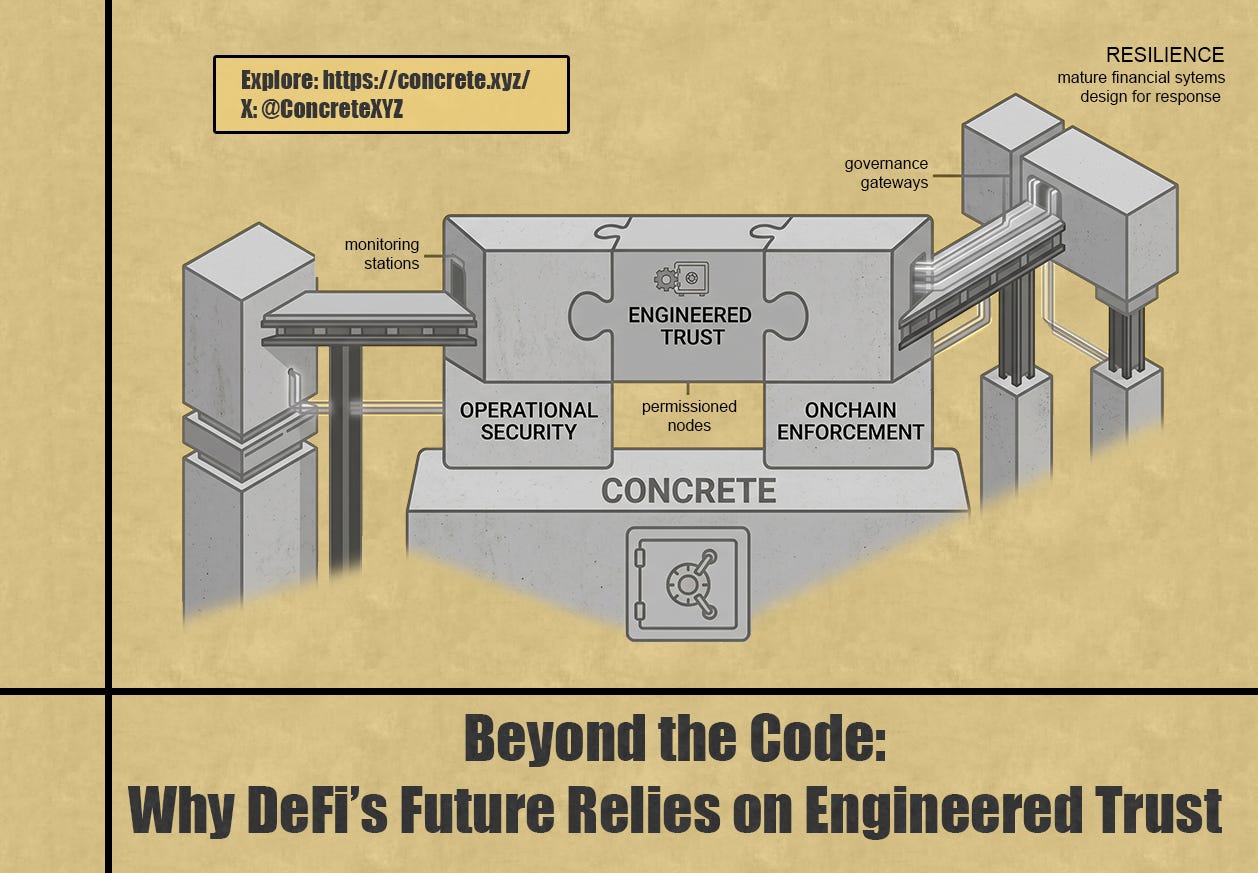
Engineered trust means defining who can do what, under what conditions, with what constraints, and with what recourse if something goes wrong. It is the opposite of hidden trust — which is trust that exists in the system but has never been acknowledged or modelled.
01 Clear Roles
Every actor in the system has defined permissions. No ambiguity about who controls what.
02 Enforced Constraints
Limits aren’t just policy — they’re on-chain. Code enforces boundaries that can’t be bypassed.
03 Response Mechanisms
When things go wrong, there’s a defined path. Not a governance vote. A response.
04 Transparency
Trust is visible. Users can audit who holds what permissions and what the constraints are.
This isn’t about centralisation. It’s about honesty. A system with clear, documented, constrained trust surfaces is safer than a system that claims to have none — because the latter has hidden trust that no one is managing.
05
Why Code Alone Isn’t Enough
Smart contracts are deterministic. They execute exactly what they're told. This is a feature — and also their greatest limitation. The real world is not deterministic. Oracles fail. Economic conditions shift overnight. Novel attack vectors emerge that no audit anticipated. A black-swan event doesn't pause for governance.
Real operational security in DeFi requires a layer that code cannot provide on its own: the capacity for informed, rapid human judgment at the edges of the system. This doesn't mean reintroducing the bank. It means acknowledging that monitoring, detection, and response are engineering problems as much as smart contract logic is.
The question for institutional DeFi infrastructure isn't "is this trustless?" It's "when this fails — because all systems eventually face stress — does it fail safely, and can it recover?"
Operational Security Framework
A protocol that can pause itself in a genuine emergency, route around a compromised oracle, or isolate a vulnerable vault without waiting for a quorum vote is not less decentralised. It’s more resilient. And resilience, in the long run, is what institutions actually need.
06
How Concrete Engineers Trust Differently
Concrete Protocol
Concrete was built on a different premise from the start. Rather than treating "trustless" as the goal, Concrete treats trust as an engineering problem — something to be structured, constrained, and made explicit at every layer.
✦ Trust is explicit, not assumed. Every permission in the system is defined and visible. There is no hidden administrative backdoor, no silent multisig, no governance loophole. Role-based architecture means you always know who can do what — and what they cannot.
✦ Onchain enforcement + off-chain intelligence. Smart contracts enforce the boundaries. But Concrete pairs that with active monitoring and response systems that can detect anomalies in real time — not after the fact. The blockchain provides the proof. The infrastructure provides the awareness.
✦ Designed for response, not just prevention. Prevention is never 100%. What distinguishes Concrete Vaults is a system architecture that assumes stress and plans for it. Controlled execution environments, layered access, and defined response pathways mean that when a critical moment arrives, the system can act — not wait.
✦ Operational security as a first principle. This isn’t a feature added on top of DeFi infrastructure. It is the infrastructure. Every design decision in Concrete’s vault architecture reflects the understanding that DeFi security is not just about code — it’s about systems, monitoring, and the capacity for measured, rapid response.
This approach is what institutional DeFi actually demands. Capital doesn’t flow into infrastructure that relies on good luck. It flows into infrastructure that has modelled its risks, structured its trust, and demonstrated it can hold under pressure.
07
The Shift That’s Already Happening
The "trustless" narrative served a purpose. It was a necessary provocation against legacy systems where trust was centralised, opaque, and often abused. But as a design principle for complex financial infrastructure handling institutional capital, it was always incomplete.
The next phase of DeFi is already emerging. And it looks less like a revolt against trust — and more like a sophisticated renegotiation of it. Protocols that acknowledge trust, surface it, constrain it, and make it legible are beginning to outperform those that simply claim it doesn't exist.
The future of DeFi won't be defined by who claims to remove trust.
It will be defined by who engineers it best.
Resilience is the new trustless. Infrastructure will be judged not by its ideology but by how it behaves when conditions are worst. The protocols that survive — and earn the capital flows that follow — will be those that were honest about where trust lives in their systems, and rigorous about how they designed for it.
The myth is over. The engineering has started.
Visit https://app.concrete.xyz/