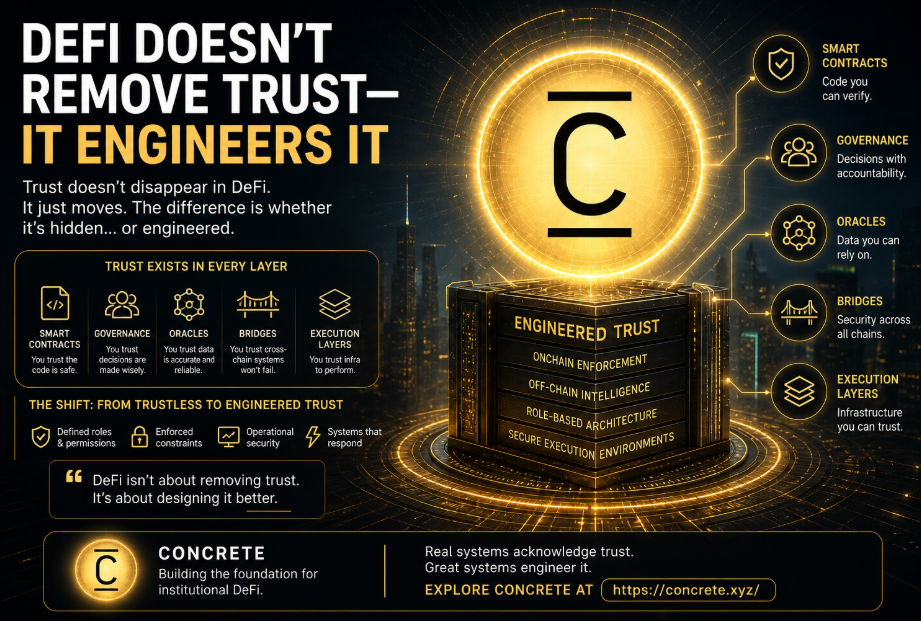
DeFi Doesn’t Remove Trust — It Engineers It
 Dinaalanaa3 min read·Just now
--
DeFi was built on a powerful narrative:
“Don’t trust people. Trust code.”
For a while, that idea felt revolutionary.
No banks. No intermediaries. Just smart contracts executing logic transparently on-chain.
But as DeFi matured, reality became harder to ignore:
Trust didn’t disappear. It just moved.
The real question is no longer whether trust exists —
but where it exists and how it’s engineered.
The Myth of “Trustless” Systems
The term trustless became one of the most widely used ideas in crypto:
- “Code is law”
- “No intermediaries needed”
- “Everything is decentralized”
At face value, it sounds perfect.
But in practice, no system is fully trustless.
Even in DeFi, users are still relying on multiple layers of assumptions — many of which are not always visible.
Where Trust Actually Lives in DeFi
Trust in DeFi hasn’t been removed. It has been redistributed across the stack:
- Smart Contracts
You trust that the code has no bugs or vulnerabilities. - Governance Systems
You trust that token holders make rational and secure decisions. - Oracles
You trust external data feeds to be accurate and manipulation-resistant. - Bridges
You trust cross-chain systems not to be exploited. - Execution Layers
You trust infrastructure to behave correctly under stress.
In most cases, this trust is abstracted away, not eliminated.
The Problem with Decentralization Theatre
One of the biggest issues in today’s DeFi landscape is what can be called:
“Decentralization Theatre.”
Some systems appear decentralized — but lack real resilience.
Examples include:
- Multisigs as “security”
A few signers controlling critical functions. - Inactive DAOs
Governance exists, but participation is low. - Timelocks
Delaying actions without actually preventing risk. - Rigid Systems
Protocols that cannot react during emergencies.
These designs create the appearance of decentralization,
but not necessarily actual safety.
And in high-stakes financial systems, appearance is not enough.
From Trustless to Engineered Trust
Instead of chasing the illusion of removing trust,
the next evolution of DeFi is about engineering it properly.
Engineered trust means:
- Clearly defined roles and responsibilities
- Explicit permissions and boundaries
- Enforced constraints on actions
- Systems that can respond to failures in real time
This is how mature financial systems operate.
And it’s how DeFi infrastructure must evolve to support real-world use.
Why Operational Security Matters
In practice, code alone is not enough.
Real systems require:
- Continuous monitoring
- Rapid response mechanisms
- Human judgment in edge cases
- Layered security models
Unexpected scenarios will always exist.
Markets move fast. Attacks evolve. Edge cases happen.
A purely static system — no matter how well written —
cannot anticipate everything.
This is where operational security becomes critical.
How Concrete Approaches Trust Differently
This is where a new model begins to emerge.
Concrete takes a fundamentally different approach to DeFi infrastructure:
- Trust is explicit, not hidden
- Systems are designed for response, not just prevention
- Onchain enforcement combined with off-chain intelligence
- Role-based architecture for controlled execution
- Secure environments for critical operations
Instead of pretending trust doesn’t exist,
Concrete acknowledges it and structures it deliberately.
This approach prioritizes:
Operational security over decentralization theatre.
And that distinction matters — especially as DeFi moves toward institutional adoption.
👉 Explore Concrete at https://concrete.xyz/
The Bigger Shift in DeFi
DeFi is entering a new phase.
The industry is moving beyond simple narratives like:
- “Trustless systems”
- “Pure decentralization”
Toward something more realistic and more powerful:
- Structured trust
- Explicit system design
- Resilience under pressure
Because in the end:
Infrastructure isn’t judged by how it looks —
but by how it behaves when things go wrong.
The future of DeFi won’t belong to protocols that claim to remove trust.
It will belong to those who engineer it best.