DeFi Doesn’t Remove Trust — It Engineers It
--
How the next phase of decentralized finance depends on making trust explicit, structured, and enforceable.
The myth that started it all
DeFi was born from a compelling idea. Remove the middlemen. Replace human judgment with code. Build systems where no single entity holds power. The rallying cry was simple: “Don’t trust people. Trust code.”
For a while, it worked — or at least, it worked well enough. Early protocols demonstrated that you could lend, borrow, and swap assets without a bank, a broker, or a counterparty you’d ever met. The promise of a trustless financial system started to feel real.
But as the ecosystem matured, a quieter truth began to emerge. One that the early narratives hadn’t accounted for.
Trust didn’t disappear from DeFi. It just moved — and in moving, it became harder to see.
Where trust actually lives
Every DeFi interaction you make rests on a stack of assumptions. When you deposit into a protocol, you’re trusting that the smart contract was written correctly — and that the audit missed nothing. When a liquidation triggers, you’re trusting that the oracle feeding price data hasn’t been manipulated. When you bridge assets cross-chain, you’re trusting that the bridge’s security model holds under adversarial conditions.
Smart contracts Correctness & audit coverage
Governance Voter participation & intent
Oracles Data integrity & manipulation resistance
Bridges Cross-chain security models
Execution layers MEV, ordering & finality
None of these are trustless. Each is a node where trust has been relocated — from a known institution to an anonymous codebase, from a regulated entity to an algorithm. The trust is real. It’s just been abstracted away, making it invisible until something breaks.
The problem with decentralization theatre
Here’s where it gets uncomfortable. A significant portion of what calls itself “decentralized” in DeFi isn’t meaningfully resilient — it’s performing the aesthetics of decentralization while retaining the risks of centralisation without the protections.
Consider a protocol governed by a DAO where fewer than 5% of token holders participate in any given vote. Or a multisig where three of the five keyholders are known to one another and operate under the same jurisdiction. Or a timelock that announces an emergency action 48 hours before execution — in a market that can move 40% in an afternoon. These are not decentralized systems. They are systems wearing decentralization as a costume.
The distinction matters enormously: the appearance of decentralization is not the same as actual safety. When something goes wrong — and in DeFi, things go wrong — the question isn’t whether the architecture looked decentralized on a diagram. The question is whether the system could respond.
Engineered trust: a better model
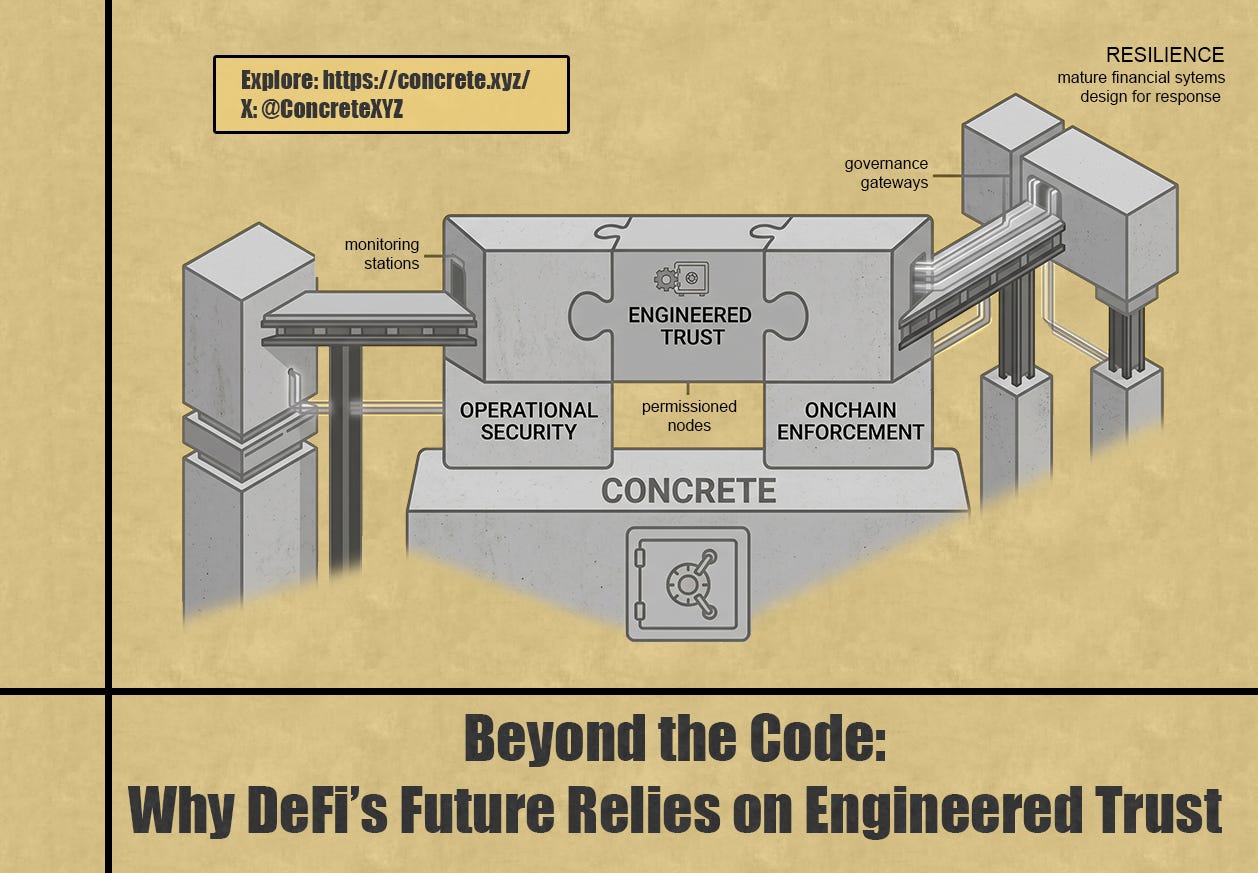
Mature financial infrastructure — whether traditional or onchain — doesn’t eliminate trust. It designs it. Trust is made explicit: who holds what authority, under what conditions, with what constraints, and with what accountability mechanisms in place.
This is engineered trust. It looks like clear role-based permissions. It looks like enforced constraints that can’t be bypassed in a moment of pressure. It looks like systems that are designed not just to prevent failure, but to respond when failure happens anyway — because in complex systems, some failure is always inevitable.
The shift from “trustless” to “engineered trust” isn’t a retreat from DeFi’s ideals. It’s a maturation of them. It acknowledges that the goal was never the absence of trust — it was the absence of hidden, unaccountable trust.
Why operational security is the real frontier
Code is powerful. But code alone cannot handle every scenario. When a novel exploit is discovered at 3am, when an oracle begins reporting anomalous prices, when a governance proposal moves faster than anyone anticipated — these are moments that require monitoring, rapid response, and human judgment operating within defined guardrails.
Operational security in DeFi means building systems that are monitored continuously, not just deployed and forgotten. It means having response mechanisms that can act in minutes, not days. It means layered defenses — onchain enforcement backed by off chain intelligence — so that a single point of failure doesn’t become a systemic one.
This is where most DeFi infrastructure still falls short. And it’s where the next generation of protocols will be differentiated.
How Concrete takes a different approach
Concrete is built on the premise that trust in DeFi infrastructure should be explicit, not hidden. Its architecture reflects this at every layer: role-based permissions define who can do what and under what conditions. Controlled execution environments enforce those boundaries onchain. Off chain intelligence provides the monitoring and response capabilities that pure code can’t.
Rather than claiming to remove trust, Concrete structures it. Rather than designing only for the happy path, it designs for failure — because resilient systems are judged not by how they perform when everything is fine, but by how they behave when it isn’t.
This is what institutional DeFi actually requires: not the ideology of trustlessness, but the engineering of trust that is transparent, structured, and enforced. Concrete vaults embody this principle — onchain enforcement paired with the kind of operational security that makes real-world capital comfortable participating in decentralized finance.
Explore more at concrete.xyz.
The shift that’s already underway
DeFi is growing up. The “trustless” narrative served an important purpose — it broke open the imagination of what financial infrastructure could look like. But it was always a simplification. The protocols that will define the next decade of onchain finance won’t be those that shout loudest about removing trust. They’ll be the ones that engineer it most carefully.
Resilience matters more than ideology. Infrastructure will be judged by how it behaves under stress. And the systems that acknowledge trust — that design it deliberately, make it visible, and hold it accountable — are the ones that will earn the confidence of the next wave of participants.
The future of DeFi won’t be defined by who removes trust. It will be defined by who engineers it best.