Eusebius3 min read·Just now
--
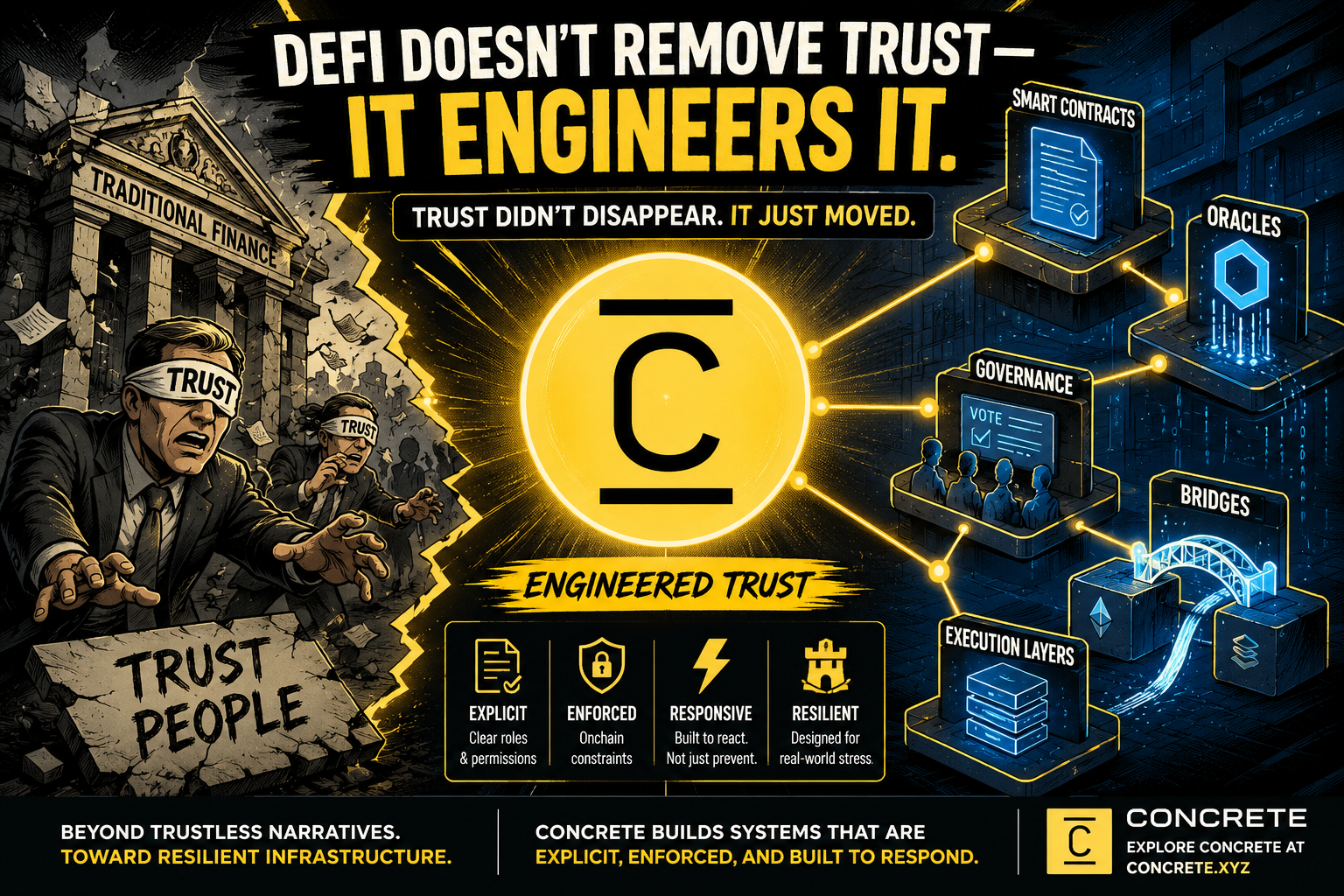
DeFi Doesn’t Remove Trust It Engineers It
DeFi was built on a powerful idea:
“Don’t trust people. Trust code.”
For years, this became one of the industry’s defining narratives. Smart contracts replaced intermediaries. Protocols became autonomous. “Code is law” became the foundation of what many believed would be a completely trustless financial system.
But as DeFi evolved, something became increasingly obvious:
Trust never disappeared.
It simply moved.
Today, every DeFi user still relies on trust just in different forms:
Smart contracts
Governance systems
Oracles
Bridges
Execution layers
The reality is that no financial system is fully trustless.
The real question is not whether trust exists.
It’s where that trust exists, how visible it is, and whether it has been engineered deliberately.
Where Trust Actually Lives in DeFi
Most DeFi systems present themselves as autonomous and decentralized. But underneath the surface, they depend on multiple layers of assumptions.
Users trust that:
Smart contracts behave as intended
Governance participants act responsibly
Oracles deliver accurate data
Bridges remain secure
Execution systems function during volatility
Even when systems are decentralized, trust still exists within the infrastructure itself.
In many cases, trust is not eliminated it is simply abstracted away from the user experience.
This is one of the biggest misconceptions in DeFi security.
A protocol may appear trustless from the front end while still relying heavily on operational assumptions behind the scenes.
The Problem With Decentralization Theatre
As the industry grew, another issue emerged: the appearance of decentralization became more important than actual resilience.
Some systems advertise themselves as decentralized because they use:
Multisigs
DAOs
Timelocks
Governance voting
But structure alone does not guarantee safety.
A multisig can still become a centralized point of failure.
A DAO with low participation can concentrate decision-making among a few actors.
Timelocks may delay risk, but they do not necessarily prevent it.
And fully rigid systems may struggle to react during critical market conditions.
This creates what many now recognize as decentralization theatre systems optimized to look decentralized without being operationally resilient.
There is a difference between the appearance of decentralization and actual security.
The Shift Toward Engineered Trust
Mature systems do not pretend trust disappears.
They design for it.
This is the idea behind engineered trust.
Instead of hiding assumptions, engineered systems make them explicit:
Roles are clearly defined
Permissions are structured
Constraints are enforced
Response mechanisms are built into the system
This is how large-scale financial infrastructure has always operated.
Not by assuming failure is impossible but by preparing for it.
As DeFi matures, the industry is beginning to move in the same direction.
Why Operational Security Matters
Real financial systems cannot rely on code alone.
Markets are unpredictable. Edge cases exist. Conditions change faster than static systems can adapt.
That is why operational security matters.
Strong DeFi infrastructure requires:
Continuous monitoring
Layered security systems
Rapid response capabilities
Human judgment during abnormal conditions
Code is powerful, but code alone cannot anticipate every scenario.
The strongest systems are not the ones that assume nothing can go wrong.
They are the ones designed to respond effectively when something does.
How Concrete Approaches Trust Differently
This is where Concrete takes a fundamentally different approach.
Instead of hiding trust assumptions behind decentralization narratives, Concrete makes them explicit and structured.
Its architecture is designed around:
Clear operational roles
Controlled execution environments
Onchain enforcement mechanisms
Off-chain intelligence and monitoring
Systems built for response, not just prevention
This approach prioritizes operational security over decentralization theatre.
Rather than pretending trust does not exist, Concrete focuses on engineering systems where trust is:
Visible
Constrained
Accountable
Enforceable
That distinction matters especially in institutional DeFi, where resilience and reliability matter more than ideology.
The Bigger Shift Happening in DeFi
DeFi is entering a new phase.
The early era was dominated by narratives around fully trustless systems and pure decentralization. But over time, the industry has learned that resilience matters more than slogans.
Explore Concrete at https://concrete.xyz/�