--
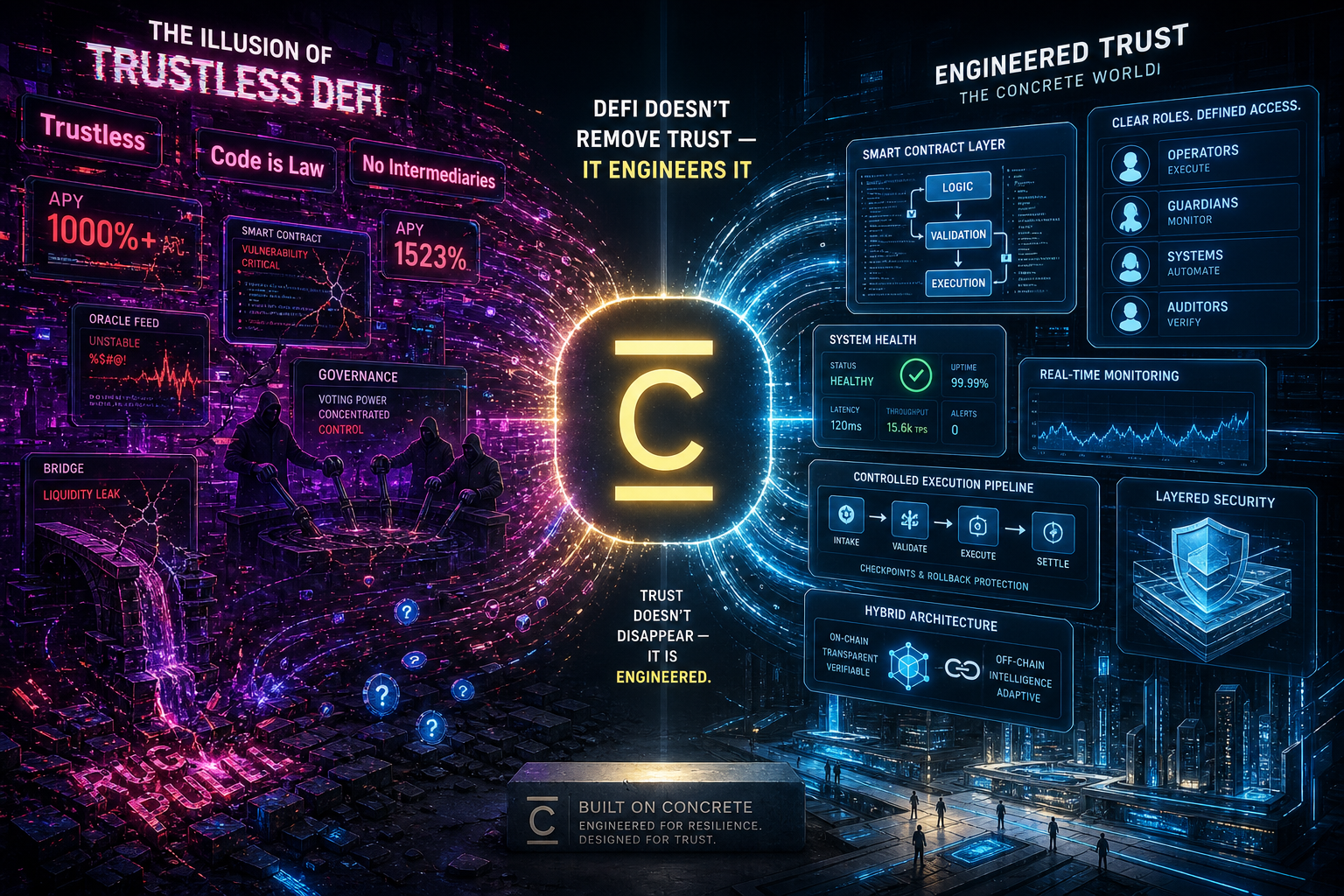
DeFi Doesn’t Remove Trust — It Engineers It
DeFi was built on a powerful and seductive idea:
“Don’t trust people. Trust code.”
For a while, that idea felt revolutionary.
Smart contracts replaced intermediaries. Transactions became transparent. Systems executed automatically. The promise was simple: remove human trust, and you remove human failure.
But as DeFi evolved, something became clear:
Trust didn’t disappear. It just moved.
And today, the real question is no longer whether trust exists in DeFi—
It’s where it exists, and how it’s designed.
The Myth of “Trustless” Systems
At the core of DeFi’s identity are a few widely accepted beliefs:
“DeFi is trustless”
“Code is law”
“No intermediaries needed”
These ideas helped bootstrap an entire industry. They simplified complexity into something intuitive and compelling.
But they were never entirely true.
Because in reality, no system is fully trustless.
Every system—financial or otherwise—relies on assumptions. And assumptions are just another form of trust.
So the real question becomes:
Is trust being deliberately engineered—or quietly ignored?
Where Trust Actually Lives in DeFi
To understand DeFi properly, you have to look beneath the surface.
Trust hasn’t been eliminated—it has been redistributed across multiple layers:
1. Smart Contracts
Users trust that:
The code is secure
There are no hidden vulnerabilities
The logic behaves as intended
But most users cannot audit code themselves. They trust auditors, developers, or reputation.
2. Governance Systems
Protocols often rely on DAOs or token-based governance.
Users trust that:
Decisions are made fairly
Voting power isn’t overly concentrated
Governance won’t act maliciously
In practice, governance often reflects power dynamics—not pure decentralization.
3. Oracles
DeFi depends heavily on external data.
Users trust that:
Price feeds are accurate
Data cannot be manipulated
Failures are handled safely
If an oracle fails, the entire system can break—no matter how perfect the smart contract is.
4. Bridges
Cross-chain infrastructure is one of the most fragile layers.
Users trust that:
Assets are properly backed
Validation mechanisms are secure
No single point of failure exists
Historically, bridges have been one of the largest attack surfaces in DeFi.
5. Execution Layers
Transactions don’t exist in isolation.
Users trust that:
Transactions execute as expected
MEV (Maximal Extractable Value) doesn’t exploit them unfairly
Network conditions won’t distort outcomes
Execution is not neutral—it’s an active environment with incentives and risks.
The Problem With “Decentralization Theatre”
As DeFi matured, a new issue emerged:
Systems that look decentralized—but aren’t actually resilient.
This is what we can call decentralization theatre.
Examples include:
Multisigs as “security”
A handful of signers controlling critical functions
DAOs with low participation
Where a small minority effectively governs the system
Timelocks
That delay actions—but don’t prevent bad decisions
Rigid systems
That cannot respond when something goes wrong
These mechanisms create the appearance of decentralization.
But appearance is not the same as safety.
Decentralization without accountability or responsiveness is just risk—distributed, not reduced.
From Trustless to Engineered Trust
If trust cannot be removed, then the next step is obvious:
Trust must be designed.
This is where the concept of engineered trust comes in.
Engineered trust means:
Clear roles and responsibilities
Who can do what—and under what conditions
Defined permissions
Not everything is open; access is structured
Enforced constraints
Systems limit what is possible, even for insiders
Response mechanisms
The system can react when something goes wrong
This is how mature financial systems operate.
Not by pretending trust doesn’t exist—
But by making it explicit, controlled, and enforceable.
Why Code Alone Is Not Enough
One of the biggest misconceptions in DeFi is that code can handle everything.
It can’t.
Real-world systems require:
Continuous monitoring
Rapid response capabilities
Human judgment in edge cases
Layered security approaches
Smart contracts are deterministic.
But reality is not.
Markets move. Attacks evolve. Conditions change.
And when they do, purely static systems break.
How Concrete Approaches Trust Differently
This is where a new design philosophy emerges.
Concrete doesn’t try to hide trust.
It makes it explicit—and engineers it deliberately.
Key principles include:
1. Explicit Trust Design
Trust assumptions are not abstracted away.
They are:
Defined
Visible
Structured
2. Systems Built for Response
Instead of only preventing failure, systems are designed to:
Detect issues
React quickly
Contain damage
3. On-Chain Enforcement + Off-Chain Intelligence
Concrete combines:
Deterministic smart contract guarantees
Real-time monitoring and decision-making
This hybrid approach reflects how real systems operate.
4. Role-Based Architecture
Not everything is permissionless chaos.
Instead:
Roles are clearly defined
Actions are controlled
Responsibilities are assigned
5. Controlled Execution Environments
Execution is not left entirely to chance.
It is:
Structured
Monitored
Constrained
Concrete prioritizes operational security over decentralization theatre.
It focuses on how systems behave under stress—not just how they look on paper.
The Bigger Shift in DeFi
DeFi is entering a new phase.
The narrative is changing:
From “trustless” → to “trust-aware”
From ideology → to engineering
From appearance → to resilience
The systems that will define the future are not the ones that claim to eliminate trust.
They are the ones that:
Acknowledge it
Structure it
Enforce it
Optimize it
Because in the end:
Resilience matters more than ideology.
Final Thought
The future of DeFi won’t be defined by who claims to remove trust.
It will be defined by:
Who engineers it best.
🚨 Explore Concrete: https://concrete.xyz/� 🚨