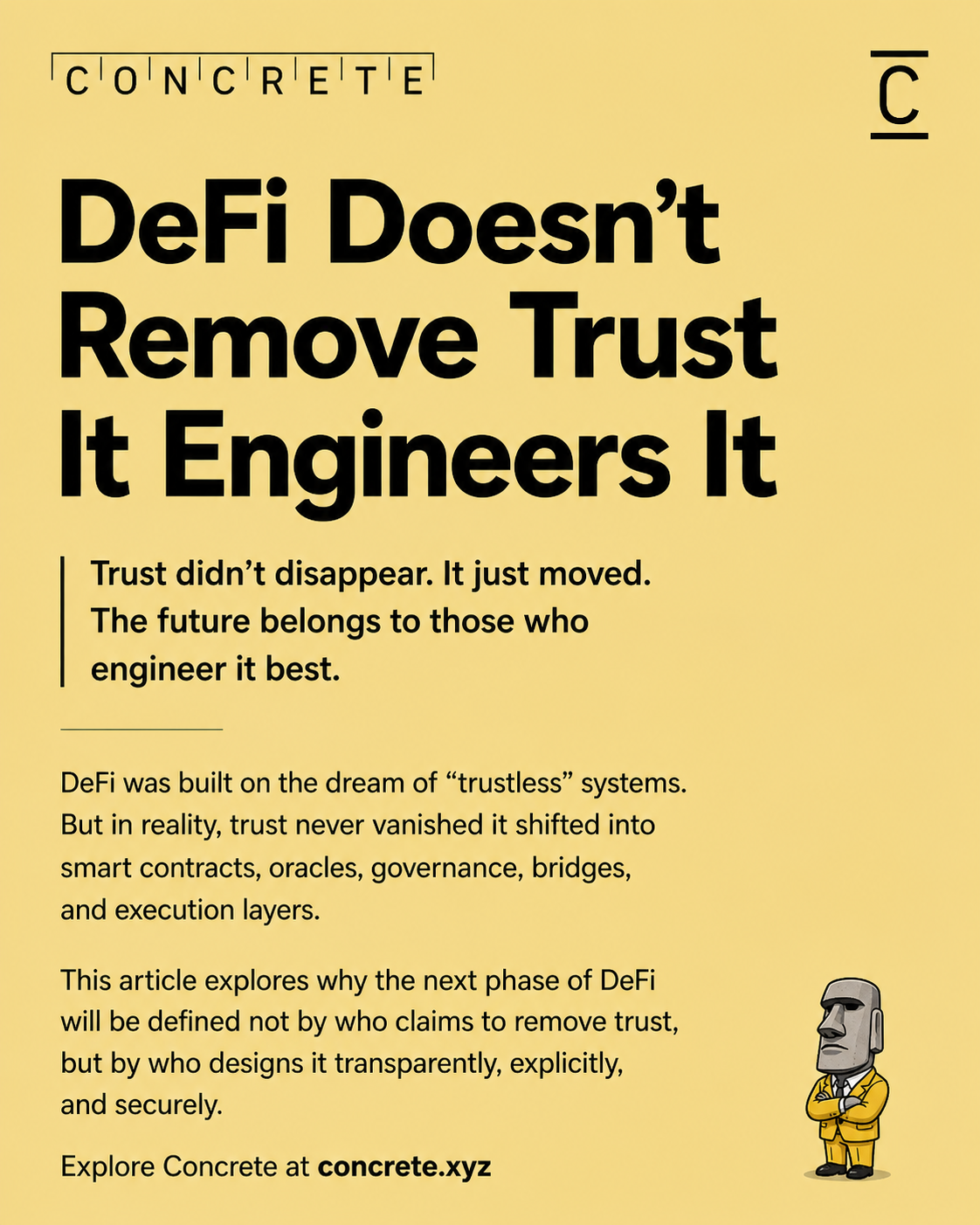
DeFi Doesn’t Remove Trust — It Engineers It
 Asha Iyanuoluwa3 min read·Just now
--
For years, DeFi has been built on a seductive myth:
“DeFi is trustless.” “Code is law.” “No intermediaries needed.”
It’s a powerful narrative — clean, elegant, almost ideological. But as the industry matures, the cracks in that story are impossible to ignore. Because in real systems, trust never disappears. It only changes form.
The real question isn’t whether trust exists. It’s where it lives and how intentionally it’s designed.
Where Trust Actually Lives in DeFi
Even the most “trustless” systems rely on layers of assumptions that users rarely see. Trust isn’t removed, it’s abstracted.
Smart Contracts
You trust that:
- the code is correct
- audits caught everything
- no hidden upgrade paths exist
- no economic attack vectors were missed
Smart contracts aren’t trustless. They’re trust transferred from humans to code.
Governance Systems
Token voting introduces:
- whale influence
- voter apathy
- governance capture
- rushed or uninformed decisions
Governance is a trust layer, just one with different failure modes.
Oracles
Every oracle is a bridge between off-chain truth and on-chain execution. You trust:
- data providers
- aggregation logic
- update frequency
- fallback mechanisms
Oracles are a trust bottleneck disguised as infrastructure.
Bridges
Bridges are the most obvious trust chokepoint in DeFi. You trust:
- multisig operators
- relayers
- verification systems
- cross-chain consensus assumptions
Billions have been lost because this trust was implicit, not engineered.
Execution Layers
MEV, reorgs, censorship — these are not theoretical risks. You trust:
- validators
- sequencing rules
- liveness guarantees
Execution is a trust layer that most users never think about.
The Problem With Decentralization Theatre
Much of DeFi still operates under the illusion of decentralization — systems that look decentralized but behave like centralized services when stressed.
Examples include:
- multisigs marketed as “community governance”
- DAOs with <5% voter participation
- timelocks that delay attacks but don’t prevent them
- protocols unable to respond during emergencies
This is decentralization theatre: the appearance of safety without the substance.
Real decentralization isn’t about optics. It’s about resilience.
Engineered Trust: A Better Model
The next phase of DeFi won’t be built on eliminating trust — it will be built on engineering it.
Engineered trust means:
- clearly defined roles
- explicit permissions
- enforceable constraints
- systems designed for failure, not fantasy
- transparency about who can do what, and when
This is how mature financial systems operate. And it’s how the next generation of DeFi infrastructure must operate.
Why Operational Security Matters
Code alone cannot handle every scenario. Real systems require:
- continuous monitoring
- rapid response capabilities
- human judgment in edge cases
- layered security models
- controlled execution environments
This is the difference between a protocol that survives stress — and one that collapses under it.
Operational security isn’t a nice-to-have. It’s the backbone of institutional DeFi.
How Concrete Engineers Trust
This is where Concrete takes a fundamentally different approach.
Instead of pretending trust doesn’t exist, Concrete makes it explicit, structured, and enforceable.
Concrete’s model includes:
Onchain Enforcement + Offchain Intelligence
Rules are enforced onchain, but informed by real-time offchain monitoring and analysis.
Role-Based Architecture
Clear, auditable permissions — no hidden powers, no ambiguous authority.
Controlled Execution Environments
Concrete vaults operate with deterministic behavior, minimizing attack surface and maximizing predictability.
Operational Security First
Concrete prioritizes:
- response over rhetoric
- resilience over ideology
- engineered trust over decentralization theatre
This is DeFi infrastructure built for institutions — not narratives.
The Bigger Shift Ahead
DeFi is evolving.
The industry is moving beyond the simplistic idea of “trustless systems” and toward a more mature understanding:
- Trust is unavoidable.
- What matters is how it’s designed.
- Resilience beats ideology.
- Infrastructure will be judged by how it behaves under stress.
The future of DeFi won’t be defined by who claims to remove trust.
It will be defined by who engineers it best.
Explore Concrete at https://concrete.xyz/