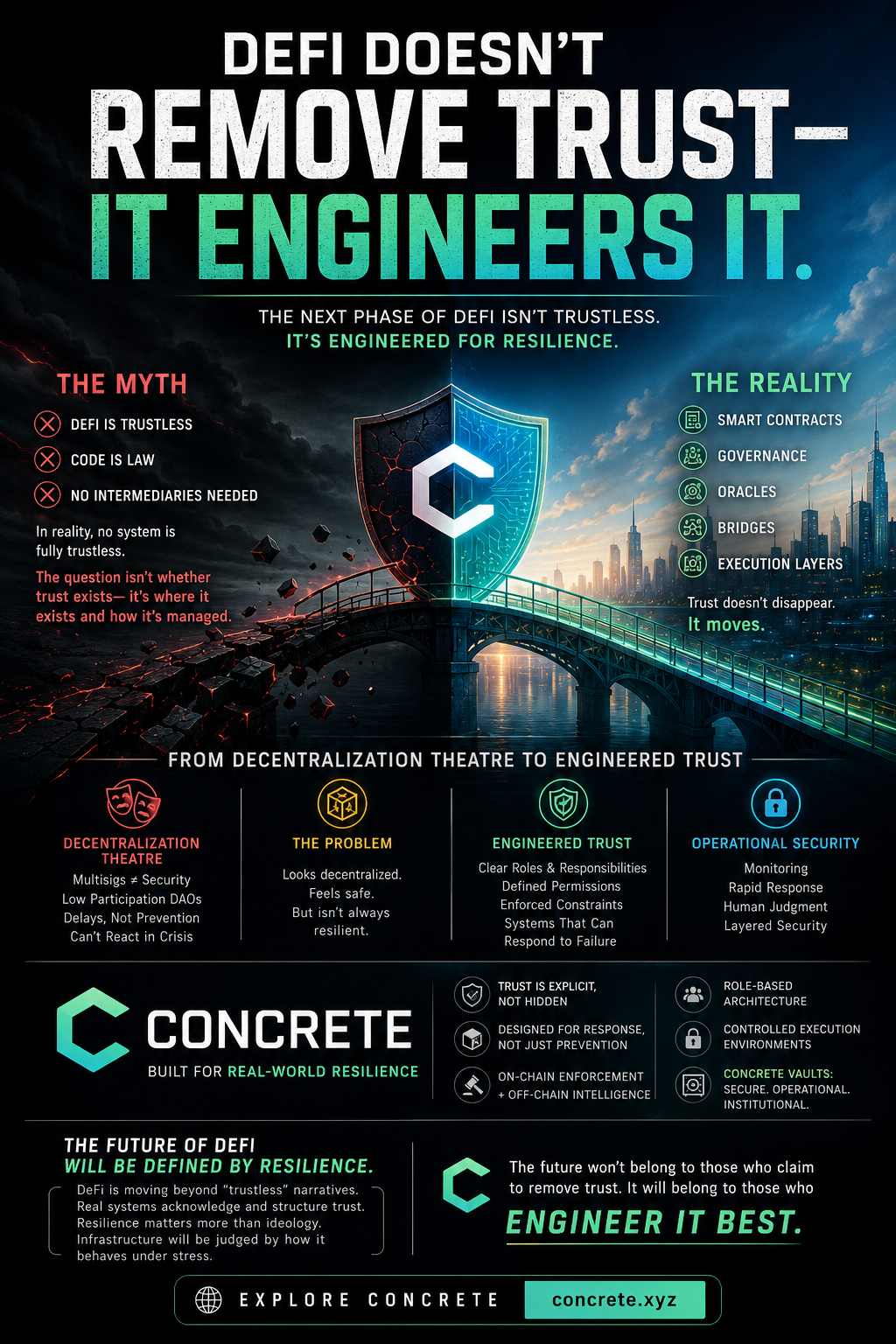
DeFi Doesn’t Remove Trust — It Engineers It
--
For years, DeFi has been built around one powerful narrative:
“Don’t trust people. Trust code.”
It became the ideological foundation of crypto finance.
No banks.
No intermediaries.
No centralized authority deciding who gets access and who does not.
Only transparent smart contracts executing immutable rules onchain.
At first, this idea felt revolutionary. And in many ways, it was.
But as DeFi evolved from experimental protocols into financial infrastructure managing billions of dollars, something became increasingly obvious:
Trust never disappeared.
It simply moved.
The real question is no longer:
“Can finance become trustless?”
The real question is:
“How should trust be engineered?”
Because every serious system — whether traditional or decentralized — ultimately depends on assumptions, coordination, operational security, and human response mechanisms.
And the next phase of DeFi will belong to protocols that acknowledge this reality instead of hiding behind decentralization theatre.
The Myth of “Trustless” Systems
The phrase “trustless systems” became one of the most repeated ideas in crypto.
The assumption was simple:
- smart contracts remove human discretion
- code replaces institutions
- decentralization eliminates trust requirements
But no real-world system operates without trust.
Even in DeFi, users constantly rely on invisible assumptions:
- trusting smart contracts to behave correctly
- trusting governance systems not to be captured
- trusting oracles to provide accurate data
- trusting bridges to secure cross-chain assets
- trusting execution layers to remain operational during stress
What changed was not the existence of trust.
What changed was the location of trust.
Instead of trusting banks or centralized operators, users now trust technical infrastructure, governance coordination, and operational security frameworks.
That distinction matters.
Because hidden trust is often more dangerous than explicit trust.
Where Trust Actually Lives in DeFi
The idea that code alone guarantees safety oversimplifies how DeFi infrastructure actually works.
Behind every protocol are layers of assumptions that users rarely see.
Smart Contract Assumptions
Every protocol depends on developers writing secure code.
Even audited contracts can contain vulnerabilities, logic flaws, or unforeseen attack vectors.
History has shown this repeatedly through exploits, governance attacks, oracle manipulation, and bridge failures.
Code is powerful.
But code is not omniscient.
Governance Systems
DAOs are often presented as decentralized governance mechanisms.
In practice, many governance systems suffer from:
- low voter participation
- concentrated token ownership
- governance apathy
- rushed emergency decisions
A protocol may appear decentralized while operational control remains concentrated among a small group of participants.
That is still trust.
It is simply distributed differently.
Oracle Dependencies
DeFi protocols rely heavily on external data feeds.
Price feeds determine:
- collateral ratios
- liquidations
- lending conditions
- vault behavior
If oracle infrastructure fails or gets manipulated, entire systems can become unstable.
This means protocols are not only trusting code.
They are trusting information pipelines.
Bridge Security
Cross-chain bridges introduced one of the largest hidden trust assumptions in crypto.
Bridges often rely on:
- multisig validators
- relayer systems
- centralized coordinators
- offchain verification
Billions of dollars have been lost because bridge infrastructure became the weakest layer of DeFi security.
Again, trust was never removed.
It was abstracted away.
The Problem With Decentralization Theatre
One of the biggest issues in modern DeFi is the illusion of decentralization.
Many systems optimize for appearances instead of resilience.
This creates what can be described as decentralization theatre.
A protocol may advertise itself as decentralized because it uses:
- multisigs
- governance voting
- timelocks
- distributed validators
But these mechanisms alone do not guarantee safety.
In some cases, they create slower and weaker responses during critical moments.
For example:
- a multisig can still be compromised
- a DAO may fail to coordinate during emergencies
- timelocks delay action but cannot stop catastrophic exploits
- decentralized governance may become ineffective under pressure
True resilience is not about maximizing ideological purity.
It is about ensuring systems behave safely under stress.
And that requires more than slogans.
The Rise of Engineered Trust
The next evolution of DeFi is not about eliminating trust.
It is about engineering trust deliberately.
Engineered trust means building systems where:
- permissions are clearly defined
- responsibilities are transparent
- constraints are enforceable
- operational responses are structured
- failures can be contained
This is how mature financial systems operate.
Not through blind trust.
But through layered safeguards, accountability structures, and operational controls.
The strongest DeFi infrastructure will not be the systems pretending humans no longer matter.
It will be the systems designed around the reality that humans, coordination, and operational security are unavoidable parts of finance.
Why Operational Security Matters
Real financial systems require more than immutable code.
They require active operational security.
Because no smart contract can anticipate every edge case, market event, or exploit scenario.
This is why modern DeFi infrastructure increasingly depends on:
- continuous monitoring
- rapid response systems
- anomaly detection
- layered security models
- controlled execution environments
- human judgment during abnormal conditions
Code is excellent at enforcing rules.
But operational systems are necessary for managing uncertainty.
The strongest protocols combine both.
This is where the industry is heading.
From static “trustless” systems toward adaptive and enforceable security architecture.
How Concrete Approaches Engineered Trust
This is where Concrete introduces a fundamentally different philosophy.
Instead of pretending trust does not exist, Concrete makes trust explicit, structured, and enforceable.
Explore Concrete at Concrete
Concrete focuses on operational security as a core layer of DeFi infrastructure.
Its approach prioritizes resilience over decentralization theatre.
That means:
- systems designed for response, not just prevention
- onchain enforcement combined with offchain intelligence
- role-based architecture with defined permissions
- controlled execution environments
- structured operational controls for vault management
Rather than relying purely on ideology, Concrete recognizes that institutional-grade DeFi requires engineered trust.
This is especially important for:
- DeFi security
- institutional DeFi participation
- secure vault infrastructure
- operationally resilient protocols
Concrete vaults are built around the understanding that security is not a single mechanism.
It is a layered operational process.
Through onchain enforcement and structured permissions, Concrete creates systems capable of reacting intelligently during volatile or adversarial conditions.
That is a major shift from earlier generations of DeFi infrastructure.
The Future of DeFi Will Be Defined by Resilience
The crypto industry is slowly moving beyond simplistic “trustless systems” narratives.
Because reality has forced a more mature conversation.
The protocols that survive long term will not be the ones making the boldest decentralization claims.
They will be the ones building systems capable of handling stress, uncertainty, attacks, and operational complexity.
The future of DeFi infrastructure will depend on:
- engineered trust
- operational security
- resilient architecture
- transparent governance
- enforceable constraints
- intelligent response systems
In the end, trust is unavoidable.
The difference is whether it is hidden behind marketing narratives — or intentionally designed into the system itself.
DeFi does not remove trust.
It engineers it.
And the protocols that engineer it best will define the next era of finance.