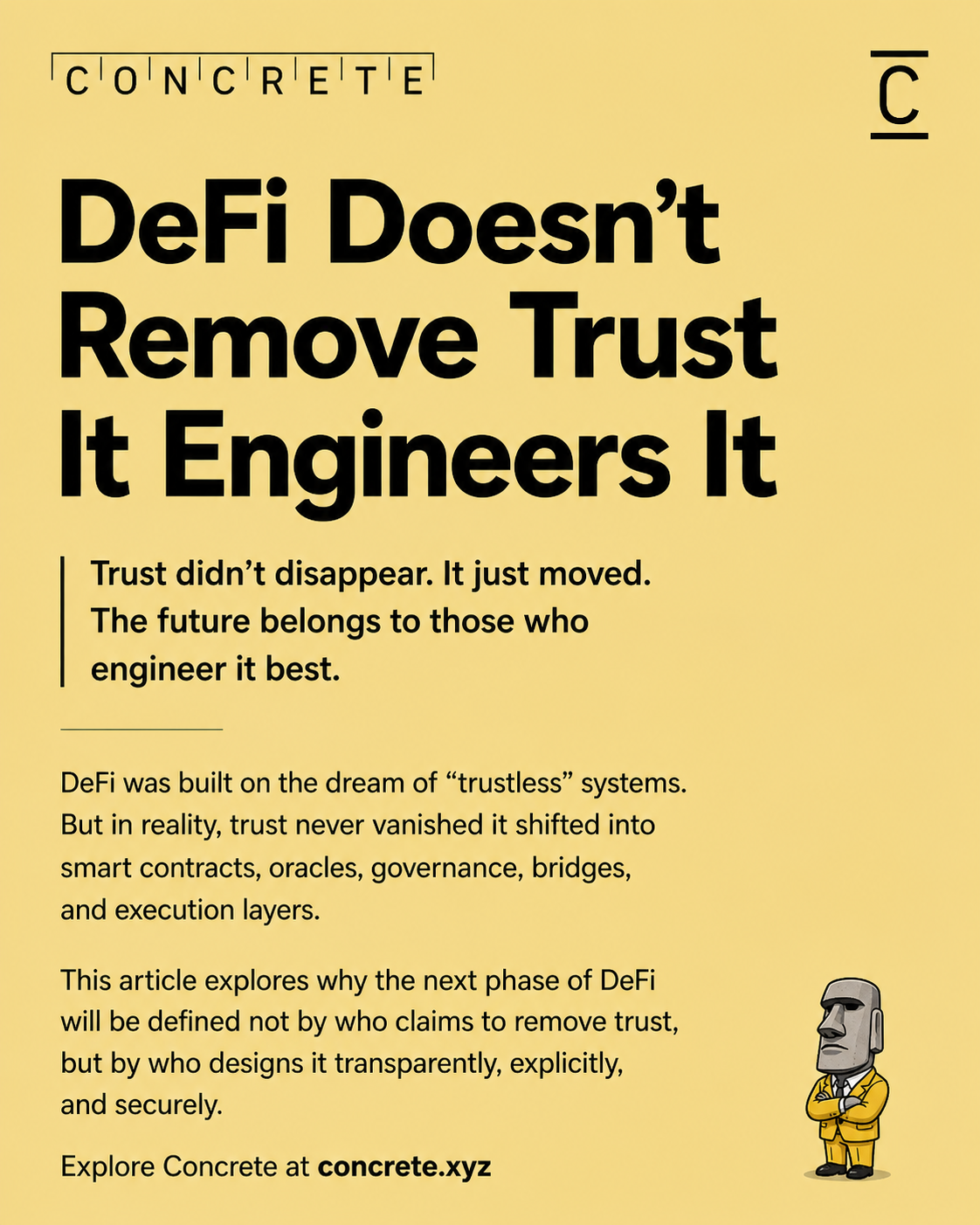
🧱 DeFi Doesn’t Remove Trust — It Engineers It
--
DeFi was built on a powerful narrative:
“Don’t trust people. Trust code.”
For a while, that idea felt revolutionary.
No intermediaries. No gatekeepers. Just immutable smart contracts executing exactly as written.
But as the ecosystem matured, a more nuanced reality emerged:
Trust didn’t disappear. It just moved.
1️⃣ The Myth of “Trustless” Systems
“Code is law.”
“DeFi is trustless.”
“No intermediaries needed.”
These ideas helped bootstrap an entire industry.
But no real system operates without trust.
Instead, the real question is:
Where does trust live — and how is it managed?
Because even in DeFi, users are constantly making trust assumptions — whether they realize it or not.
2️⃣ Where Trust Actually Lives
Under the surface, DeFi is layered with trust dependencies.
You trust:
- Smart contracts to behave as intended (and remain bug-free)
- Governance systems to act in the protocol’s best interest
- Oracles to provide accurate external data
- Bridges to securely move assets across chains
- Execution layers to process transactions correctly
None of this is “trustless.”
It’s trust redistributed across infrastructure.
The difference is that much of it is abstracted away — hidden behind clean interfaces and simplified UX.
3️⃣ The Problem With Decentralization Theatre
Not everything that looks decentralized is actually resilient.
This is where “decentralization theatre” comes in — systems that signal safety without fully delivering it.
Examples include:
- Multisigs that concentrate control in a few hands
- DAOs with low participation and governance capture
- Timelocks that delay actions but don’t eliminate risk
- Rigid systems that fail under unexpected conditions
These mechanisms can create the appearance of decentralization.
But appearance ≠ security.
Real resilience comes from how a system behaves under stress — not how it looks on a dashboard.
4️⃣ From Removed Trust → Engineered Trust
The next phase of DeFi isn’t about eliminating trust.
It’s about designing it intentionally.
Engineered trust means:
- Clear roles and responsibilities
- Explicit permission structures
- Enforced constraints
- Systems designed to respond to failure — not just prevent it
This is how mature financial infrastructure operates.
And increasingly, it’s how serious DeFi systems are being built.
5️⃣ Why Operational Security Matters
Code is powerful — but it isn’t omniscient.
Real-world systems require:
- Continuous monitoring
- Rapid response mechanisms
- Human judgment in edge cases
- Layered security models
Black swan events, exploits, and market dislocations don’t wait for governance votes.
Purely static systems often fail not because they lack decentralization —
but because they lack adaptability.
6️⃣ How Concrete Approaches Trust
Concrete represents a shift away from decentralization theatre toward operationally engineered trust.
Its approach is grounded in a few key principles:
- Trust is explicit, not hidden
- Systems are designed for response, not just prevention
- On-chain enforcement combined with off-chain intelligence
- Role-based architecture with clearly defined permissions
- Controlled execution environments to reduce unintended risk
Instead of pretending trust doesn’t exist, Concrete structures it —
making systems more predictable, auditable, and resilient.
👉 Explore Concrete at https://concrete.xyz/
7️⃣ The Bigger Shift
DeFi is evolving.
The narrative is moving beyond:
“Trustless at all costs” → “Trust, but engineered correctly”
Because in the end:
- Trust is unavoidable
- Resilience is measurable
- And systems are judged by performance under stress — not ideology
The next generation of DeFi won’t be defined by who claims to remove trust.
It will be defined by who engineers it best.