DeFi Doesn’t Remove Trust — It Engineers It
 Huyenmint3 min read·Just now
--
DeFi was built on a powerful idea:
“Don’t trust people. Trust code.”
For a while, that felt like a breakthrough.
No intermediaries.
No gatekeepers.
Just smart contracts executing logic.
But as the system evolved, something became clear:
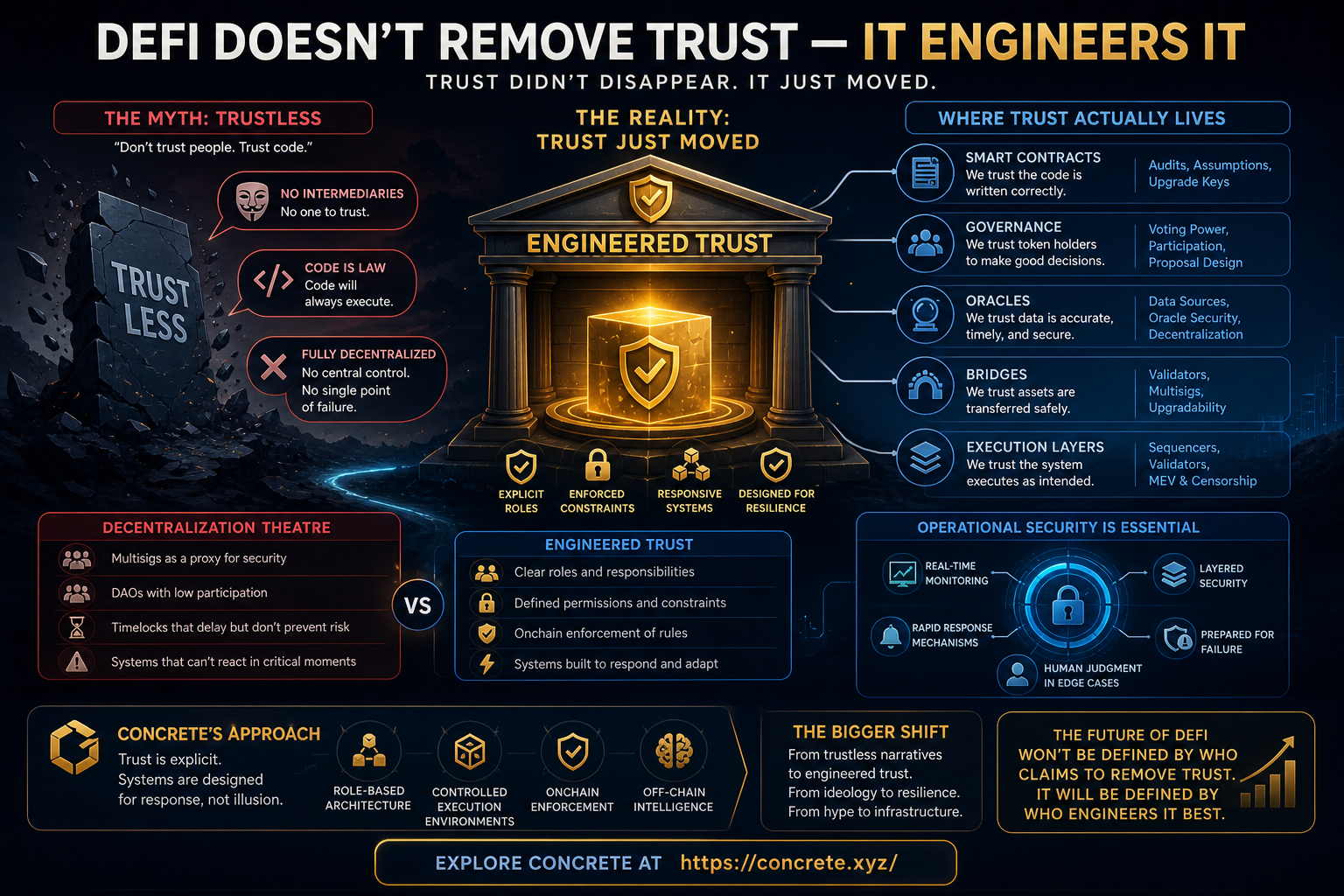
Trust didn’t disappear. It just moved.
1️⃣ The Myth of “Trustless”
The early narrative was simple:
– DeFi is trustless
— Code is law
— Systems run without human intervention
But in reality, no system is fully trustless.
Every system relies on assumptions.
The real question isn’t:
“Is there trust?”
It’s:
“Where does that trust live — and how is it managed?”
2️⃣ Where Trust Actually Lives
In practice, DeFi depends on multiple layers of trust:
– smart contract design and audits
— governance decisions and upgrades
— oracle data feeds
— bridge infrastructure
— execution layers and sequencing
Each layer introduces its own assumptions.
These are not removed.
They are abstracted.
And often, users don’t see them.
3️⃣ The Problem With Decentralization Theatre
Not all decentralization leads to resilience.
Some systems look decentralized — but behave differently under stress.
Examples include:
– multisigs acting as centralized control points
— DAOs with low participation or coordination
— timelocks that delay risk but don’t eliminate it
— systems that cannot react quickly during critical events
This creates what can be called:
decentralization theatre
The appearance of safety — without the guarantees.
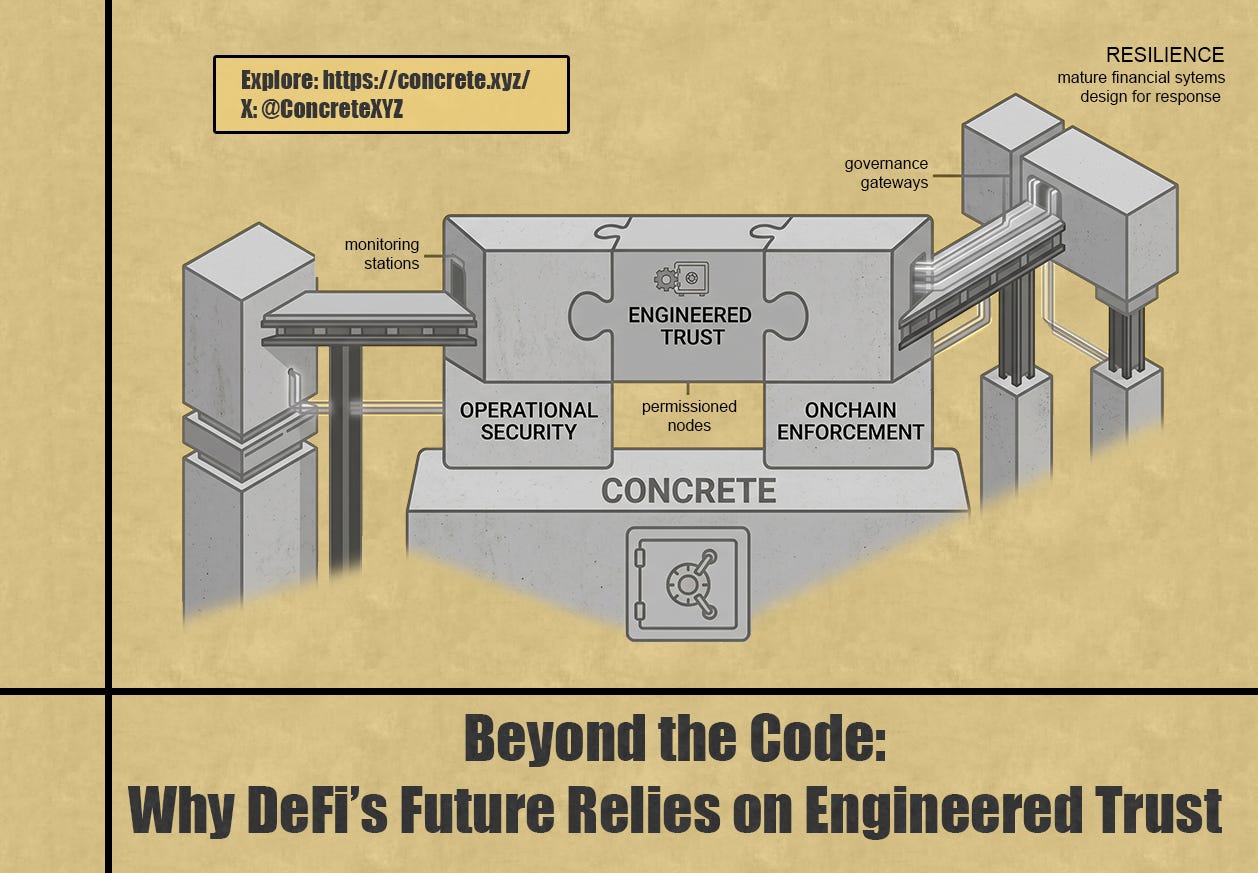
4️⃣ Engineered Trust
A more mature model accepts a simple truth:
Trust is unavoidable.
The difference is whether it is hidden — or designed.
Engineered trust means:
– clearly defined roles and responsibilities
— explicit permissioning
— enforceable constraints
— systems built to respond to failure, not just prevent it
This is how real financial systems operate.
And it’s how modern DeFi infrastructure is evolving.
5️⃣ Operational Security Matters
Code alone cannot handle every scenario.
Real-world systems require:
– continuous monitoring
— fast response mechanisms
— human judgment in edge cases
— layered security models
This is the foundation of DeFi security at scale.
Because resilience is not just about preventing failure —
It’s about how a system behaves when failure happens.
6️⃣ Concrete’s Approach
This is where Concrete vaults take a different path.
Instead of hiding trust behind abstraction,
Concrete makes it explicit and structured.
Through:
– role-based architecture (Allocator, Strategy Manager, Hook Manager)
— controlled execution environments
— onchain enforcement of rules and constraints
— integration of off-chain intelligence where needed
This creates a system where:
– responsibilities are clear
— risk is bounded
— decisions are structured
Concrete focuses on operational security, not decentralization theatre.
This is what institutional DeFi looks like in practice.
7️⃣ The Bigger Shift
DeFi is evolving beyond ideology.
The narrative is shifting:
– from “trustless systems”
— to engineered trust systems
In this new phase:
– trust is acknowledged, not denied
— systems are designed for resilience
— infrastructure is judged under stress — not marketing
The future of DeFi won’t be defined by who claims to remove trust.
It will be defined by:
who engineers it best.
👉 Explore Concrete: https://concrete.xyz/ 🚀