DeFi Doesn’t Remove Trust — It Engineers It
--
DeFi was built on a powerful idea:
“Don’t trust people. Trust code.”
For a while, this felt revolutionary. Smart contracts replaced intermediaries, and the system appeared to remove the need for trust entirely.
But as DeFi has evolved, one thing has become clear:
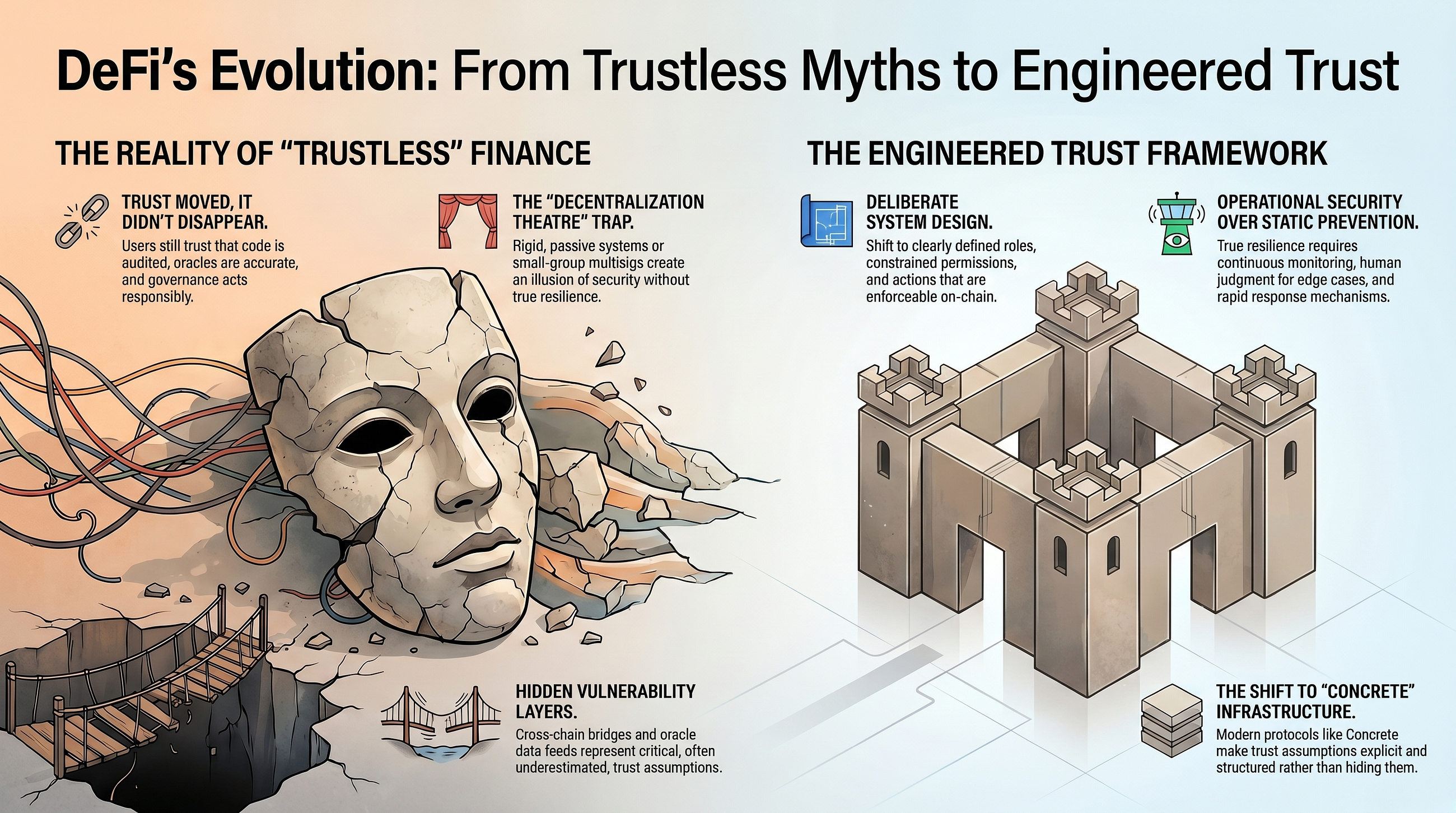
Trust didn’t disappear — it just moved.
The Myth of Trustless Systems
The concept of “trustless systems” is one of the most popular narratives in DeFi.
People believe:
- Code is law
- No intermediaries are needed
- Systems run automatically
But in reality, no system is completely trustless.
The real question is:
Where does trust exist, and how is it managed?
Where Trust Actually Lives in DeFi
Even today, DeFi depends on multiple layers of trust:
- Smart contracts → Are they secure and audited?
- Governance systems → Who really controls decisions?
- Oracles → Is the external data reliable?
- Bridges → Are cross-chain transfers safe?
- Execution layers → Are transactions processed correctly?
These components show one thing clearly:
Trust is not removed — it is redistributed.
The Problem of Decentralization Theatre
Many DeFi projects appear decentralized, but are not truly secure.
This creates what can be called:
“Decentralization Theatre”
Examples include:
- Multisigs controlled by a few people
- DAOs with low participation
- Timelocks that delay but don’t prevent risks
- Systems that fail during critical moments
This leads to a dangerous misunderstanding:
Decentralization does not equal safety.
From Trustless to Engineered Trust
If trust cannot be removed, then it must be designed properly.
This is called:
Engineered Trust
It includes:
- Clear roles and responsibilities
- Defined permissions
- Enforced system constraints
- Ability to respond to failures
This is how real financial systems operate.
Why Operational Security Matters
Code alone cannot handle every situation.
Real systems need:
- Continuous monitoring
- Fast response mechanisms
- Human judgment in edge cases
- Layered security
Without operational security, even decentralized systems can fail.
How Concrete Approaches This
Concrete focuses on making trust explicit and structured, not hidden.
Its approach includes:
- On-chain enforcement + off-chain intelligence
- Role-based system design
- Controlled execution environments
- Systems built for response, not just prevention
Concrete prioritizes real security over fake decentralization.
👉 Explore Concrete at https://concrete.xyz/
The Future of DeFi
DeFi is evolving.
The future will not be about removing trust completely.
Instead, it will focus on:
- Transparency
- Structured systems
- Real resilience
The winners in DeFi will not be those who claim to remove trust.
They will be the ones who engineer it best.