DCA Alternatives. Part I
 Rabbit 🐰7 min read·Just now
--
Everyone’s heard that the safest way to buy Bitcoin is to buy the same dollar amount at regular intervals. It’s called DCA — Dollar-Cost Averaging. I know people who follow this approach, and they’re doing quite well.
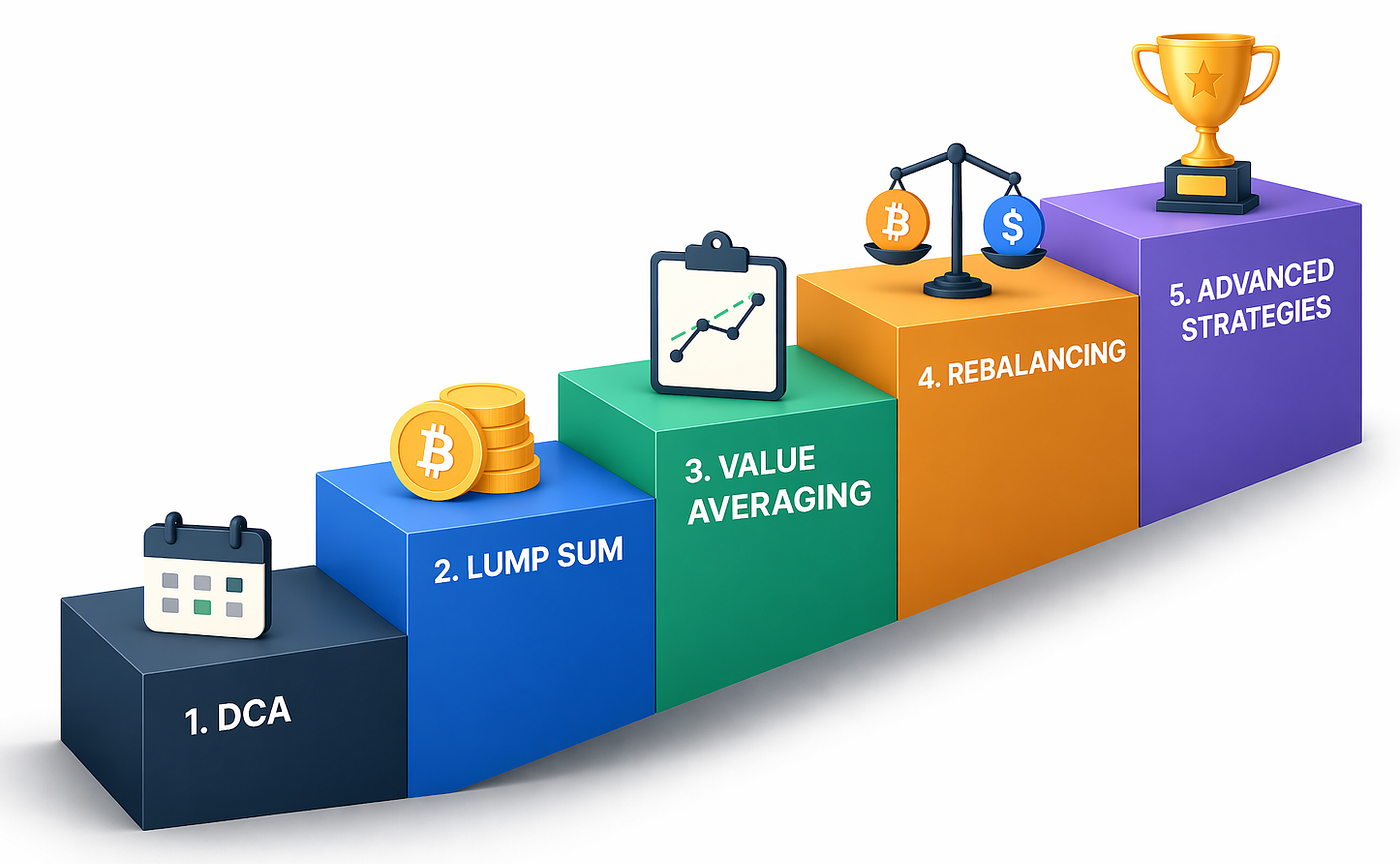
But if you dig into the topic a little, it turns out there are smarter strategies, and none of them are any more complicated than DCA. DCA is just the first rung on the ladder of personal finance. Yet for some reason, most people who use Bitcoin as a store of value and a way to grow their savings never climb higher.
Let’s take a look at what other investment strategies could make worthy alternatives to DCA.
An honest word about DCA: good, but not the final answer
DCA is an excellent starter strategy. You don’t need to guess where the bottom is, and you don’t need to worry that “now isn’t the time.” The strategy is indifferent to the market. Bitcoin crashes 60% — you buy $100. Bitcoin hits an all-time high — you still buy $100. You just keep buying regularly, and as long as you stay disciplined and patient, Bitcoin rewards you thanks to its remarkable property: over the long run, its price always goes up, no matter what short-term or medium-term swings come along.
But what if we look at lessons from other markets?
Researchers at Vanguard analyzed the behavior of the US, UK, and Australian markets from 1976 to 2022 and concluded that lump-sum investing outperforms DCA:
- in 61.6% to 73.7% of cases over a one-year horizon,
- in 64% of cases over a six-month horizon,
- and in 92% of cases over a 36-month horizon.
Over the period studied, the stock markets of these countries trended upward on average — much like Bitcoin does in the long run. And the sooner the money started working, the better the return. This means DCA isn’t an automatically winning choice. It’s a choice in favor of psychological comfort, not maximum returns.
Let’s see what options we actually have to choose from.
A small fork in the road: building versus managing
Before we dive into the strategies, let’s separate the two distinct processes where DCA is typically applied.
- Portfolio building. This is how we initially put our money to work: all at once, in parts, or based on signals.
- Portfolio management. This is how we maintain the portfolio’s structure over time. A classic example is rebalancing — the steps we take when one asset has grown while another has slipped.
DCA can be viewed as a strategy for either process. If we earn regular income in dollars and use that income to buy a fixed dollar amount of Bitcoin, that’s portfolio building. But if we already have capital in dollars and gradually convert it into Bitcoin, that’s portfolio management. From here on, I’ll explicitly flag which process each strategy belongs to.
1. Lump-sum investing (building)
The idea in one sentence. If you have a large amount of money, don’t spread it out over many months — invest it all at once.
How it works. You have $1,000 in hand. Instead of splitting it into 12 monthly chunks of roughly $83, you buy Bitcoin with the entire amount. And if Bitcoin’s price rises, you capture that growth from day one at full force. With DCA, most of your capital sits in stablecoins for months without earning anything; with a lump-sum investment, you catch the whole upswing.
I won’t discuss the scenario where the dollar portion of your portfolio sits in a bank rather than in stablecoins. I think everyone understands that keeping significant sums in a bank isn’t a great idea. Banks can always find a reason not to give you your money back. Keeping funds in stablecoins — especially decentralized ones like DAI and LUSD — is far safer. And you can swap DAI or LUSD for Bitcoin anytime at the best rate on rabbit.io.
Pros of lump-sum investing:
- Statistically beats DCA in a rising market.
- Maximum simplicity.
- Highest capital efficiency (your money is working from day one).
Cons:
- Entering right at a peak can mean months of drawdown. A classic example is early October 2025: anyone who bought Bitcoin then is still underwater.
- Emotional pressure (it’s not easy to commit everything at once and go all in).
Who it’s for: Those who already have the necessary sum, have a multi-year planning horizon, and are prepared to see their portfolio drop by tens of percent the day after the purchase.
2. Value Averaging (building)
The idea in one sentence. You fix not the size of each monthly contribution, but the trajectory of the portfolio’s value.
Value Averaging (VA) was invented by economist Michael Edleson in 1988 and popularized by his 1991 book.
How it works. Instead of the goal “invest $100 per month,” you set the goal “the portfolio must grow by $100 per month.” In other words, at the end of each following month, the portfolio should be worth $100 more than at the end of the previous month.
- January. Bitcoin is at $100,000. The portfolio is worth $0. Target: $100. You buy 100,000 satoshis (0.001 BTC) for $100.
- February. Bitcoin has dropped to $70,000, and the portfolio is worth $70. The February target is $200. You invest $130 (not $100, as you would with DCA) to get back on the planned trajectory, buying 185,714 satoshis. Now your portfolio is worth $200.
- March. Bitcoin has surged to $122,500, and the portfolio is worth $350. Since the March target is $300, you sell 40,816 satoshis for $50 and lock in the profit.
And what would have happened with classic DCA, using the same prices and a $100 monthly contribution?
- January — purchase of 100,000 satoshis (for $100).
- February — purchase of 142,857 satoshis (for $100).
- March — purchase of 81,633 satoshis (for $100).
Total purchased: 324,490 satoshis, which at a Bitcoin price of $122,500 are worth $397.50.
The VA result: invested $180 ($100 + $130 − $50), portfolio value $300, profit $120 (that’s +66.7% on the capital invested).
The DCA result: invested $300, portfolio value $397.50, profit $97.50 (that’s +32.5% on the capital invested).
Notice that VA’s return is higher both in relative and absolute terms.
A caveat is in order here. In his book, Edleson relied on the internal rate of return (IRR) and showed that IRR was higher for VA than for DCA. But in 2013, researcher Simon Hayley demonstrated that IRR is a distorted metric for strategies with variable contributions. It systematically overstates VA’s effectiveness. So VA really does often beat DCA — just not by as much as the strategy’s creator believed.
Pros:
- Puts the “buy low, sell high” principle to work.
- Thanks to a strict, clear plan, it helps you be bolder during panics and sobers you up during periods of euphoria.
Cons:
- If the market crashes, the strategy demands substantial additional investments.
- Requires monthly calculations rather than a simple “buy” button.
- Emotional pressure (when everyone’s shouting about the end of the world, it’s hard to invest more).
Who it’s for: Those who have financial reserves available for larger contributions and are willing to spend a little time setting up an algorithm for monthly calculations (or to do the math by hand).
3. Calendar rebalancing (managing)
The idea in one sentence. Once a month, once a quarter, every six months, or once a year, we return the portfolio to its original proportions.
How it works. You’ve decided your portfolio should be 50% Bitcoin and 50% stablecoins. A month later, Bitcoin’s price has risen, and the ratio in your portfolio is now 60/40. You go to rabbit.io and swap one-sixth of your Bitcoin back into stablecoins, restoring the target 50/50 ratio.
This strategy works for portfolios with more than two assets as well. For example, if your portfolio is 40% Bitcoin, 40% stablecoins, and 20% tokenized gold (PAXG or XAUT), you can likewise visit rabbit.io once a month (or every six months, or once a year), send us some of what has grown, and receive from us whatever has lagged behind.
Pros:
- A golden mean between slow portfolio building and a dramatic all-in entry.
- Sells what’s currently expensive and buys what’s currently cheap.
- Limits risk concentration in any single asset.
Cons:
- Doesn’t react between rebalancing dates. A major crash mid-period? Discipline demands waiting until the end of the period.
- In a calm market, it leads to pointless trades involving trivial amounts.
- Statistically underperforms a “buy and hold” approach (lump-sum investing) in a rising market.
- During deep drawdowns, it’s psychologically hard to buy what’s falling.
Who it’s for: Anyone who wants to manage risk systematically, especially with a multi-asset portfolio.
4. Threshold (tolerance-band) rebalancing (managing)
The idea in one sentence. We rebalance not on a schedule, but when an asset’s share strays outside acceptable limits.
How it works. You set a rule: Bitcoin should make up 50% of the portfolio, give or take 10%. As long as the ratio stays within 40% to 60%, you do nothing. Once it crosses the boundary, you rebalance.
Vanguard’s research has shown that portfolios rebalanced by threshold deliver returns over the long run comparable to those of monthly rebalancing, but require fewer trades.
Pros:
- The strategy reacts to real market movements, not to the calendar.
- In calm periods, it avoids unnecessary trades.
Cons:
- Requires more active monitoring.
- You have to choose the band width carefully (too narrow — too many trades; too wide — the benefit is lost).
Who it’s for: Anyone willing to watch price movements and respond to alerts.
Beyond these four strategies, there are others that can also be called DCA alternatives — equally simple, but smarter. To avoid overwhelming you, I’ll cover them in Part II of this article. It will be published in The Rabbit Hole exactly one week from now. Subscribe so you don’t miss it.