How real-time analytics, simulations, and navigation models guide a crewed mission around the Moon
The Part of Artemis II Most People Didn’t See
When Artemis II launched, most of the world focused on the rocket, the crew, and the historic return to lunar missions.
But what makes this mission truly different isn’t just hardware. It’s how deeply data science and analytics are embedded into every decision, long before and during the flight.
This mission isn’t just flown. It’s modeled, simulated, tracked, and continuously analyzed.
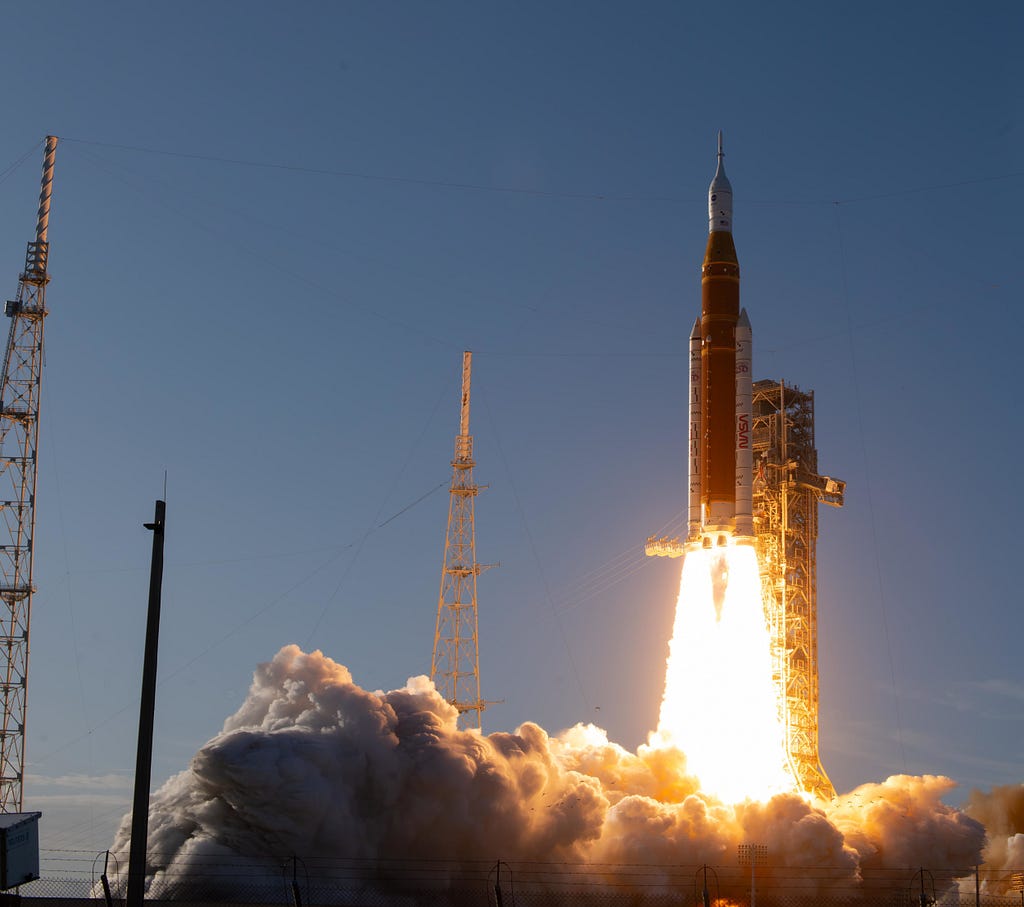
Before Liftoff: Thousands of Missions Before One Real One
Before Artemis II ever left Earth, NASA had already “flown” it thousands of times.
Using high-performance computing, engineers ran physics-based simulations to test:
- Propulsion behavior under different conditions
- Orbital paths and trajectory variations
- Communication delays and system responses
- Edge cases that are extremely rare but mission-critical
These are not generic tests. They are structured scenario simulations similar to Monte Carlo methods, where small variations are introduced to understand how the system behaves under uncertainty.
This is one of the biggest differences from earlier missions.
Then vs Now: What Changed Since Apollo
During Apollo 11 Moon Landing, onboard computers had extremely limited processing power. Many calculations were done ahead of time, and astronauts had to manually monitor and react to systems.
With Artemis II, the approach has shifted:
- Heavy reliance on pre-flight simulation and modeling
- Continuous data flow from spacecraft to Earth
- Ground-based systems supporting decision-making in near real time
The mission is no longer just controlled. It is continuously informed by data.
How NASA Actually Tracks the Spacecraft
At the center of this system is NASA’s Deep Space Network (DSN), a global network of massive antennas located in California, Spain, and Australia.
This system enables:
- Continuous tracking of Orion using radio signals
- Doppler shift measurements to estimate velocity
- Signal timing to calculate distance and trajectory
In simple terms, NASA doesn’t just “see” where the spacecraft is.
It calculates its position using data from signals traveling across space.
Real-Time Telemetry: Data That Keeps the Mission Alive
As Artemis II travels around the Moon, the Orion spacecraft constantly sends telemetry data, including:
- Position and velocity
- Orientation and navigation data
- Propulsion system status
- Environmental and life support metrics
This data is processed on Earth through structured analytics systems. Engineers monitor patterns, detect small deviations, and make informed decisions when needed.
Even small signal changes can indicate shifts in motion or system behavior. That’s where data becomes critical.
What Happens When the Spacecraft Disappears
When Orion passes behind the Moon, it temporarily loses direct communication with Earth.
This isn’t a failure. It’s expected.
During this period:
- The spacecraft operates autonomously using pre-validated sequences
- Data is stored onboard
- Once communication resumes, all data is transmitted back to Earth
This is where pre-mission simulations become essential.
Engineers must trust systems that were validated long before launch.
The Algorithm Quietly Guiding the Mission
One of the most important techniques used in navigation is Kalman filtering.
This algorithm continuously combines:
- Sensor data (which can be noisy)
- Mathematical models of motion
The result is a constantly refined estimate of:
- Where the spacecraft is
- How fast it’s moving
- Where it will be next
This method has been used in previous missions, but Artemis II benefits from richer data and more precise inputs, making these estimates far more accurate.
In simple terms, the spacecraft is not just moving.
It is continuously recalculating its position using data.
How This Compares to Modern Space Missions
Companies like SpaceX also rely heavily on telemetry and automated monitoring.
However, Artemis II operates in deep space, where:
- Communication delays are longer
- Real-time control is limited
- Systems must rely more on pre-validated models
This makes simulation and planning far more critical than in near-Earth missions.
What This Means for the Future
Artemis II is not just a mission. It’s a foundation.
- Artemis III (2027) aims to land humans near the Moon’s south pole
- Future missions will involve longer stays, surface systems, and more autonomy
As missions become more complex, the role of data will only grow.
More simulations, more telemetry, and more intelligent systems will shape how exploration happens.
Why This Matters Beyond Space
You don’t have to work at NASA to see the impact of this.
The same principles used here are applied in:
- Autonomous systems
- Robotics
- Transportation
- Large-scale engineering
Artemis II shows what happens when data science operates in an environment where failure is not an option.
Key Takeaways
- NASA runs thousands of simulations before a single mission
- The Deep Space Network enables precise tracking using signal data
- Real-time telemetry allows continuous monitoring and decision support
- Kalman filtering refines navigation using data and models together
- Artemis II reflects a shift toward data-driven mission design
Your Thoughts
One thing that stands out is how much of this mission depends on decisions made before launch through simulation and modeling.
Do you think future missions will rely more on onboard autonomous systems, or continue depending on ground-based analytics like this?
Curious to hear your perspective.
Data Science Powers NASA’s Artemis II Mission was originally published in DataDrivenInvestor on Medium, where people are continuing the conversation by highlighting and responding to this story.