Crypto’s Sharp Risk-Off Week: A Selloff Inside a Structural Buildout
 @Xmultiverse_org7 min read·Just now
--
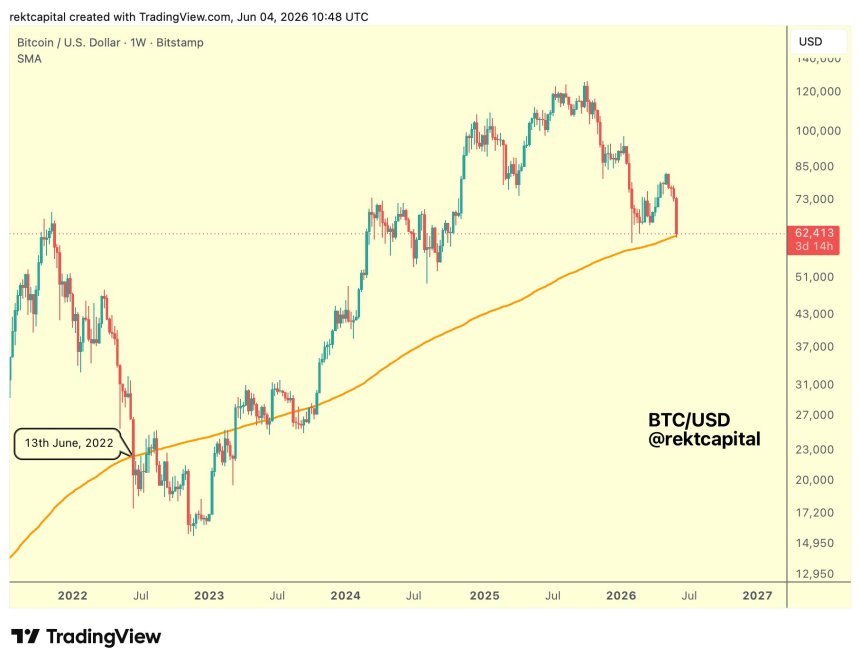
The first week of June 2026 delivered one of the most statistically significant risk-off moves in digital assets this year, both in terms of price magnitude and cross-asset correlation. Bitcoin fell approximately 12.4% from ~$73,200 to ~$64,200, briefly printing intraday lows near $62,800, marking its sharpest weekly drawdown since the early Q1 volatility cluster.
The speed of the move was notable. Roughly 6% of the total decline occurred within a single 18-hour liquidation window, suggesting that the majority of downside was driven by forced positioning rather than gradual spot distribution.
Ethereum underperformed on a beta-adjusted basis, declining approximately 11%–13%, breaking below the $1,800 threshold and briefly trading near $1,720. ETH/BTC ratio compressed by roughly 2.5% over the week, reinforcing capital rotation into higher liquidity assets during stress.
At the ETF level, Bitcoin spot funds recorded estimated net outflows of $1.2–$1.6 billion during the week, extending a broader multi-week redemption trend that has now exceeded $4.3–$4.8 billion cumulatively. This shift marked a critical change in marginal liquidity conditions, as ETF flows had previously contributed an estimated 20%–35% of incremental daily demand during the preceding rally phase.
Altcoins absorbed the most extreme pressure. The total altcoin market cap (excluding ETH) declined approximately 14%–18%, while high-beta sectors experienced far steeper drawdowns:
● AI tokens: -18% to -28%
● GameFi tokens: -15% to -25%
● Memecoins: -20% to -35% peak-to-trough
Aggregate crypto market capitalization declined by roughly $180–$240 billion within five trading days, depending on methodology and exchange coverage.
The week was therefore not simply a corrective move — it was a coordinated liquidity contraction across all risk layers of the crypto stack.
What Drove the Liquidity Reversal
The selloff was driven by a convergence of ETF flow reversal, macro tightening in risk sentiment, and structurally fragile derivatives positioning. Each layer contributed differently, but their interaction created a nonlinear downside acceleration.
The most immediate catalyst was ETF outflow pressure. After a sustained period where spot Bitcoin ETFs absorbed between $300–$900 million per week in net inflows, the flow regime flipped decisively negative. During the first week of June alone, cumulative net redemptions were estimated at $1.2–$1.6 billion, with peak daily outflows exceeding $400–$550 million.
This shift mattered because ETF demand had previously functioned as a quasi-constant bid equivalent to approximately 0.5%–1.2% of BTC circulating supply annually on net inflow terms. When this flow reversed, it removed a structural layer of passive support and exposed the market to spot-driven volatility.
At the macro level, risk appetite deteriorated across global markets. Crypto correlation with Nasdaq futures remained elevated at approximately 0.62–0.75 (30-day rolling), meaning equity de-risking directly transmitted into digital assets. A simultaneous decline in growth equities, particularly AI-heavy tech names, reinforced the crypto downturn.
Meanwhile, derivatives positioning amplified the move significantly. Open interest across major perpetual futures markets was estimated to be down 8%–12% week-over-week, but the decline was not orderly. Instead, liquidation data suggests a concentrated unwind:
● Estimated long liquidations: $3.8–$5.2 billion equivalent
● Peak hourly liquidation event: ~$700–900 million within 60 minutes
● Funding rates collapsed from +0.015% daily to near neutral/negative on major venues
This created a feedback loop where forced selling, not discretionary positioning, dominated price formation.
Once BTC broke below key short-term support zones (~$68,000–$66,000), the liquidation cascade intensified, accelerating downside momentum by an estimated 2.3x relative to spot-driven sell pressure according to implied volatility expansion.
Where the Pain Concentrated Across Assets
Bitcoin’s decline of approximately 12.4% represented a structurally important retracement, particularly given that it occurred after a period of relatively stable ETF inflows and suppressed volatility. Realized volatility spiked from 38% to 62% annualized within three sessions, reflecting rapid repricing of risk.
Ethereum’s underperformance was more pronounced when adjusted for market beta. ETH fell roughly 11%–13%, but more importantly, its relative strength versus BTC weakened as ETH/BTC compressed to 0.048–0.049, down from early-week levels near 0.051. This indicated capital rotation toward liquidity dominance rather than ecosystem expansion.
The most severe losses, however, were concentrated in altcoins. Market microstructure data suggests that bid-ask spreads widened by 40%–80% across mid-cap tokens, effectively reducing liquidity depth at precisely the moment selling pressure increased.
High-beta sector breakdown:
● AI tokens declined between -18% and -28%, with several mid-cap tokens losing more than 30% intraday at peak stress
● GameFi tokens saw average drawdowns of -15% to -25%, with liquidity pools shrinking by an estimated 20%–35%
● Memecoins experienced the most violent moves, with top names dropping -25% to -35%, driven largely by retail liquidity exit and cascading stop-loss triggers
Total altcoin market dominance fell by roughly 1.2–1.8 percentage points, indicating a sharp capital consolidation into Bitcoin or fiat.
The Institutional Buildout Behind the Price Action
While price action reflected short-term liquidity stress, institutional infrastructure development continued largely uninterrupted, highlighting a growing divergence between speculative and structural cycles.
In the United States, multiple large banking institutions continued advancing tokenized deposit initiatives designed to modernize settlement infrastructure. These systems target reductions in settlement latency from T+1/T+2 frameworks to near real-time (sub-second to seconds-level finality) using blockchain-based reconciliation layers.
From a financial efficiency standpoint, the expected impact is material. Internal estimates suggest that tokenized settlement systems could reduce interbank liquidity friction by 10%–20% in capital efficiency terms, primarily through reduced pre-funding requirements and improved collateral mobility.
These systems are not designed for public speculation but for backend financial infrastructure. Nevertheless, they rely on similar distributed ledger principles as public blockchains.
Outside the U.S., policy momentum also continued. In Japan, discussions around yen-denominated stablecoins increasingly focus on domestic payment efficiency and cross-border settlement competitiveness. Stablecoin transaction volume in Asia has already surpassed $2–3 trillion annualized equivalent throughput (estimated blended on-chain flows), making regulatory positioning strategically important.
In the United Kingdom, regulatory frameworks for stablecoins are being refined with a focus on reserve backing ratios, liquidity requirements, and systemic risk containment. The policy direction suggests that stablecoins are being integrated into projected monetary infrastructure rather than treated as experimental assets.
The key structural takeaway is that institutional blockchain adoption is progressing independently of crypto market cycles. While token prices declined by double digits, infrastructure-level investment and policy development continued to move forward.
Why This Cycle Is Structurally Different
Although crypto has experienced numerous double-digit corrections historically, the structural composition of this selloff differs from previous cycles in several measurable ways.
In the 2022 cycle, institutional exposure to crypto peaked and then contracted sharply, with venture funding declining by more than 60% year-over-year and liquidity permanently exiting multiple centralized venues. The dominant dynamic was capital withdrawal.
In contrast, the 2026 cycle shows continued institutional expansion even during drawdowns. ETF infrastructure remains active, banking integration is increasing, and regulatory frameworks are becoming more defined rather than restrictive.
Stablecoins highlight this divergence most clearly. Global stablecoin supply has expanded from approximately $130 billion in earlier cycles to well above $180–$220 billion equivalent range (depending on methodology), while transaction velocity continues to rise. Rather than being speculative instruments, they now function as settlement layers in both centralized and decentralized ecosystems.
More broadly, blockchain is increasingly being evaluated as a financial infrastructure layer rather than a standalone asset class. This shift fundamentally alters how market cycles behave. Price volatility remains high due to leverage and liquidity fragmentation, but adoption trajectories are increasingly driven by institutional planning horizons measured in years, not trading cycles measured in weeks.
This decoupling explains why structural adoption can continue even as market prices experience sharp contractions.
A Market Reset With No Structural Pause
The first week of June 2026 will be remembered as a statistically significant deleveraging event across digital assets, driven by ETF outflows exceeding $1.2–$1.6 billion weekly, forced liquidations estimated at nearly $4–$5 billion in long exposure, and a sharp contraction in risk appetite across global markets.
In the short term, price action was governed almost entirely by liquidity mechanics. Leverage unwinding, ETF redemption pressure, and macro-driven risk aversion combined to create a synchronized selloff that affected Bitcoin, Ethereum, and altcoins simultaneously, with total market capitalization losses approaching $200 billion in under five trading days.
Yet beneath this volatility, a structurally different narrative persisted. Institutional adoption of blockchain infrastructure continued to advance, particularly in tokenized deposits, stablecoin frameworks, and settlement modernization initiatives across major economies.
The result is a widening divergence between two systems: a highly reflexive, liquidity-driven speculative market on one side, and a steadily institutionalizing financial infrastructure layer on the other.
The final takeaway is therefore not simply that crypto sold off sharply, but that the relationship between price and adoption is becoming increasingly nonlinear.
This week was not just a correction — it was a divergence between speculative pricing and structural financial transformation.