Crypto Tech Solutions: An Enterprise Deployment Guide
 Blocsys Technologies Pvt. Ltd.17 min read·Just now
--
You’re probably dealing with a familiar tension. The business team wants tokenisation, faster settlement, new revenue lines, or a DeFi-adjacent product. Your legal team wants control, auditability, and a clean answer to “what happens when something goes wrong?”. Engineering wants a design that won’t collapse under traffic, fragmented liquidity, or compliance retrofits.
That’s where most crypto projects either become disciplined software programmes or expensive prototypes.
For CTOs and product leads, crypto tech solutions aren’t a single product category. They’re a stack of choices about infrastructure, custody, workflow design, monitoring, and operational risk. The teams that ship successfully usually make one strategic decision early. They stop treating blockchain as the product and start treating it as one layer in a broader enterprise system.
The practical question isn’t whether crypto infrastructure is maturing. In India, the market signal is already clear. India ranked first in the 2025 Chainalysis Global Crypto Adoption Index, while APAC saw a 69% year-over-year increase in on-chain crypto activity value received, rising from $1.4 trillion to $2.36 trillion in the 12 months ending June 2025. For technical leaders, that shifts the conversation from curiosity to deployment discipline.
What Are the Core Components of Enterprise Crypto Solutions
Most enterprise platforms in this space fail for a simple reason. The team buys or builds one capability, usually wallets, token contracts, or exchange logic, and underestimates the rest of the operating system around it.
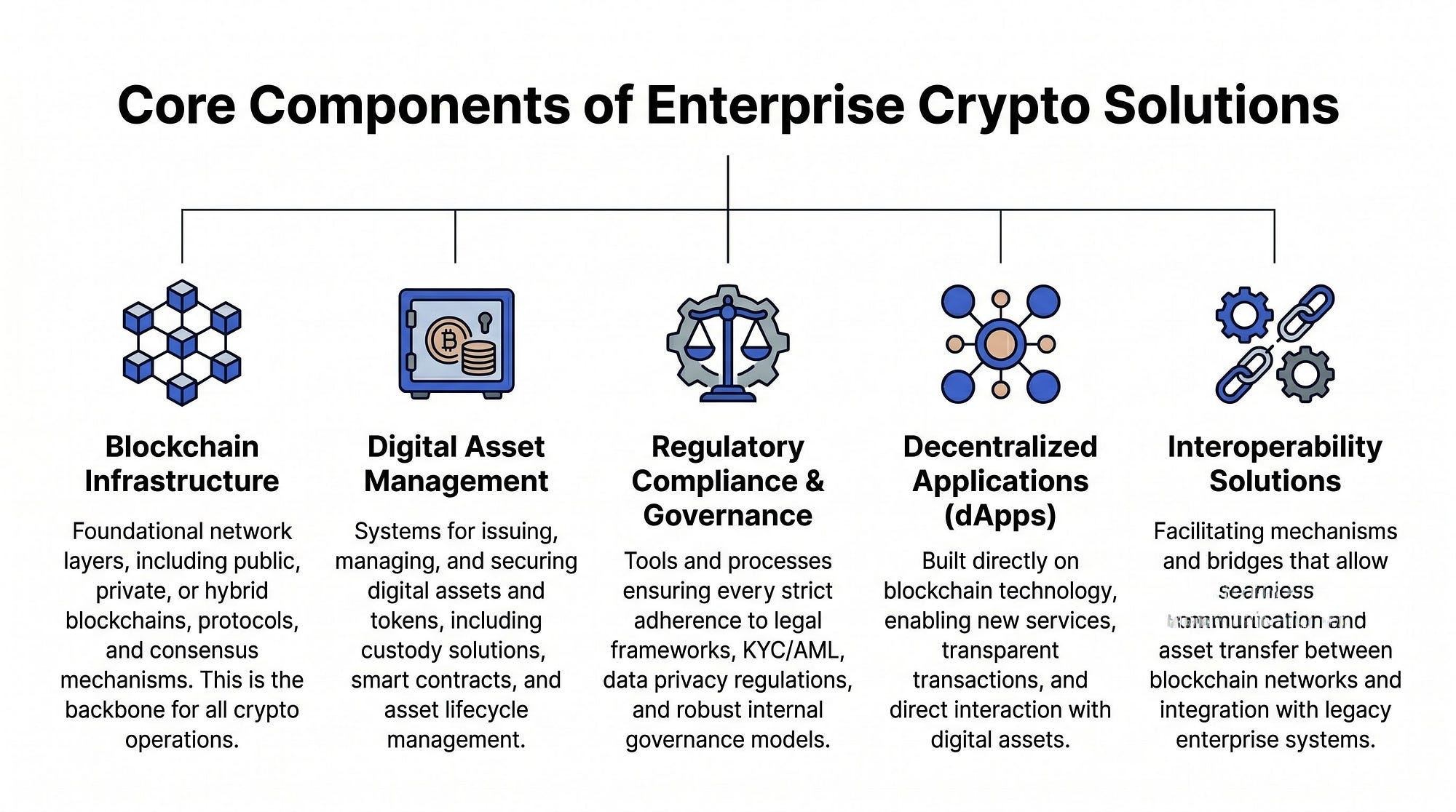
A usable architecture starts with five components that have to work together.
Blockchain infrastructure
Blockchain infrastructure is the base network layer that executes transactions, stores state, and enforces consensus. For enterprises, its purpose isn’t ideological decentralisation alone. It determines throughput, fee predictability, settlement finality, privacy options, and how much control the operator retains over upgrades and integrations.
Public chains are useful when liquidity, ecosystem access, and composability matter. Private or hybrid models fit environments where governance, permissioning, or data isolation matter more. In practice, many serious products use both. Public chains for issuance or settlement, and off-chain services for policy enforcement, reporting, and orchestration.
Digital asset management
Digital asset management covers issuance, custody, smart contract administration, treasury controls, and lifecycle events such as minting, transfer restrictions, redemption, and corporate actions. Its business purpose is to keep assets operable and governable after launch, not just to create tokens.
Many product plans are too narrow; issuing a token is easy compared with handling key rotation, failed transfers, emergency pauses, cap table logic, and reconciliation with finance or inventory systems.
Practical rule: If your team can’t describe how an asset is redeemed, frozen, audited, and retired, the token model isn’t production-ready.
Regulatory compliance and governance
Regulatory compliance and governance means continuous controls over onboarding, transaction screening, audit trails, policy enforcement, and internal approvals. Its purpose is to reduce regulatory exposure while making sure operations remain reviewable by legal, finance, and risk teams.
This layer must exist before scale. If it’s bolted on later, product velocity drops because every new market, token type, or partner requires redesign.
Decentralised applications
Decentralised applications are the user-facing products that let customers interact with tokens, markets, wallets, or protocols. Their purpose is to package blockchain capabilities into usable workflows, such as subscriptions, trading, collateral management, rewards, or asset purchases.
What works here is familiar product design. Clear user journeys, low-friction signing, sensible failure states, and strong telemetry. What doesn’t work is forcing users to think like protocol engineers.
Interoperability and enterprise integration
Interoperability solutions connect chains, custodians, payment rails, internal ledgers, and reporting systems. Their business purpose is continuity. They prevent crypto workflows from becoming isolated systems that break treasury, compliance, or customer operations.
A quick architecture lens helps:
Component What it decides Common failure mode Infrastructure Settlement model and network constraints Picking a chain before defining operating requirements Asset management Token lifecycle and control model Focusing on minting, ignoring post-issuance operations Compliance Risk gating and auditability Treating AML and governance as a later integration dApps User workflow and conversion Exposing protocol complexity to end users Interoperability Data and asset movement across systems Building a product that can’t connect to legacy systems
For technical leadership, the useful mental model is simple. Infrastructure enables assets. Assets require controls. Controls shape applications. Interoperability makes the system commercially usable.
How to Design Secure and Scalable Tokenisation Systems
Tokenisation gets discussed as if it were one design problem. It isn’t. Tokenising a native digital asset, a carbon credit, and a precious metal each creates different obligations around custody, redemption, legal rights, and data integrity.
That’s why architecture should start with the asset itself, not with the token standard.
Start with the claim, not the chain
A token is only as reliable as the claim behind it. For a native digital asset, the token is usually the asset. For a real-world asset, the token represents a legal, contractual, or operational claim on something outside the chain.
That changes everything.
For precious metals, the contract model has to answer practical questions. Who holds the metal. How often reserves are reconciled. Whether redemption is physical, cash-settled, or both. What happens if a custodian fails. If those answers live in scattered PDFs and side agreements, the token system becomes difficult to trust and hard to scale.
In India, this matters because the opportunity is real but the operational gap is still wide. The market context is clear in this analysis of financial inclusion and tokenisation gaps, which notes that approximately 190 million adults remain unbanked despite over 800 million smartphone users. It also notes that tokenised RWAs on Indian-focused chains grew 45% in Q1 2025, yet only 12% of projects achieved production scalability because KYC and AML hurdles remained unresolved.
Choose token standards based on lifecycle complexity
Many teams know the names. Fewer choose them for the right reasons.
- ERC-20 fits fungible supply models such as stable-value assets, fund units, or metal-backed fractional claims where each unit should behave identically.
- ERC-721 suits uniquely identified assets when each token carries distinct attributes, provenance, or ownership history.
- ERC-1155 works well for mixed inventories where a platform needs both fungible and non-fungible behaviour in one contract system.
The wrong choice usually shows up later as operational friction. Teams start with a familiar standard, then realise they need transfer restrictions, jurisdiction-based access rules, role-based minting, or document-linked metadata that wasn’t designed cleanly from the start.
Token design shouldn’t optimise for launch simplicity alone. It should optimise for the full asset lifecycle, including disputes, redemption, reporting, and regulator review.
Build control points outside the smart contract too
Smart contracts matter, but overloading them with every business rule usually creates rigidity. Strong tokenisation systems split responsibility across layers:
- On-chain contracts for asset logic, ownership state, and immutable events.
- Off-chain policy services for KYC, sanctions screening, approval flows, and document validation.
- Operations tooling for treasury actions, reconciliation, exception handling, and support workflows.
That split keeps contracts auditable while allowing policy changes without contract rewrites. It also reduces the temptation to encode every compliance nuance directly on-chain.
A useful implementation reference is this RWA tokenization checklist for asset tokenization projects. It’s valuable because it forces teams to think through legal ownership, servicing, custody, and operational readiness before writing issuance logic.
What usually works and what usually fails
A practical contrast is below.
Decision area What works What fails Asset definition Clear legal claim and redemption model Ambiguous linkage between token and underlying asset Contract design Minimal, auditable logic with strong admin controls Complex contracts carrying every business rule Compliance flow Pre-transfer and post-transfer controls with review paths Manual checks disconnected from issuance and transfers Operations Reconciliation, reserve checks, incident playbooks Launching without service and exception management
The strongest tokenisation systems behave less like experiments and more like regulated software products.
What Is Required for Resilient Trading and DeFi Infrastructure
Trading infrastructure decisions become expensive when they’re made in the wrong order. Teams often start by debating centralised versus decentralised models when the more useful question is this. Where should speed, trust, and liquidity live in your system?
That answer drives architecture.
CLOB versus AMM versus hybrid models
A centralised limit order book (CLOB) gives you deterministic matching, familiar market structure, and better control over latency-sensitive execution. It’s usually the right fit for professional trading experiences, market-maker support, and products where users expect exchange-style behaviour.
An automated market maker (AMM) reduces dependence on an always-populated order book and offers stronger on-chain transparency. It’s useful for long-tail assets, composable DeFi integrations, and environments where programmability matters more than exchange-like microstructure.
A hybrid model is often the practical middle ground. Matching and risk controls can run in a high-performance off-chain engine, while custody, settlement, or selected trade proofs anchor on-chain.
The comparison below is more useful than ideology:
Architecture Strength Trade-off Best fit CLOB Low-latency execution and familiar UX Higher operational responsibility Exchanges, pro trading desks AMM On-chain transparency and composability Slippage and liquidity design complexity DeFi products, long-tail markets Hybrid Balance of speed and auditability More integration complexity Enterprise platforms needing both control and openness
For teams evaluating that middle path, this hybrid exchange platform architecture guide is a strong technical reference because it frames the split between matching, custody, and settlement clearly.
The systems that make markets resilient
Matching logic gets attention, but resilience usually depends on less glamorous components:
- Custody design decides whether users, the platform, or a qualified partner controls assets and how withdrawals, treasury actions, and emergency operations are handled.
- Market data pipelines determine whether pricing, order book updates, and risk signals remain trustworthy under load.
- Execution controls govern retries, failed settlement handling, sequence guarantees, and protection against stale prices.
- Cross-chain routing affects how assets move between ecosystems without turning every swap into an operational incident.
Cross-chain functionality deserves caution. Atomic swaps, bridge-based transfers, and liquidity-network approaches all solve different problems. Bridge-heavy designs are convenient, but they also concentrate risk. If your product depends on moving value across chains, treat bridge selection as a board-level security question, not a simple feature choice.
Why analytics belongs inside the trading stack
Many teams still treat on-chain analytics as a research tool. In production systems, it belongs in risk and liquidity operations.
A useful market example appears in this overview of crypto technical analysis tools and indicators, which cites India-focused usage of CryptoQuant and Glassnode metrics such as NUPL and exchange inflow and outflow. It notes that during 2025 bull runs, Bitcoin dominance hit 55%, and that a 20% spike in India-specific exchange inflows preceded 15% price corrections in altcoins like MATIC by 72 hours in Q1 2025, with 78% backtested accuracy on Polygon and 2.5M daily active wallets.
That doesn’t mean every product needs a quant stack. It means serious trading platforms should feed market structure, on-chain flow, and treasury exposure into one operating view.
If your exchange risk team learns about liquidity stress from X posts before it sees it in internal dashboards, the monitoring design is already behind.
There’s also a commercial dimension. Teams building exchange infrastructure often need to understand investor expectations around market design, custody, and compliance readiness. This curated list of Top Cryptocurrency United States Investors is useful during fundraising preparation because it shows who is active in the category and what calibre of product narrative tends to matter.
How Can AI Enhance Crypto Compliance and Monitoring
Rule-based compliance systems are still necessary. They’re just no longer sufficient.
Crypto platforms generate behavioural signals that static KYC workflows can’t interpret well on their own. Wallet clustering changes. Flow patterns shift across chains. The same customer may appear low-risk at onboarding and high-risk once transaction behaviour changes. That’s why modern compliance needs to operate continuously, not only at entry.
Where AI actually helps
AI is useful in compliance when it narrows analyst effort to the right cases and spots behavioural anomalies earlier than fixed thresholds can. In practice, that usually means combining deterministic screening with models that evaluate transaction patterns, wallet relationships, and deviations from expected user behaviour.
This is the shift from point-in-time compliance to continuous compliance.
In India, enterprise tooling has already moved in that direction. According to Elliptic’s compliance platform information, blockchain analytics platforms such as Chainalysis and Elliptic cover 99% of global trading volume, use 1B labeled crypto addresses, and provide 99.99% uptime for real-time risk screening. The same source states that these systems can detect 85% of suspicious transactions in real time through behavioural pattern matching on networks such as Ethereum and Polygon.
A practical compliance architecture
The strongest operating model isn’t AI alone. It’s layered controls.
- Deterministic screening first for sanctions lists, known high-risk entities, exposed wallet addresses, and prohibited jurisdictions.
- Behavioural modelling next for wash trading patterns, transaction splitting, unusual routing, rapid hops across chains, or abrupt changes in customer activity.
- Case management after that so analysts can review context, create escalation paths, and preserve an auditable decision trail.
- Policy orchestration around all of it so product, legal, and operations teams can update controls without rebuilding core transaction systems.
A platform team can also benchmark tools beyond any single vendor category. This curated set of privacy and compliance tools is useful when comparing workflow coverage, not just blockchain analytics coverage.
Why AI changes the economics of compliance
Without AI-assisted triage, teams usually face one of two bad outcomes. Either they over-block legitimate activity and damage user trust, or they under-review edge cases and create regulatory risk.
That’s why the integration matters at the workflow level, not just in a dashboard. Risk scoring should influence onboarding decisions, withdrawal holds, settlement review, and even smart contract permissions where appropriate. If you’re evaluating implementation patterns, this overview of AI for blockchain systems is useful because it frames AI as an operational layer across detection, automation, and governance rather than as a standalone feature.
A short example helps. A rules engine may flag a transfer because it exceeds a threshold. An AI-assisted system can add context. Is the wallet newly active. Has it interacted with risky services. Is the pattern consistent with layering, wash activity, or sanctioned exposure. Did the same account just alter device behaviour or funding source patterns. That context changes how quickly a risk team can act.
A useful technical walkthrough sits below.
Strong compliance design doesn’t try to eliminate all risk. It makes risk visible early enough for the business to respond with control, evidence, and speed.
A Phased Roadmap for Production-Ready Deployment
A common failure pattern looks like this. The team ships smart contracts on schedule, wallet flows pass QA, and the first pilot customers are ready. Then legal blocks rollout in one jurisdiction, finance cannot reconcile on-chain movements to internal ledgers, and operations has no clear procedure for freezes, redemptions, or key compromise. The architecture may be technically sound, but the deployment plan was not.
That is why production readiness has to be staged. Enterprise crypto systems succeed when architecture, controls, and operating model mature in the same sequence as the product itself.
Fast-growth markets increase the pressure. As noted earlier, India ranked first in global crypto adoption, and APAC recorded strong year-over-year growth in on-chain activity. That creates an obvious opportunity, but it also shortens the margin for design mistakes. Teams need a roadmap that translates high-level crypto strategy into decisions about custody, service boundaries, compliance evidence, and operational ownership.
Phase one and phase two
The first phase is strategic discovery and architectural design, dedicated to translating the business model into system constraints. Define the asset lifecycle, target jurisdictions, participant roles, settlement expectations, and recovery paths before any implementation starts. If those choices remain vague, teams usually end up rebuilding core services after audit or after the first enterprise client asks basic control questions.
The second phase is MVP development and contract assurance. The goal is to prove the product can handle its highest-risk workflows under realistic conditions. For a tokenisation platform, that may mean issuance, transfer restriction, redemption, and cap-table synchronisation. For an exchange or DeFi product, it may mean order execution, liquidity controls, wallet screening, and withdrawal review. AI-assisted compliance should be wired in at this stage, not bolted on later, so risk scoring and case management affect real user and operator flows.
Typical outputs from these phases include:
- Architecture decisions on chain selection, custody approach, signing patterns, data residency, and off-chain service ownership
- Control definitions for onboarding, transaction approvals, treasury actions, exception handling, and audit evidence
- Contract and platform reviews focused on business logic, role design, upgrade paths, and recovery procedures
- Operating runbooks for issuance, settlement, freezes, redemptions, support escalation, and key events
Phase three and phase four
The third phase is scalability testing and security hardening. In this phase, teams learn whether they built a credible platform or a convincing demo. Throughput matters, but it is only one part of the answer. Test signing queues, webhook retries, ledger reconciliation, monitoring noise, case-review latency, and dependency failures across RPC providers, custody services, and payment rails. In production, operational bottlenecks usually break before the chain does.
The fourth phase is launch and continuous operations. Launch should happen only after engineering, compliance, finance, and support can all work from the same operational record. That means alerts route to named owners, reconciliation completes on schedule, policy decisions are explainable, and incidents can be handled without improvisation. For enterprise buyers, that discipline matters as much as feature depth.
A practical roadmap looks like this:
Phase Primary objective Common mistake Discovery Define operating model, control boundaries, and deployment constraints Choosing chain and tooling before clarifying legal, custody, and workflow requirements MVP Validate high-risk transaction paths and operator actions Treating the MVP as a prototype and postponing assurance work Hardening Prove recoverability, observability, and service resilience Testing transaction speed without testing operational failure modes Launch Run with evidence, ownership, and repeatable procedures Leaving reconciliation, incident response, and support workflows for post-launch
The roles that matter most
Delivery usually depends on five groups working from one plan rather than parallel assumptions.
- Product leadership defines the commercial model, customer obligations, and release priorities.
- Solutions architecture sets boundaries between on-chain logic, off-chain services, and third-party dependencies.
- Security and compliance establishes approval paths, monitoring rules, evidence standards, and jurisdiction-specific controls.
- Platform engineering builds the services that make the blockchain layer usable in production, including observability, key management, and integrations.
- Operations and finance own reconciliation, exception handling, reporting, and day-two support.
The trade-off is straightforward. Teams can move faster early by skipping design discipline, but they usually pay for it during audit, partner onboarding, or the first live incident. A phased roadmap reduces that rework. It gives CTOs a way to connect token architecture, AI-driven compliance, and operating readiness into one production plan instead of treating them as separate workstreams
Launch is the point where architecture starts proving whether it was designed for real operators, not just for a testnet demo.
The Future Outlook for Crypto Tech in 2026–2028
The next phase of crypto tech solutions won’t be defined by novelty alone. It will be defined by whether platforms can support ordinary business processes without forcing users and regulators into protocol-native complexity.
One clear signal is the rise of stablecoin infrastructure as a foundation layer for broader enterprise workflows. According to the State of Crypto 2025 report, stablecoin supply reached over $300 billion globally in 2025, with Tether and USDC accounting for 87% of the market. The same report says they settled $772 billion adjusted on Ethereum and Tron in September 2025 alone, representing 64% of all transaction volume. That matters because it shifts stablecoins from a niche trading instrument to a practical settlement rail for tokenisation, treasury movement, and cross-border operations.
What technical leaders should expect
Three changes look especially important over the next 12 to 24 months.
- Identity will move closer to the transaction layer. DID-style models and reusable attestations will become more relevant because teams need compliance evidence without repeating the same onboarding friction in every product.
- Governance automation will mature. More platforms will push policy enforcement into programmable approval systems, especially where treasury actions, asset servicing, and market controls need multi-party review.
- Sector-specific tokenisation will outgrow generic platforms. Carbon markets, precious metals, private funds, and structured digital asset products each need domain-specific data models and servicing logic.
What probably won’t work
General-purpose crypto infrastructure with no opinionated compliance model will struggle in enterprise settings. So will products that assume all users want self-custody, on-chain transparency at any cost, or fully decentralised operations.
The better strategic bet is modularity. Build systems that can support permissioned flows, selective disclosure, stablecoin settlement, and AI-assisted monitoring without rewriting the core platform each time regulation or market structure changes.
Build Your Vision with Blocsys Technologies
Most organisations don’t need another abstract conversation about Web3 strategy. They need a delivery partner that can translate product intent into architecture, controls, and an executable roadmap.
Blocsys Technologies works in the part of the market where that translation matters. The company helps fintechs, exchanges, and digital asset businesses build production-ready blockchain and AI-powered platforms. That maps directly to the needs that tend to block deployment: tokenisation system design, trading infrastructure, and compliance workflows that can operate at enterprise level.
Where Blocsys fits in the stack
If your team is building a tokenised asset platform, the challenge usually isn’t the contract in isolation. It’s connecting issuance logic to custody, redemption, transfer policy, and operations. Blocsys supports that by designing tokenisation systems around business workflows rather than around token minting alone.
If the priority is exchange or DeFi infrastructure, the pressure points are different. Matching behaviour, custody boundaries, market data, cross-chain movement, and observability all need to work together. That’s where a technical implementation partner can reduce architecture drift before it becomes expensive.
Compliance is usually the most underestimated workstream. Product teams often know they need KYC, wallet screening, and monitoring, but they don’t always have a coherent design for continuous controls. Blocsys’s focus on AI-powered compliance workflows is relevant here because the core problem isn’t collecting alerts. It’s integrating risk intelligence into transaction systems and operator decisions.
What a useful engagement should look like
A serious partner should help your team do four things well:
- Clarify scope early so the product model, control model, and operating model align.
- Design for production so token logic, trading services, and monitoring aren’t treated as separate projects.
- Reduce rework by making architecture decisions that survive audit, scaling, and market expansion.
- Support execution through development, integration, hardening, and launch operations.
The right next step usually isn’t “build everything”. It’s deciding which risks must be solved in architecture, which can be handled in workflow, and which should remain configurable as regulation and market structure evolve.
If you’re evaluating crypto tech solutions at that level, Blocsys is aligned with the problem as it exists in enterprise delivery.
Frequently Asked Questions about Crypto Solutions
Below are the questions technical and business leaders usually ask once the strategic discussion becomes a delivery decision.
Question Answer What should I budget for a custom crypto platform? Budget by system scope, not by blockchain features alone. A tokenisation platform, a hybrid exchange, and a compliance-heavy DeFi product have different cost structures because custody, monitoring, integrations, and operational tooling often consume more effort than smart contracts. How long does production-ready delivery usually take? The honest answer depends on governance complexity and integration load. Teams move faster when they lock down asset rules, custody assumptions, and compliance workflows early. Most delays come from unresolved policy questions, audit rework, and changing requirements after core architecture is already built. Should we hire in-house or use a specialised development partner? In-house teams work well when you already have strong product, platform, security, and compliance leadership. A specialised partner is useful when your team needs architecture acceleration, scarce blockchain expertise, or extra delivery capacity without building a full internal function immediately. What’s the biggest non-technical risk in enterprise crypto projects? Misalignment between product ambition and operating reality. Teams launch features they can’t support operationally, legally, or financially. That usually shows up as manual workarounds, poor exception handling, and disputes over who owns risk decisions. How do we choose between a public, private, or hybrid blockchain model? Choose based on settlement needs, governance requirements, privacy expectations, and integration constraints. Public chains help with liquidity and ecosystem access. Private and hybrid models make more sense when permissioning, data control, or institutional workflows matter more. Is compliance only a concern for exchanges? No. Tokenisation platforms, custodial products, treasury tools, and DeFi-adjacent applications all need compliance logic. The form changes, but the need for audit trails, screening, approvals, and monitoring remains.
The best early workshop usually covers three things. What asset or market behaviour the platform must support, who controls risk decisions, and how the team will run the system once customers are live.
If you’re planning a tokenisation platform, exchange, DeFi product, or AI-assisted compliance stack, Blocsys Technologies can help you turn that concept into an architecture and delivery plan built for real operations. Connect with the team to review your use case, pressure-test the design, and define the fastest path to a secure production launch.