Crypto Swap Slippage: Why It Happens and How to Choose the Right Rate Mode
--
A crypto user checks the exchange preview and sees one amount. A few minutes later, after the transaction confirms on-chain, the final amount received is lower than expected. That moment creates one of the most common frustrations in digital asset exchanges: crypto swap slippage.
For many traders and everyday users, slippage feels random or hidden. In reality, it usually comes from market movement during the time between sending funds and receiving enough blockchain confirmations for the exchange to complete.
This becomes even more important during volatile periods when prices move quickly across multiple blockchains and assets. A user swapping BTC to ETH, DOGE to USDT, or TRX to BTC may suddenly notice that the market changed before the exchange finalized.
Understanding how slippage works helps users make better decisions about exchange timing, rate modes, and transaction expectations.
What Causes Crypto Swap Slippage?
Crypto swap slippage happens when the final exchange rate changes between the moment an order is created and the moment the transaction is processed.
In practice, several things can influence this:
- Rapid market movement
- Blockchain confirmation delays
- Network congestion
- Volatility between different assets
- Sudden liquidity shifts
For example, imagine someone exchanging SOL for BTC during a volatile market session. They create the order based on one displayed rate, but before the transaction receives enough confirmations, the market price moves downward. The completed exchange may return slightly less BTC than initially expected.
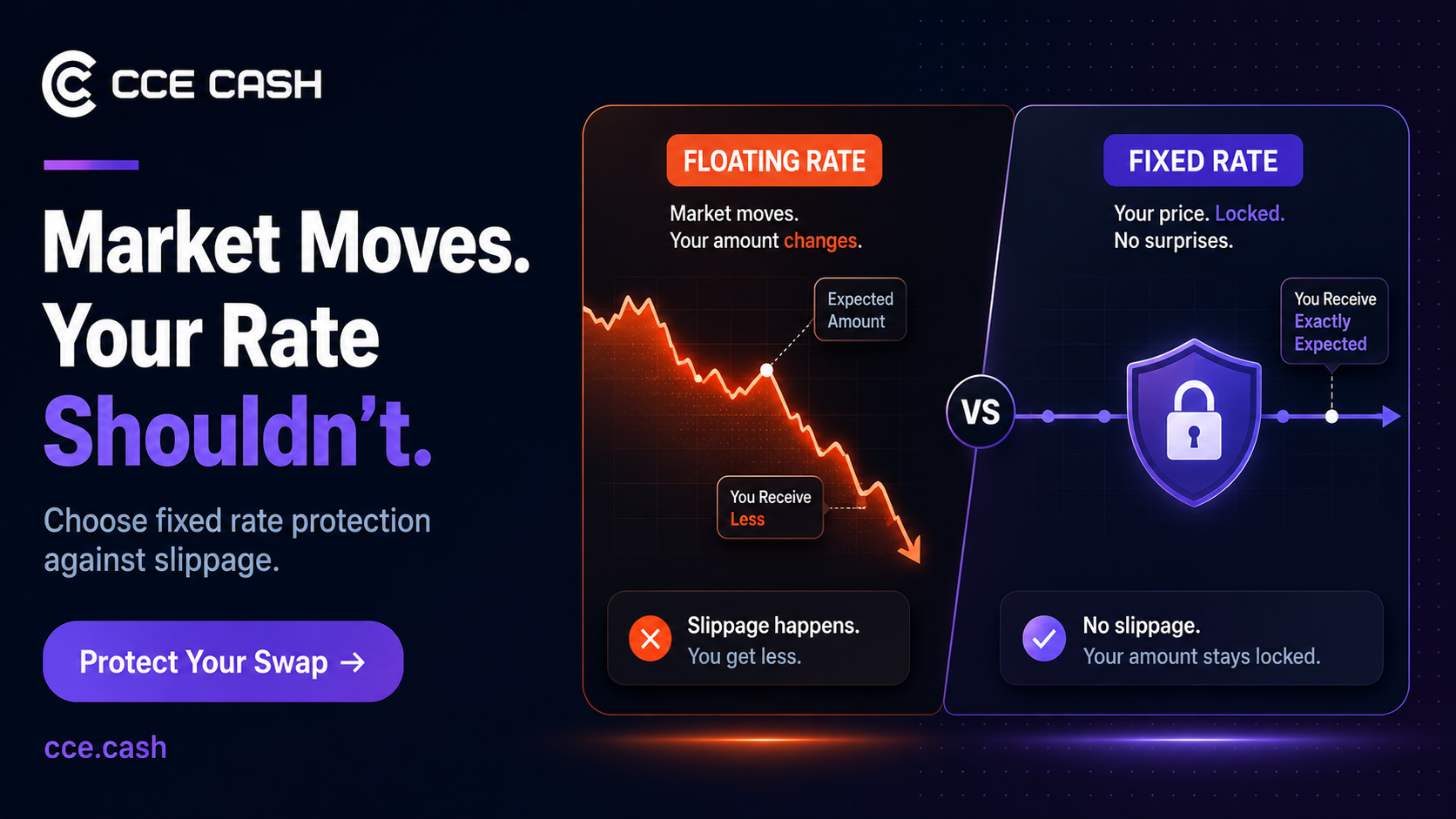
This is especially noticeable with floating rate exchanges because the rate adjusts according to live market conditions during processing.
That does not necessarily mean the exchange failed. It means the market moved while the blockchain transaction was still confirming.
Many users underestimate how much confirmation time matters in crypto. Even a few extra minutes can affect the final amount during active trading periods.
A useful discussion question for crypto users is this:
Would users rather prioritize the fastest possible execution, or prioritize certainty about the final amount received?
The answer often depends on the purpose of the transaction.
Floating Rate vs Fixed Rate Protection
One of the simplest ways to manage rate slippage is understanding the difference between floating and fixed exchange rates.
Floating rate exchanges follow real-time market conditions. This approach can be useful for users who want fast execution and are comfortable with market movement during confirmation time.
If the market moves positively, the user may receive more than expected. If the market moves negatively, the final amount may decrease.
This creates both opportunity and risk.
Fixed rate protection works differently.
With a fixed rate exchange, the exchange rate is locked for a limited period. According to the CCE Cash FAQ, the fixed rate remains locked for 10 minutes, provided the exact transaction amount arrives within that time window.
This helps users avoid uncertainty caused by market swings during processing.
A practical scenario:
A user wants to convert 5,000 USDT (TRC20) into BTC before sending funds to another wallet. Because Bitcoin price volatility can move rapidly, the user chooses a fixed rate exchange instead of a floating rate option. Even if the market changes during those minutes, the locked rate remains unchanged as long as the transaction conditions are met.
For users handling larger transfers, treasury movements, or exact payout requirements, price certainty exchange tools often become more important than marginal speed advantages.
On the other hand, some users may still prefer floating rates during stable market periods because floating exchanges automatically follow current market pricing.
Why Blockchain Speed Matters in Rate Slippage
Many people blame exchanges for slippage when the actual cause is blockchain timing.
Crypto exchanges cannot finalize a swap until the blockchain confirms the deposit transaction.
According to the CCE Cash tutorial and FAQ, exchanges complete after the required network confirmations, and timing depends on blockchain conditions and transaction fees.
Low network fees can slow confirmations significantly.
For example:
- A BTC transaction with a low miner fee may remain pending longer
- ETH network congestion can delay confirmations
- High volatility during waiting periods increases floating rate risk
This creates an important connection between network speed and slippage exposure.
Users sometimes focus only on exchange rates while ignoring blockchain conditions. In reality, confirmation speed is part of the exchange experience itself.
This is why many experienced crypto users monitor:
- Network congestion
- Estimated confirmation times
- Transaction fees
- Asset volatility before initiating swaps
How CCE Cash Handles Exchange Flexibility
CCE Cash approaches crypto exchange utility with a dual-mode system that allows users to choose between floating and fixed rate exchanges depending on their priorities.
The platform operates as a fully automated cryptocurrency exchange service supporting cross-chain swaps between assets including BTC, ETH, USDT, SOL, XMR, TRX, DOGE, TON, AVAX, BNB, LTC, BCH, and more.
No registration is required. Users simply select currencies, choose a rate mode, enter a receiving address, and send funds. The system automatically detects deposits, processes the exchange, and sends assets to the destination wallet.
Order tracking includes:
- Real-time status updates
- Blockchain explorer links
- Order inquiry codes
This transparency helps users understand where a transaction currently stands during processing.
For users concerned about floating rate risk during volatile markets, fixed rate protection offers a way to reduce uncertainty. For users who prioritize flexibility and real-time execution, floating rates remain available.
The exchange process is designed to work across devices without requiring applications or account creation.
Another important point is that expired fixed-rate orders are not automatically abandoned. Users can contact support to continue the exchange at floating rate or request a refund minus network fees.
Final Thoughts
Crypto swap slippage is not always avoidable, but it becomes much easier to manage once users understand how market movement, blockchain confirmations, and exchange rate modes interact.
Choosing between floating and fixed rate exchanges depends on the transaction goal:
- Speed and live pricing
- Or predictable final amounts
As cross-chain activity continues growing across BTC, ETH, SOL, DOGE, TRX, TON, and stablecoins, understanding rate slippage becomes part of basic crypto transaction management.
Users who want more control over exchange conditions can explore both rate modes directly through CCE Cash.