Crypto Market Update: What could drive the Market in June 2026?
 AURA DEX3 min read·Just now
--
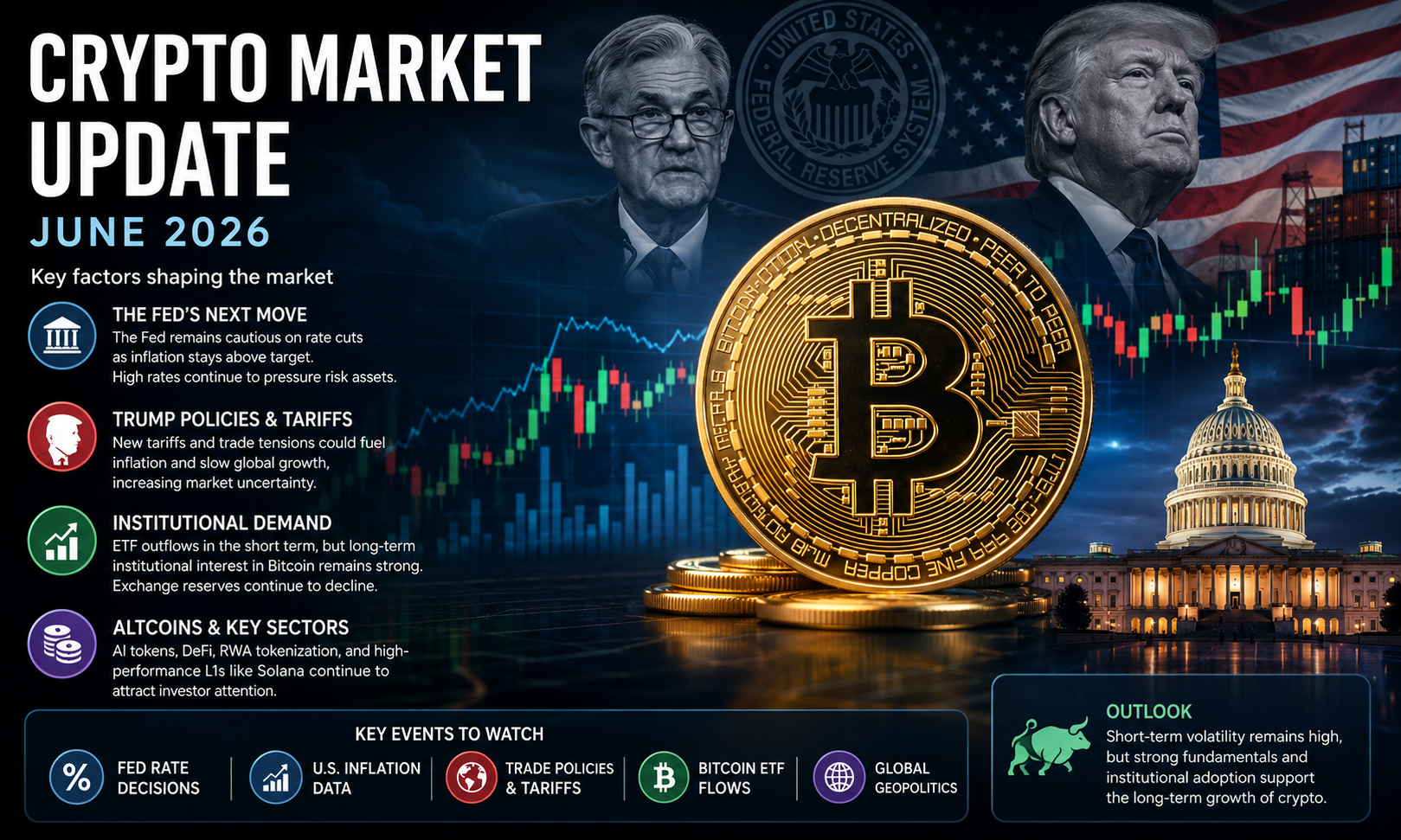
The cryptocurrency market has entered June 2026 facing a complex mix of macroeconomic uncertainty, political developments, and institutional activity. While Bitcoin continues to demonstrate resilience compared to previous market cycles, investors are closely monitoring decisions from the U.S. Federal Reserve, the economic policies of President Donald Trump, and the flow of capital into digital assets.
The Fed Remains the Market’s Biggest Catalyst
One of the most important factors influencing crypto markets today is the Federal Reserve’s monetary policy.
Despite signs of moderating inflation, the Fed has maintained a cautious stance on interest rates. Markets are currently pricing in the possibility that rates will remain elevated for longer than previously expected, as policymakers continue prioritizing price stability.
For cryptocurrencies, this creates a challenging environment. Higher interest rates tend to reduce liquidity and make traditional income-generating assets more attractive, often limiting capital flows into risk assets such as Bitcoin and altcoins.
As a result, every inflation report, employment figure, and statement from Federal Reserve Chair Jerome Powell has become a key driver of market sentiment.
Trump’s Economic Policies Create New Uncertainty
President Donald Trump’s administration has recently intensified discussions around tariffs and international trade policies.
Markets are concerned that additional tariffs could increase inflationary pressure while simultaneously slowing economic growth. This combination presents a difficult scenario for investors because it may force the Federal Reserve to maintain restrictive monetary policies for longer.
The crypto market has reacted sensitively to these developments, with Bitcoin and equities often moving in tandem following major trade-related announcements.
Investors are now watching closely for any policy decisions that could impact inflation expectations, global liquidity, and overall market confidence.
Institutional Demand Remains Strong
While recent weeks have seen periods of outflows from spot Bitcoin ETFs, institutional interest in digital assets remains one of the strongest long-term bullish factors for the market.
Many analysts view the recent ETF outflows as profit-taking and portfolio rebalancing rather than a fundamental shift in sentiment toward Bitcoin.
Several indicators continue to support the long-term outlook:
- Significant institutional ownership through spot Bitcoin ETFs
- Declining Bitcoin reserves on centralized exchanges
- Growing adoption of digital assets among financial institutions
- Increasing integration of blockchain technology into traditional finance
These trends suggest that large investors continue to view Bitcoin as a strategic asset despite short-term volatility.
What’s Happening in the Altcoin Market?
Altcoins have generally underperformed Bitcoin in recent months as investors favor larger, more established assets during periods of uncertainty.
Capital has largely concentrated around Bitcoin and Ethereum, while many smaller cryptocurrencies continue to struggle with lower liquidity and weaker investor demand.
However, several sectors continue to attract attention:
- Artificial Intelligence (AI) tokens
- Decentralized Finance (DeFi) protocols
- Real-world asset tokenization projects
- High-performance Layer-1 ecosystems such as Solana
- Blockchain infrastructure and interoperability solutions
These sectors are widely viewed as potential leaders should broader market conditions improve.
Key Events to Watch
Several upcoming developments could shape the next major move in the crypto market:
1. Federal Reserve Rate Decisions
Any indication of future rate cuts could significantly improve risk appetite across financial markets.
2. U.S. Inflation Data
Lower-than-expected inflation could strengthen expectations for monetary easing.
3. Trump Administration Trade Policies
Additional tariffs or trade restrictions may increase market volatility.
4. Bitcoin ETF Flows
Institutional inflows remain one of the strongest indicators of long-term market confidence.
5. Global Geopolitical Developments
Political tensions and macroeconomic uncertainty continue to influence investor behavior across all asset classes.
Conclusion
The crypto market in June 2026 stands at an important crossroads.
Short-term challenges remain, including elevated interest rates, inflation concerns, and uncertainty surrounding U.S. economic policy. However, strong institutional participation, growing ETF adoption, and continued blockchain innovation provide a solid foundation for the industry’s long-term growth.
While volatility is likely to remain a defining feature of the market in the coming weeks, investors should pay close attention to Federal Reserve decisions, inflation trends, and institutional capital flows, as these factors will likely determine the direction of the next major crypto market move.
As always, in crypto, the biggest opportunities often emerge when uncertainty is at its highest.
:::`