Crypto Is Falling, But Not for the Reason Most People Think
 Bokiko9 min read·Just now
--
Crypto is having one of those weeks where everyone wants a simple explanation.
Some will call it manipulation.
Some will call it the end of the cycle.
Some will say Bitcoin is dead again.
Others will pretend they saw it coming perfectly.
The truth is less dramatic, but more important.
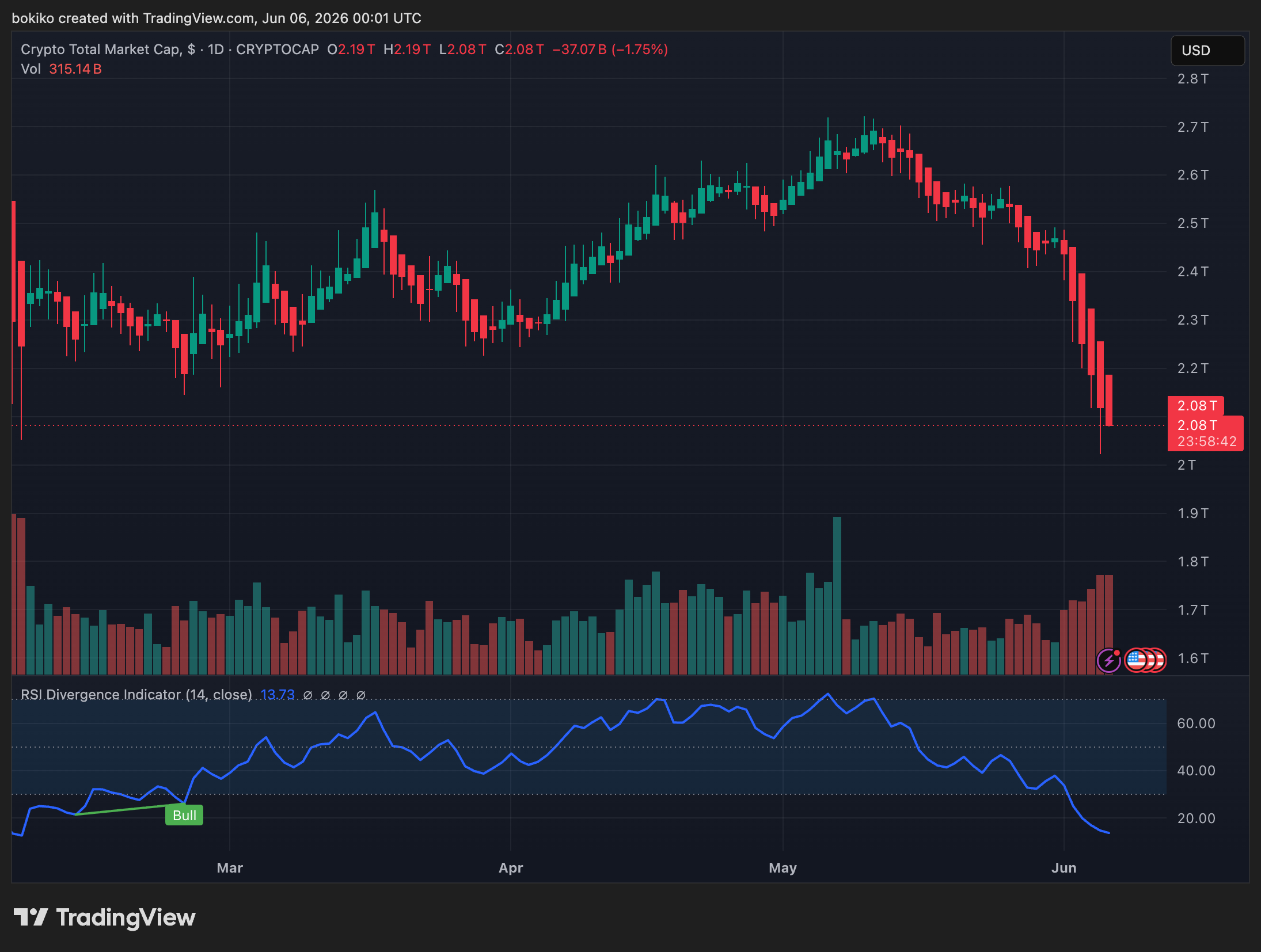
Crypto is not falling because of one single reason. It is falling because several pressures arrived at the same time: ETF outflows, forced leverage liquidations, macro pressure, capital rotation into AI equities, and a loss of patience with weaker crypto narratives.
This is not a panic article. It is also not a blind “buy the dip” article.
It is a look at what is really driving crypto down, which assets are under the most pressure, and what needs to happen before the market can recover.
The crash in numbers
Bitcoin has fallen back toward the $60,000 area after trading far higher late last year. Ethereum has been hit even harder, trading near the mid $1,500 range. Solana is back near the low $60s. SUI, NEAR, HYPE, ZEC, TAO, RENDER, FET, ICP and other high beta names have seen even sharper moves.
This is normal behavior during a crypto deleveraging event.
Bitcoin falls first. Ethereum follows. Then liquidity disappears from altcoins, and the weakest or most crowded narratives get punished the hardest.
What makes this move different is that crypto is now more institutional than in previous cycles. Spot ETFs, public companies, fund flows, macro positioning and cross asset rotation matter much more than before.
Crypto is no longer trading in isolation.
Driver 1: ETF outflows are now the main pressure point
The biggest change in this cycle is that Bitcoin now has a much larger institutional wrapper around it.
That helped on the way up. It also hurts on the way down.
When Bitcoin ETFs were receiving strong inflows, they created steady buy pressure and gave the market a clean narrative: institutions are coming, Wall Street is buying, and Bitcoin is becoming a mainstream asset.
Now that flow has reversed.
Digital asset investment products have seen heavy outflows, with Bitcoin carrying most of the pressure. Ethereum also saw significant outflows. That tells us this is not just retail panic. Institutional money is also reducing exposure.
This matters because ETF flows have become one of the cleanest signals for Bitcoin demand.
When flows are positive, dips get absorbed. When flows are negative for multiple days, rallies get sold.
That is why the market feels heavy. It is not only price going down. It is the buyer of last resort stepping back.
Driver 2: Leverage turned a selloff into a flush
Every crypto crash has two stages.
The first stage is selling.
The second stage is forced selling.
That second stage is where leverage gets wiped out.
More than a billion dollars in leveraged positions were liquidated in a short period, mostly from long positions betting on a bounce. When price failed to hold support, exchanges automatically closed those positions, creating even more sell pressure.
This is why crypto moves so violently.
A normal decline can become a waterfall because the derivatives market is too crowded. Traders use leverage, stops get triggered, liquidations cascade, and the chart suddenly looks much worse than the original news.
This does not mean the market is broken. It means the market was overleveraged.
The good side is that liquidation events clean the market. The bad side is that they push good assets and bad assets down together before the market becomes healthy again.
Driver 3: Macro is no longer friendly
Crypto performs best when liquidity is improving, rates are expected to fall, risk appetite is high, and investors are comfortable moving further out on the risk curve.
Right now, that setup is weaker.
Strong US data has reduced hopes for near term rate cuts. Higher for longer interest rates make speculative assets less attractive. At the same time, geopolitical tensions and energy concerns add another layer of uncertainty.
This matters because crypto is still treated as a risk asset by large pools of capital.
Bitcoin can have a long term monetary thesis. Ethereum can have a settlement layer thesis. Solana can have a consumer crypto thesis. AI tokens can have an infrastructure thesis.
But in a risk off market, most investors do not separate the narratives at first. They reduce exposure across the board.
That is what we are seeing now.
Driver 4: Capital is rotating into AI, not crypto AI
One of the most important parts of this selloff is capital rotation.
The market is not rejecting risk completely. It is choosing a different type of risk.
AI equities, semiconductor names, data center infrastructure and mega IPO narratives have captured investor attention. Crypto is now competing with a much louder AI story.
This is especially important for crypto AI tokens.
Many assumed that if AI stocks go up, AI tokens should automatically follow. The market is proving that this is not always true.
AI equities represent real revenue, real customers, real earnings and direct exposure to infrastructure spending. AI crypto tokens still need to prove where token value capture comes from.
That is why TAO, RENDER, FET, ICP, WLD, NEAR and other AI related crypto names are under pressure despite the broader AI theme remaining strong.
The market is not saying AI is dead.
It is saying crypto AI tokens need more than branding.
Driver 5: Bitcoin dominance is harder to read now
Another quiet change is the rise of stablecoins.
Stablecoins now represent a much larger share of the crypto market. This changes how we should read Bitcoin dominance.
In older cycles, falling Bitcoin dominance often meant capital was rotating into altcoins. Today, some of that “lost” dominance is simply stablecoin growth.
That means lower Bitcoin dominance does not automatically mean alt season.
Right now, the market looks more defensive than aggressive. Capital is not rushing from Bitcoin into smaller coins. Much of it is moving into stablecoins, leaving crypto completely, or rotating into traditional AI and tech equities.
That is why many altcoins are falling harder than Bitcoin even when Bitcoin dominance is not exploding higher.
Asset by asset view
Bitcoin
Bitcoin remains the center of the market.
The key question is whether it can hold the high $50,000s to low $60,000s area. If Bitcoin stabilizes there, the market can rebuild. If it loses that area while ETF outflows continue, the next leg down becomes more dangerous.
Bitcoin’s long term thesis is not dead. But the short term market is flow driven now.
If ETF flows stabilize, Bitcoin can build a base. If they continue to bleed, every bounce will likely face selling.
Ethereum
Ethereum is in a tougher position.
ETH is not only dealing with the market crash. It is also dealing with a confidence problem. Investors want to understand Ethereum’s role in a world of L2s, Solana, stablecoins and faster execution layers.
Ethereum still has the deepest developer ecosystem and remains one of the most important settlement layers in crypto. But price does not reward history. It rewards current demand, current flows and current belief.
For ETH to recover strongly, ETH/BTC needs to stabilize and the market needs to regain confidence in Ethereum’s value capture.
Solana
Solana remains one of the strongest high beta assets in crypto.
That means it can fall hard during deleveraging, but it can also recover faster when risk appetite returns. The Solana thesis is still based on speed, consumer apps, trading, meme activity, DePIN, payments and a strong builder culture.
For SOL, the key question is whether activity and developer momentum remain strong while price is weak.
SUI and NEAR
SUI and NEAR are promising infrastructure assets, but this type of market does not reward potential alone.
In bull markets, investors pay for future growth. In selloffs, they ask for proof.
SUI needs to show real ecosystem growth, user activity, DeFi liquidity and consumer adoption. NEAR benefits from the AI narrative, but the market wants to see whether that narrative creates real token demand.
Both can survive, but both need evidence.
HYPE
HYPE is one of the more interesting names because Hyperliquid is not just a story. It has product market fit, real users, trading activity and a strong position in onchain perpetuals.
But HYPE is also a reflexive asset. It benefits from market activity and confidence. When crypto volumes are strong and traders are active, the story becomes stronger. When the market deleverages, even good products get sold.
The key for HYPE is whether it can maintain activity, revenue, liquidity and user loyalty during a weak market.
If it can, it may remain one of the stronger relative performers after the dust settles.
ZEC
ZEC had one of the most violent moves.
This is a reminder that privacy narratives can move fast in both directions. ZEC can attract attention when the market wants privacy, censorship resistance and older proof of work assets. But when that trade gets crowded, the unwind can be brutal.
The long term privacy argument is real. The short term price action can still be extreme.
AI related tokens
The AI crypto basket is facing a reality check.
The world may still be extremely bullish on AI, but that does not mean every AI token deserves a premium.
TAO has one of the stronger narratives because it sits closer to decentralized model competition and incentive systems. RENDER has a clearer infrastructure angle. FET and other agent related tokens need to prove sustained demand. ICP has a broader compute and web infrastructure story, but still needs stronger token demand. WLD remains controversial and will continue to trade with both AI identity narratives and regulatory risk.
The next phase for AI crypto will be more selective.
The market will not buy every AI ticker just because it has AI in the description.
What happens next?
There are three realistic scenarios.
Scenario 1: Stabilization
Bitcoin holds the high $50,000s to low $60,000s. ETF outflows slow. Leverage gets cleaned out. Ethereum stops bleeding versus Bitcoin. Solana and stronger alts begin to bounce.
This would not mean a new bull market immediately. It would mean the forced selling phase is ending.
Scenario 2: Deeper flush
Bitcoin loses the key support area. ETF outflows continue. Macro stays hawkish. Equities weaken. Funding turns negative but price still fails to bounce.
This is the dangerous scenario.
If Bitcoin breaks lower with institutional outflows still active, altcoins can fall much more than people expect. In that environment, many tokens do not need bad news to drop. They only need no buyers.
Scenario 3: Rotation reset
Bitcoin forms a base, but the next cycle leadership changes.
Bitcoin remains the reserve asset. Ethereum has to fight to regain confidence. Solana leads high beta majors. HYPE leads product driven crypto. AI tokens split between real infrastructure and empty narratives. ZEC stays a high volatility privacy trade.
This is probably the healthiest outcome.
Crypto does not need every token to recover. It needs the good projects to separate from the noise.
What I am watching
The most important signal is ETF flow. If outflows slow or reverse, the market can breathe.
The second signal is Bitcoin’s weekly close. Intraday moves are noisy. Weekly structure matters more.
The third signal is leverage. If liquidations have already cleared the excess, the market can stabilize. If traders immediately reload leverage, the market may need another flush.
The fourth signal is ETH/BTC. If ETH keeps falling against Bitcoin, altcoin confidence will remain weak.
The fifth signal is whether AI crypto tokens can recover while AI equities remain strong. If they cannot, the market is telling us that the crypto AI narrative needs better token economics.
Final thought
This crash is not the end of crypto.
But it may be the end of lazy thinking.
The market is no longer rewarding every story, every ticker, every narrative and every “next big thing.” Capital is becoming more selective. Liquidity is more expensive. Institutions are more important. ETF flows matter. Macro matters. Revenue matters. Token design matters.
That is not bad for crypto.
It is painful, but it is healthy.
The next phase will not be about who can shout the loudest. It will be about who has real demand, real users, real liquidity and a reason to exist when the market is no longer easy.
No panic. No slogans.
Just a market asking the only question that matters:
Who still has buyers when the hype is gone?