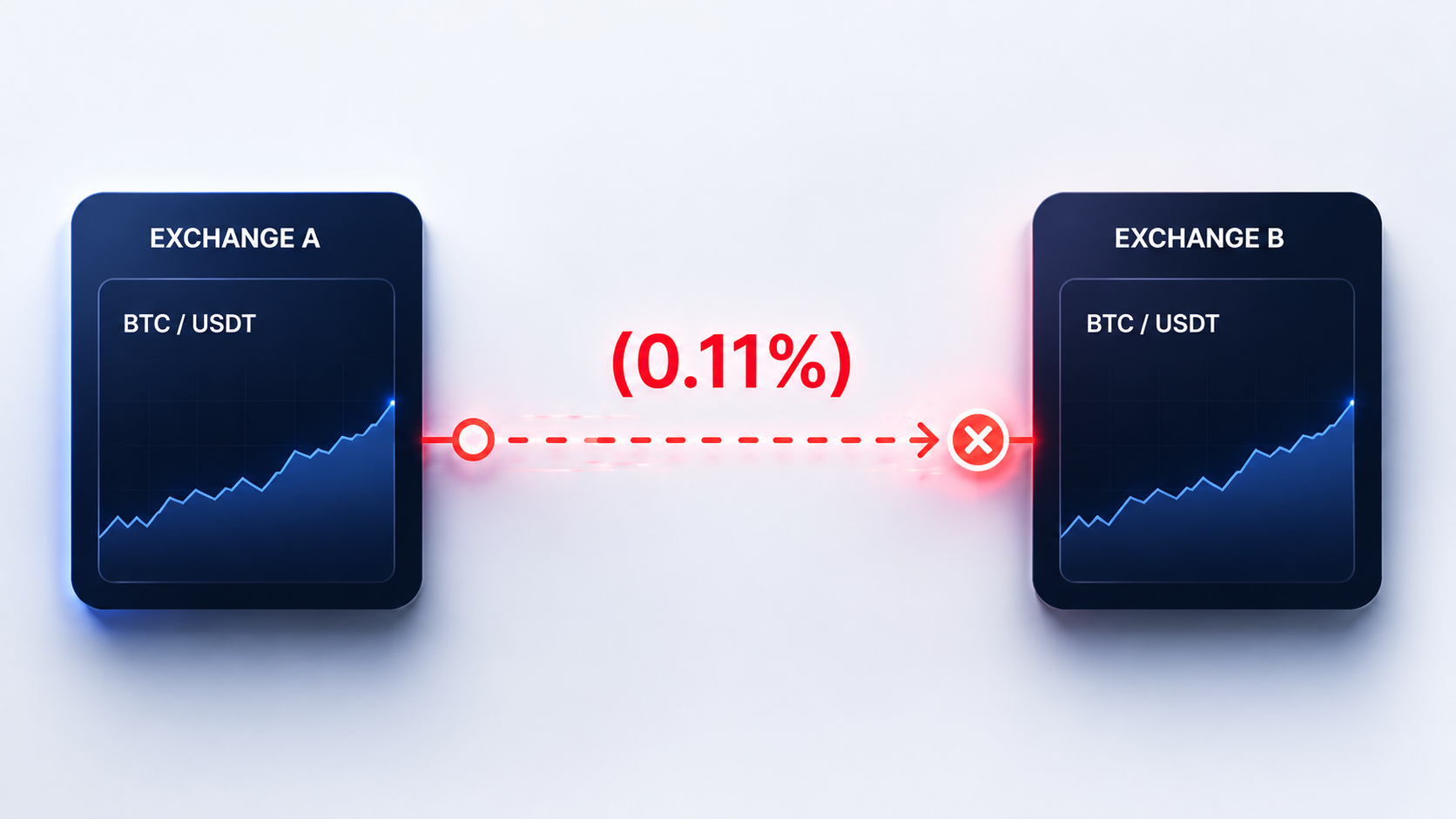
Crypto Arbitrage Is Not About Finding a Spread Anymore
 HETHA.IO4 min read·Just now
--
Crypto arbitrage is often explained through a simple idea: buy an asset where it is cheaper and sell it where it is more expensive. That formula is easy to understand, but it only describes the surface of the process.
In real automated trading, a spread alone is not enough. A price difference has to come from live market data, be recalculated into a chain, pass filtering, go through execution logic, and then appear in balances and trading analytics. If any of these stages breaks down, the fact that a spread was found does not guarantee anything by itself.
Modern crypto arbitrage is no longer just about detecting price differences. It is an infrastructure process that starts before a signal appears and continues after a trade is executed.
Before the Signal, There Is a Data Flow
When a user sees a ready arbitrage opportunity, it may look as if the system simply found a profitable difference between exchanges. In reality, a lot has to happen before that signal appears.
The system has to process constant market activity: ticks, order books, pairs, fees, and possible chain combinations. At this level, receiving data from exchanges is only the first step. The system also has to decide which changes actually matter.
If a new update does not change the order book parameters that affect chain calculation, there is no reason to recalculate the chain again. If the change is too small compared with fees and acceptable deviations, it may have no practical value for trading.
In other words, selection starts before the signal appears. The system decides which data should move forward and which data only creates noise.
This is where the difference between infrastructure and a regular scanner begins. A scanner shows a detected opportunity. Infrastructure processes the market so that this opportunity can be calculated on time and based on relevant data.
A Chain Has to Be Validated, Not Just Profitable
Positive profit in a chain does not mean that it should be used immediately.
A chain may be outdated because its generation time is too long. It may show unusually high profit that is not a real opportunity in practice, but a sign of an anomaly: a frozen order book, distorted pricing, or a problem on the exchange side. It may also no longer match the current order book if the market has changed after the calculation.
This is why there is a separate filtering layer between “the chain was calculated” and “the chain is suitable for further use.”
This layer matters because an arbitrage system does not work with one perfect opportunity. It works with a constant flow of data. In that flow, some signals will inevitably be useless, outdated, or risky.
Before real trading, it is important to evaluate not only whether the chain looks valid, but also its execution risk: how likely it is that the trade can be executed under acceptable conditions.
The task of infrastructure is not to show everything that looks profitable. It is to separate usable chains from noise.
Execution Is a Separate Level of Control
Even if a chain is fresh and has passed filtering, it does not mean that the calculated opportunity automatically becomes a trade.
The next stage is execution. After selection, the chain has to pass through execution logic: the system checks whether the calculated opportunity can be turned into a real trade under current conditions and with available funds. Only after that can the chain move to execution.
At this level, infrastructure should not simply send orders to exchanges. It should manage how those orders are executed: control acceptable deviations, account for available balances, choose the appropriate execution mode, and record the trade result for further analysis.
Execution is not a technical detail after the signal. It is the layer that connects a calculated opportunity with an actual trading result.
After the Trade, Balances Are Different
An arbitrage trade does not end just because the orders are closed.
After execution, the distribution of assets on exchanges changes. If the same chains are repeatedly executed in one direction, funds gradually shift: one asset may accumulate on one platform, while another asset accumulates on another. At some point, a new opportunity may appear again, but there may no longer be enough of the required asset on the required exchange to execute it.
The system also has to see what remains after the trade, not only the moment of calculation and execution.
It is important to understand where assets accumulate, how balance distribution changes, when reverse movement becomes necessary, and how previous executions affect future opportunities.
Without this, arbitrage becomes a set of isolated signals. With it, arbitrage becomes a controlled trading process.
Infrastructure Is the Product
In modern crypto arbitrage, value is not created only at the moment when the system shows a profitable chain. Value is created across the entire workflow:
Each layer affects whether the detected opportunity becomes a real trade and whether it still makes sense after execution. HETHA.IO is built around this logic.
HETHA.IO treats arbitrage as an infrastructure process, not as a stream of separate signals. It connects market monitoring, chain generation, filtering, execution settings, balance movement, and trading analytics into one workflow.
In real arbitrage, simply seeing a spread is not enough. You need to understand how it was calculated, whether it can be used, how it will be executed, and what happens after the trade.
Crypto arbitrage is not about finding a spread anymore. It requires infrastructure that can turn market deviations into controlled trading decisions.