Cross-Chain Swaps vs Bridges — The Difference I Wish Someone Explained to Me Earlier
 MagicLegs4 min read·Just now
--
Spend enough time in crypto and you’ll notice two words getting tossed around like they mean the same thing: bridge and cross-chain swap.
They don’t.
I used to think they did — until I started paying attention to what actually happens after you click “confirm.”
On The Open Network, this confusion is even easier to fall into. The tooling has evolved. What used to be a very simple “move token from Chain A to Chain B” experience has turned into sleek interfaces that feel like magic. But under the hood, the logic still matters.
Here’s the simplest way I now think about it:
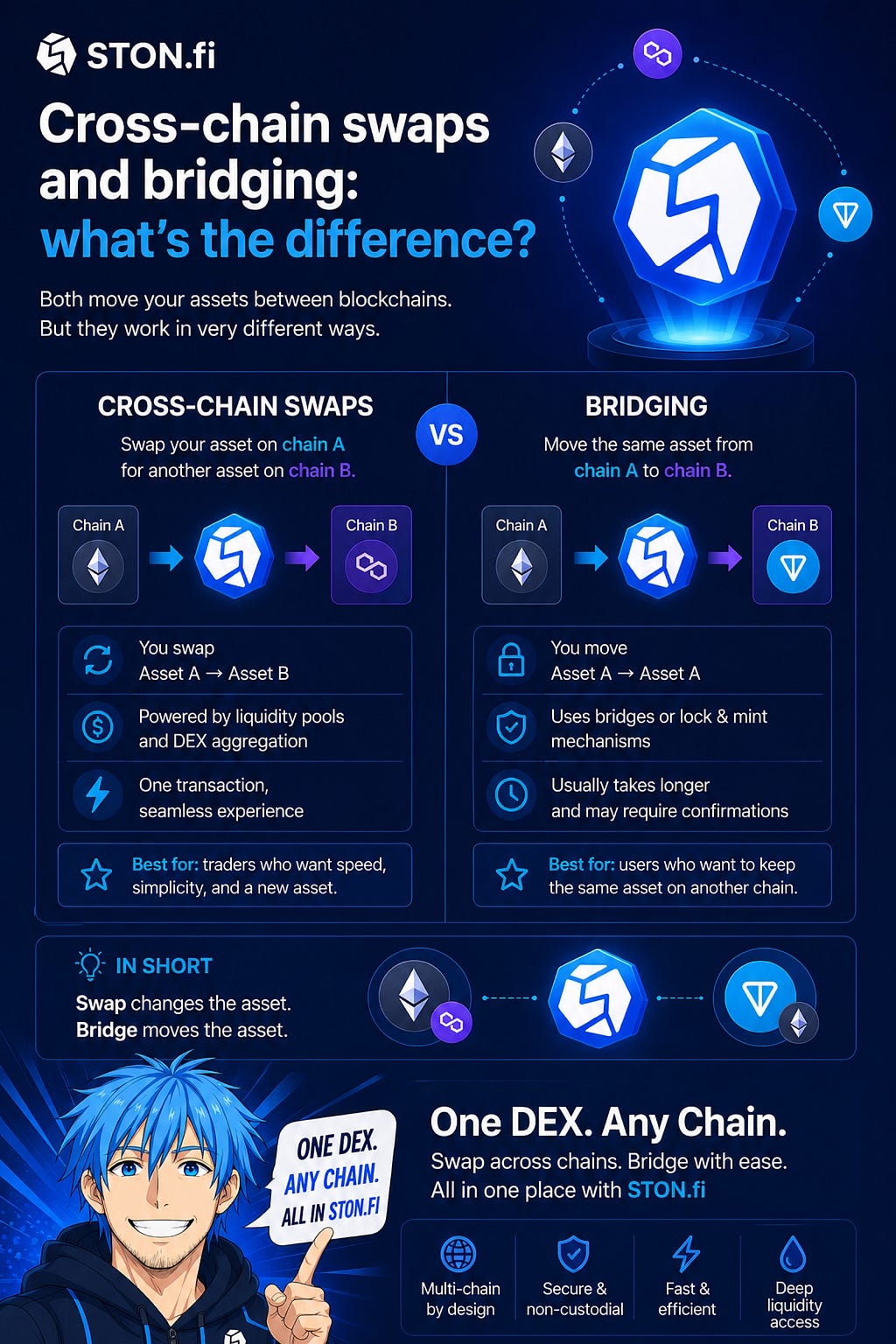
A bridge is about moving value across chains.
A cross-chain swap is about ending up with the asset you actually want on the destination chain.
That distinction changes how you choose tools — and how many headaches you avoid.
What a bridge really does
At its core, a bridge is a transport mechanism.
You hold an asset on one chain and want the same value to appear on another chain. Not a new token. Not a conversion. Just relocation.
If you bridge USDC from Chain A to Chain B, the expectation is straightforward: you receive USDC (or a wrapped/mirrored version of it) on Chain B.
The mission is movement, not transformation.
How bridges traditionally work
Most bridges you’ll encounter fall into one of two classic models:
1) Lock-and-mint
You lock your tokens on the source chain.
The bridge mints a wrapped equivalent on the destination chain.
This is why wrapped assets exist in the first place.
2) Liquidity-based transfer
Instead of minting, the bridge uses liquidity already sitting on the destination chain and releases it to you.
From your side, this can feel smoother. But the goal is still the same: get value across ecosystems.
Where bridge workflows get messy
This is where the difference stops being academic.
- Bridge-heavy flows often mean:
- Multiple steps
- Fees on both ends
- Dependence on available liquidity
- More chances to click the wrong thing
- Delays or stuck transactions in complex routes
- A larger historical attack surface compared to simple swaps
The more steps you personally have to manage, the more room there is for confusion.
I’ve learned that when a product feels “complicated,” it’s usually because I’m being asked to manage parts of the route that should be invisible.
What a cross-chain swap does differently
A cross-chain swap compresses two actions into one experience:
- Moving across chains
- Exchanging one token for another
You don’t bridge first and then go find a DEX to swap.
You start with, say, USDT on one chain…
And you end with ETH on another.
One flow. One confirmation. One outcome.
From the user’s perspective, the product is built around the result — not the transport step.
That’s the key appeal.
Why modern bridges blur the line
Here’s where things get interesting.
Newer products no longer behave like simple tunnels. They include routing, token conversion, liquidity sourcing, and destination handling inside one interface.
For example, Symbiosis Finance presents TON conversions as both on-chain and cross-chain swaps in one place. Rhino.fi describes its system as handling deposit, routing, settlement, and activation end-to-end.
From the outside, these tools look like cross-chain swap products.
And that’s why people mix the terms up.
But the distinction still matters — it’s just no longer about the interface. It’s about the primary job the product is designed to do.
The mental model I use now
If my goal is:
“I want the same asset on another chain.”
A bridge-oriented route is usually enough.
If my goal is:
“I want to arrive on another chain holding a different token with minimal steps.”
A cross-chain swap is the more natural fit.
The real difference is this:
How much of the route do you still have to manage yourself?
The less you manage, the more the product is acting like a cross-chain swap.
Final thought (and a small nudge)
Bridges and cross-chain swaps aren’t separated by a hard line anymore. Modern tools do a bit of both, which is exactly why the terms get mixed up so often.
But understanding the difference helps you choose the smoother path — the one with fewer steps, fewer fees, and fewer chances to get stuck.
If this topic clicks for you, the STON.fi blog goes much deeper into how these flows are evolving on TON and why the user experience is quietly improving behind the scenes.
Next time you move assets across chains, pause for a second and ask:
Am I trying to move value… or arrive somewhere with a specific asset?
That question alone will save you time, money, and confusion.