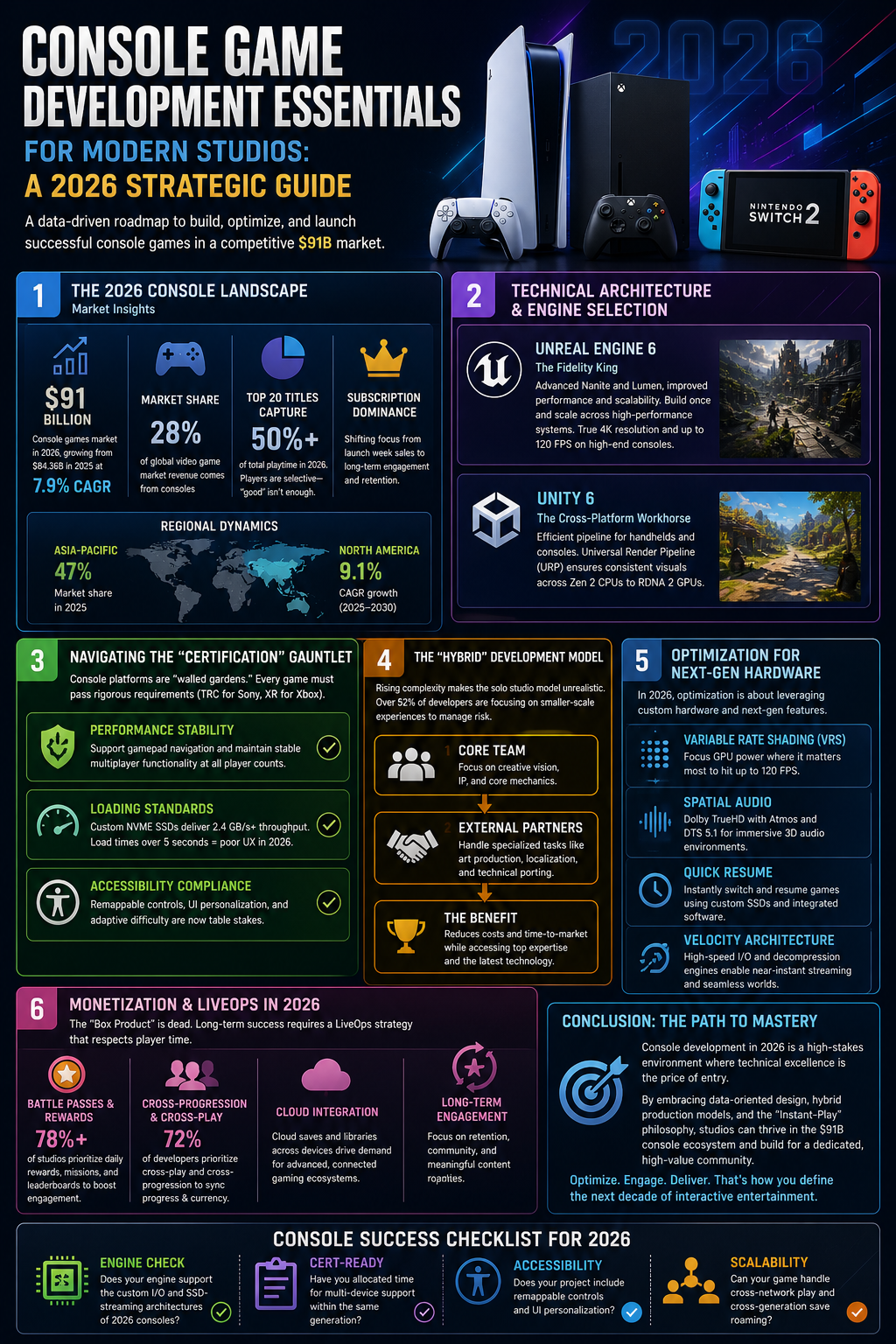
The console market in 2026 is no longer just about high-fidelity graphics and “box sales.” It has evolved into a sophisticated ecosystem of subscription services, cross-play networks, and high-performance hardware cycles. As the global console games market reaches an estimated $91 billion this year — growing from $84.36 billion in 2025 at a 7.9% CAGR — studios are facing a “Premium Renaissance.” While mobile and PC dominate in sheer player numbers, consoles remain a critical pillar, accounting for approximately 28% of global video game market revenue.
For a modern studio, succeeding on the latest hardware iterations — like the rumored “Switch 2” or refined PlayStation and Xbox ecosystems — requires more than just creative talent; it requires a deep understanding of the console-specific “Optimization-to-Certification” pipeline.
The 2026 Console Landscape: Market Insights
Before diving into the technical essentials, it is vital to understand the economic forces shaping the current console generation:
- Hardware Momentum: Demand is driven by technological innovation and consumer desire for portability. By early 2026, the market has seen the “Switch 2” reach over 6 million units in its first seven weeks, while the PS5 has shipped over 77 million units.
- The “Selectivity” Shift: Players are harder to impress. In 2026, the Top 20 titles capture over 50% of total playtime. This means “good” isn’t enough; console titles must achieve “essential” status through technical polish and exclusive content.
- Subscription Dominance: Subscription revenues are a significant trend in the forecast period. For studios, this shifts the focus from “Launch Week Sales” to “Long-Term Engagement” and retention.
- Regional Dynamics: Asia-Pacific remains a massive influence, accounting for a 47% market share in 2025, while North America is expected to grow at a 9.1% CAGR through the forecast period.
1. Technical Architecture & Engine Selection
In 2026, the choice of engine determines your studio’s ability to scale across the console “Power Gap” — the difference between a high-end 4K console and a portable handheld.
Unreal Engine 6: The Fidelity King
Unreal Engine 6 has become a standard for “AAA” Console Game Development Company workflows. With advanced Nanite (virtualized geometry) and Lumen (dynamic lighting) improvements, it allows studios to build once and scale across high-performance systems. Modern engines now deliver True 4K resolution and up to 120 FPS targets on high-end consoles.
Unity 6: The Cross-Platform Workhorse
For studios targeting a mix of handhelds and major consoles, Unity 6 offers an efficient pipeline. Its Universal Render Pipeline (URP) adoption is on the rise, ensuring visuals remain consistent on hardware ranging from custom Zen 2 CPUs to RDNA 2 GPUs.
2. Navigating the “Certification” Gauntlet
Unlike PC development, console platforms are “walled gardens.” Every game must pass a rigorous Technical Requirements Checklist (TRC for Sony, XR for Xbox).
- Performance Stability: Games must support navigation via gamepad input and maintain stable multiplayer functionality regardless of player count.
- Loading Standards: With custom NVME SSDs providing raw I/O throughput of 2.4 GB/s or higher, players expect “Instant-Play.” In 2026, any load time exceeding five seconds is considered a failure in user experience.
- Accessibility Compliance: Modern Game Development Services must include accessibility features as core components, as 2026 players demand deep personalization, ranging from remapping every control to adaptive difficulty.
3. The “Hybrid” Development Model
The rising complexity of game creation has made the “solo studio” model nearly impossible for console titles. Many studios are shifting focus to smaller, more manageable projects — over 52% of developers say their teams are focusing on smaller-scale player experiences this year to manage risk.
Co-Development and Outsourcing
To manage production capacity and hit tight deadlines, 2026 studios use a hybrid model:
- Core Team: Focuses on creative vision, IP, and core mechanics.
- External Partners: Handle specialized tasks like art production, localization, or technical porting.
- The Benefit: This model reduces costs and time-to-market while giving studios access to the latest technology and specialized expertise.
4. Optimization for Next-Gen Hardware
In 2026, optimization is about more than just polygon counts. It’s about utilizing custom hardware decompression and spatial audio integration.
- Variable Rate Shading (VRS): Focuses GPU power on key areas to maintain performance targets of up to 120 FPS.
- Spatial Audio: Console audio is finally getting its due, with hardware supporting Dolby TrueHD with Atmos and DTS 5.1 to create immersive 3D environments.
- Quick Resume & Velocity Architecture: Custom SSDs and integrated software enable players to switch between titles and instantly resume from where they left off.
5. Monetization and LiveOps in 2026
The “Box Product” is dead. Long-term success on console requires a LiveOps strategy that respects player time.
- Battle Passes & Rewards: Over 78% of studios are prioritizing daily rewards, missions, and leaderboards to boost engagement.
- Cross-Progression: Cross-play functionality is prioritized by 72% of developers, allowing players to sync game progress and virtual currency across platforms.
- Cloud Integration: Cloud-based storage allows users to access libraries across devices, fueling market demand for technologically advanced gaming systems.
Conclusion: The Path to Mastery
Console development in 2026 is a high-stakes environment where technical excellence is the price of entry. By embracing data-oriented design, hybrid production models, and the “Instant-Play” philosophy, studios can navigate the complexities of this $91 billion market.
The most successful developers are those who view consoles not just as hardware, but as the gateway to a dedicated, high-value community. As hardware cycles stretch and development costs rise, the studios that prioritize optimization and accessibility will be the ones that define the next decade of interactive entertainment.
Console Success Checklist for 2026:
- Engine Check: Does your engine support the custom I/O and SSD-streaming architectures of 2026 consoles?
- Cert-Ready: Have you allocated time for multi-device support within the same generation?
- Accessibility: Does your project include remappable controls and UI personalization?
- Scalability: Can your game handle cross-network play and cross-generation save roaming?
Console Game Development Essentials for Modern Studios: A 2026 Strategic Guide was originally published in Coinmonks on Medium, where people are continuing the conversation by highlighting and responding to this story.